
As artificial intelligence becomes increasingly integrated into everything from smartphones to large-scale computing infrastructure, the energy required to move and process data is becoming a critical challenge.
Although much of the AI industry's attention has focused on GPU performance and high-bandwidth memory (HBM), low-power DRAM technologies are also evolving to address the growing demands of AI workloads.
Samsung Electronics is pursuing two different approaches through its next-generation LPDDR6 and LPDDR5X-PIM (Processing-in-Memory) technologies.
One improves memory bandwidth and power management. The other changes where selected computations take place.
Why Data Movement Matters in AI Computing
Traditional computing architectures separate processing units from memory. Data must travel between CPUs, GPUs, AI accelerators, and memory components before and after computation.
As AI models grow more complex, this repeated movement of information can increase power consumption and create performance bottlenecks.
For AI inference workloads, memory access may become as important as raw computational capability.
This challenge is particularly significant for edge AI systems, which operate under strict power, space, and thermal constraints.
The question is no longer simply how quickly processors can calculate, but how efficiently an entire computing system can access and process information.
LPDDR5X-PIM: Computing Closer to the Data
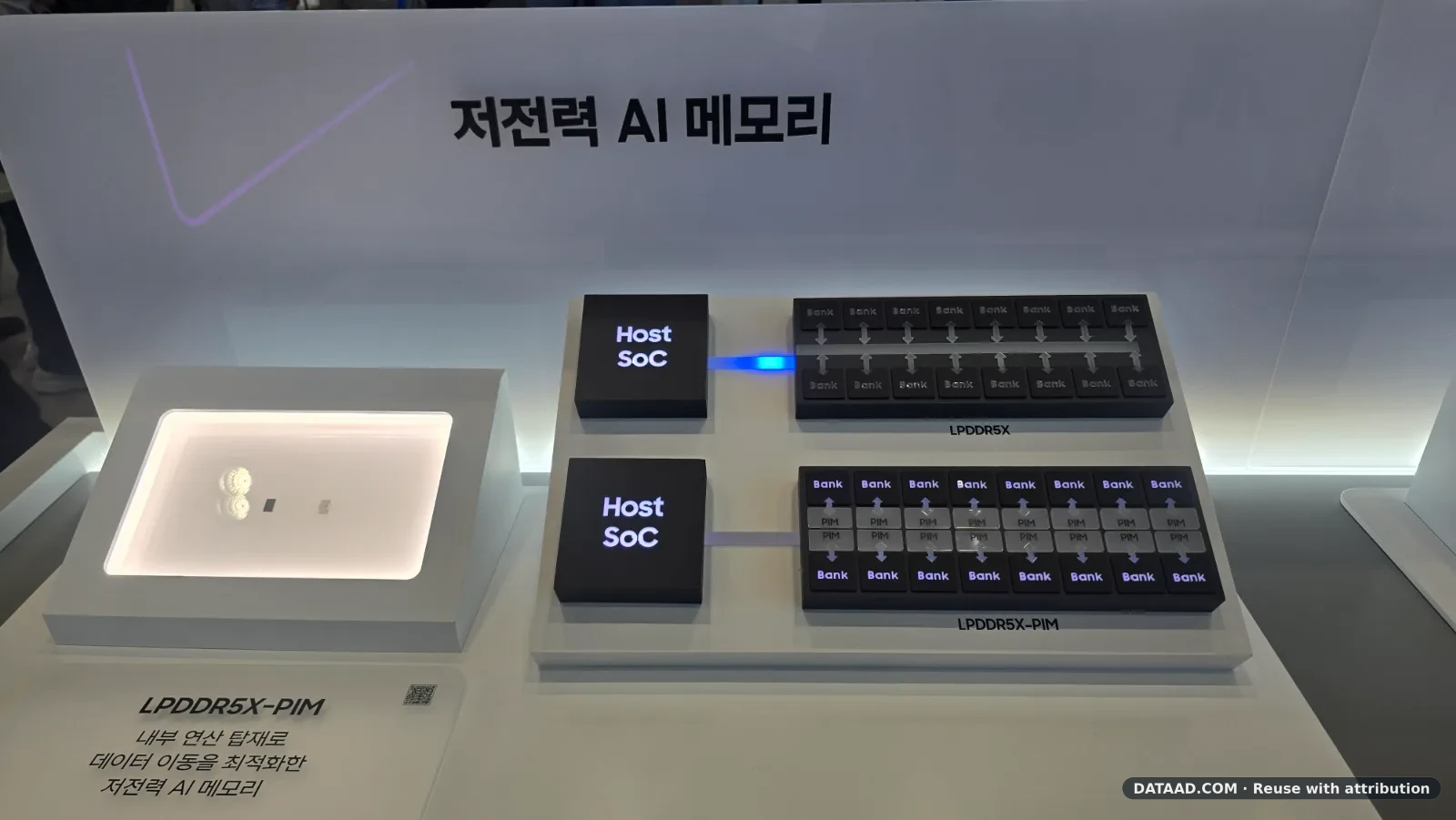
Samsung's LPDDR5X-PIM introduces processing capabilities within the memory architecture, allowing selected computational operations to be performed closer to stored data.
Rather than repeatedly transferring all data to an external processor, PIM enables certain operations to take place inside memory banks.
This approach can reduce unnecessary data transfers and improve processing efficiency for compatible workloads.
The objective is not to replace CPUs or GPUs, but to reduce the energy and time spent moving data between processing units and memory.

Samsung has reported that its LPDDR5X-PIM architecture can deliver substantial improvements in effective memory bandwidth and AI inference performance under specific evaluation conditions.
These improvements are particularly relevant to workloads involving repeated access to large volumes of model data.
However, real-world benefits depend on supported mathematical operations, processor integration, software compatibility, and the characteristics of each AI workload.
PIM should therefore be understood as an emerging architectural approach rather than a universal solution to memory bottlenecks.
LPDDR6: Higher Bandwidth with Smarter Power Management
While LPDDR5X-PIM addresses data movement, LPDDR6 advances the underlying performance and efficiency of conventional low-power memory.
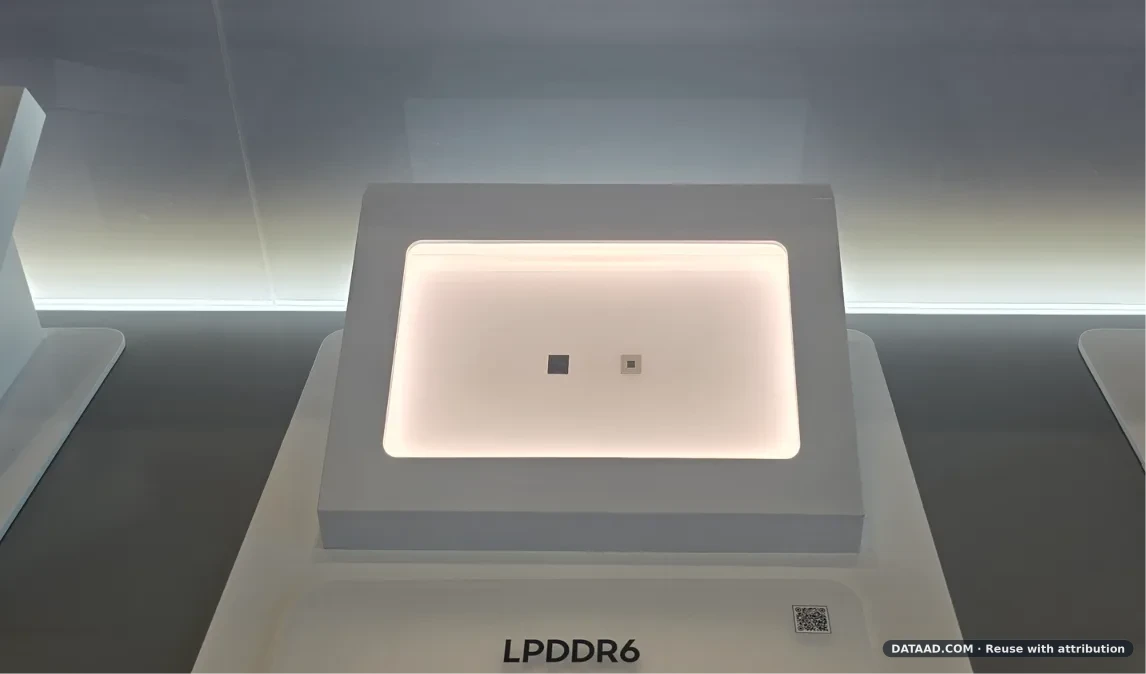
Samsung's LPDDR6 is designed to support increasingly demanding applications, including on-device AI, multimodal processing, and next-generation intelligent systems.
Samsung has highlighted memory bandwidth of up to 114 GB/s, alongside improvements in power management and operating efficiency.

Two technologies are particularly relevant to LPDDR6's approach to energy optimization:
- Dynamic Voltage and Frequency Scaling (DVFS): Adjusts memory operating conditions according to processing demand.
- Dynamic Efficiency Mode (DEM): Optimizes memory activity to reduce unnecessary power consumption during lower-utilization periods.
Samsung has reported power-efficiency improvements of up to approximately 21% compared with LPDDR5X under its specified evaluation conditions.
The actual benefit in commercial devices will depend on memory configuration, workload characteristics, and system-level integration.
LPDDR6 also introduces reliability-related improvements, including Per-Row Activation Counting (PRAC), to help manage potential data disturbance associated with repeated memory-row activation.
Two Technologies, Two Approaches to AI Efficiency
| Feature | LPDDR6 | LPDDR5X-PIM |
|---|---|---|
| Primary objective | Higher bandwidth and improved energy efficiency | Reduced data movement through in-memory processing |
| Main innovation | Advanced memory interface and adaptive power management | Processing capabilities integrated within memory banks |
| Potential applications | Mobile AI, edge computing, and selected AI systems | AI inference and specialized compute-intensive workloads |
| Key challenge | Platform support and system-level validation | Software integration and workload compatibility |
Although the technologies follow different paths, both reflect a broader shift in semiconductor development toward improving the efficiency of complete computing systems.
What This Means for AI Data Centers
AI data centers face increasing pressure to manage electrical demand, thermal loads, and operational energy consumption.
Memory is one part of this challenge.
High-bandwidth memory remains essential to many high-performance AI accelerators, while LPDDR technologies are increasingly being considered for energy-efficient computing platforms and specialized applications.
Samsung's LPDDR-based SOCAMM2 developments also illustrate how low-power memory technologies are extending beyond their traditional mobile-device applications.
For edge AI infrastructure, improved memory efficiency may contribute to smaller and more energy-efficient computing systems.
However, improvements in memory efficiency do not automatically translate into equivalent reductions in total data-center power consumption.
Real-world outcomes depend on processor architecture, workload utilization, software optimization, power delivery, and cooling system design.
The importance of Samsung's memory developments therefore extends beyond individual semiconductor specifications: they contribute to a broader conversation about how future AI infrastructure can deliver more useful computation with less energy.
Commercialization Challenges
LPDDR6 and LPDDR5X-PIM are at different stages of technological development and ecosystem integration.
LPDDR6 builds on established low-power memory standards, although platform qualification, cost, and software-hardware coordination remain important for commercial adoption.
PIM introduces more fundamental architectural changes.
Its broader adoption will require collaboration among memory manufacturers, processor designers, AI software developers, and system integrators.
Programming models, workload suitability, standardization, and manufacturing economics will help determine whether PIM becomes widely adopted.
For both technologies, system-level benchmarks and independently reproducible results will be essential in evaluating long-term benefits.
DATAAD View: AI Efficiency Begins Before Cooling
The growing energy demands of AI are often discussed in terms of electrical infrastructure, GPU power consumption, and advanced cooling technologies.
But an equally important question lies within the computing architecture itself: how much energy is consumed moving information before useful computation can take place?
Samsung's LPDDR6 and LPDDR5X-PIM demonstrate two approaches to addressing this question.
LPDDR6 seeks to transfer data more efficiently, while LPDDR5X-PIM aims to reduce some of the transfers required in the first place.
Neither technology eliminates the need for advanced cooling or high-performance memory systems. Their potential contribution lies in improving computational efficiency at the semiconductor level.
For future AI infrastructure, the relevant measure will not be memory performance alone, but the amount of useful AI computation delivered per unit of energy consumed across the complete system.
As AI continues to expand, efficient data movement may become just as important as faster processing.
References
- Samsung Semiconductor — LPDDR Memory Technologies
- Samsung Semiconductor — OCP Global Summit 2026
- Samsung Semiconductor — LPDDR6 Technology
- Samsung Semiconductor — Memory Innovation and AI Infrastructure
Disclosure: This article is an independent editorial analysis by DATAAD based on publicly available Samsung Electronics technical information and exhibition materials. Company-reported performance figures are subject to their stated evaluation conditions and have not been independently verified by DATAAD. Exhibition photographs were taken by DATAAD. This article is not sponsored by Samsung Electronics.