
EVENT PREVIEW & DATAAD ANALYSIS
September 28, 2026 | Las Vegas, USA
AI Infrastructure Enters a New Phase
As Yotta 2026 opens at Caesars Forum in Las Vegas, the AI infrastructure industry faces two closely connected challenges: securing sufficient electricity and developing cooling systems capable of supporting the next generation of high-density computing.
The rapid expansion of AI factories is changing the requirements for power generation, electrical distribution, thermal management and infrastructure integration. Increasing GPU performance is only one part of the equation. Power availability and the ability to remove heat reliably are becoming critical considerations in AI data center development.
For DATAAD, this represents a broader engineering transition. The industry must move beyond optimizing individual components and focus on the performance of the entire infrastructure system.
Yotta 2026 by the Numbers
Yotta 2026 brings together participants from the data center, AI, energy and digital infrastructure industries.
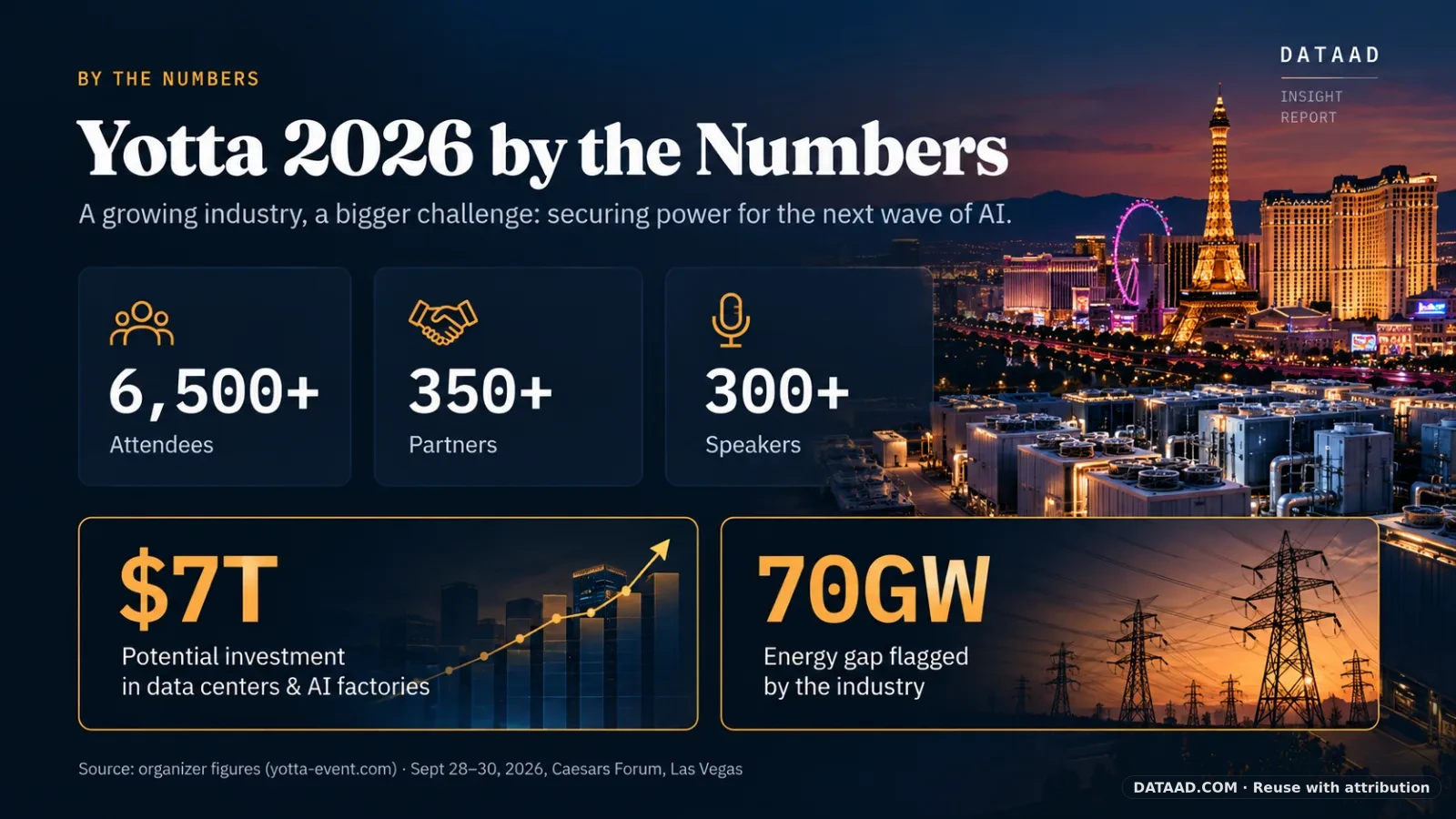
According to the organizer's published figures, the event is expected to attract more than 6,500 attendees, 350 partners and 300 speakers.
The organizer's materials also highlight potential investment of $7 trillion in data centers and AI factories, alongside an estimated 70 GW energy supply gap.
The figures illustrate the scale of the infrastructure challenge. However, the investment and energy-gap estimates should not be interpreted as confirmed investment commitments or independently measured global electricity shortages.
Similarly, the published attendance, partner and speaker figures represent the organizer's announced event scale, rather than final attendance results.
Securing Power: Four Areas of Infrastructure Development
The rapid expansion of AI infrastructure is increasing interest in four interconnected areas of electrical engineering and energy management.
1. Transformers and Power Distribution
Large AI campuses require substantial electrical infrastructure, including transformers, substations, switchgear and increasingly sophisticated power distribution systems.
Equipment lead times and grid interconnection delays can directly affect construction schedules. At the rack level, higher power density is also driving interest in alternative electrical architectures, including 800 V DC distribution.
The challenge is not simply to deliver more electricity, but to improve efficiency, safety, reliability and deployment speed.
2. On-Site Power Generation
As electricity demand increases, some data center developers are examining ways to generate power closer to their facilities.
Gas generators, fuel cells and other distributed generation technologies offer different approaches to supporting high-demand computing infrastructure.
Small modular reactors (SMRs) are also attracting interest as a potential longer-term energy source, although commercial deployment remains subject to regulatory, economic and technical considerations.
Integrating on-site generation with utility connections, backup systems and facility operations presents an additional engineering challenge.
3. Energy Storage Systems
Energy storage systems can support backup power, peak shaving, load management and coordination between on-site generation and utility supply.
Battery-based systems are particularly relevant to short-duration applications, while longer-duration technologies may offer additional flexibility depending on project economics and operational requirements.
Energy storage cannot replace adequate generation capacity, but it can improve how electricity is delivered and consumed.
4. Grid Flexibility Software
Expanding electricity generation and transmission infrastructure takes time. Making more effective use of existing grid capacity offers another approach.
Demand-response platforms, grid flexibility software and intelligent energy management systems can help coordinate electrical loads and identify opportunities to use available capacity.
For some AI applications, flexible computing workloads may also create opportunities to coordinate energy consumption with grid conditions.
Beyond Conventional Single-Phase D2C Cooling
Securing electricity is only one part of the next-generation AI infrastructure challenge. As processor power and rack density continue to increase, cooling architectures must also evolve.
Single-phase direct-to-chip (D2C) liquid cooling has become an important approach for managing high-performance computing systems. However, increasing processor heat flux and rack-level thermal loads are creating new engineering requirements.
These include coolant flow rates, pressure losses, temperature differences, heat exchanger capacity, mechanical connections and system reliability.
There is no single universal thermal design power threshold at which single-phase D2C cooling becomes technically unsuitable. Its practical limits depend on cold-plate design, coolant properties, allowable chip temperatures, flow rates and overall system architecture.
The industry is therefore examining several approaches for supporting higher-density AI infrastructure.
Two-Phase Direct-to-Chip Cooling
Two-phase D2C cooling uses the phase change of a working fluid to absorb heat at the processor or other high-heat-flux components.
By taking advantage of latent heat, two-phase systems offer a potential approach to managing increasingly concentrated thermal loads.
However, their implementation introduces additional requirements involving fluid selection, pressure management, vapor handling, condensation, materials compatibility and system maintenance.
Reliable fluid connections, leak prevention and serviceability will be important considerations as these systems develop.
Hybrid Cooling Architectures
Future AI racks may require different cooling approaches for different components rather than relying on a single cooling technology.
High-power GPUs and CPUs may benefit from advanced direct liquid cooling, while memory modules, voltage regulators, networking components and power supplies can create additional thermal-management requirements.
Hybrid architectures combining liquid cooling, residual air cooling and potentially two-phase technologies may provide greater flexibility for different system configurations.
Rack-Level Cooling Integration
Cooling performance depends not only on the cold plate but also on the complete coolant distribution network.
Coolant distribution units (CDUs), rack manifolds, hoses, quick disconnects, valves and facility piping must be designed to support the required flow rates, pressures and operating conditions.
As rack densities increase, factory-tested integrated cooling assemblies may help reduce installation complexity and improve system reliability.
This creates new engineering requirements for mechanical connections, system integration, quality control and maintenance.
Power and Cooling Must Be Designed Together
Power and cooling are often discussed as separate infrastructure challenges. In practice, they are closely connected.
Increasing processor power creates additional heat, while cooling systems themselves consume electricity through pumps, fans, heat exchangers and other supporting equipment.
A cooling architecture that reduces chip temperatures but substantially increases facility energy consumption may introduce new operational costs.
The next generation of AI factories therefore requires coordinated electrical and thermal engineering from the earliest stages of design.
Power distribution, coolant delivery, heat rejection, serviceability and infrastructure redundancy must be evaluated as parts of the same operating system.
Opportunities Across the Industrial Supply Chain
The expansion of AI factories creates opportunities for a much broader industrial supply chain than semiconductor manufacturing alone.
Electrical equipment manufacturers, energy storage developers, cooling technology suppliers, piping specialists and system integrators all have potential roles in next-generation AI infrastructure.
The challenge extends beyond increasing manufacturing capacity. These technologies must be integrated, tested and deployed within demanding construction schedules and operational requirements.
DATAAD VIEW: The Next AI Challenge Is System Integration
The AI industry has concentrated considerable attention on processor performance, memory bandwidth and computing density.
However, the next phase of development will increasingly depend on the infrastructure surrounding those chips.
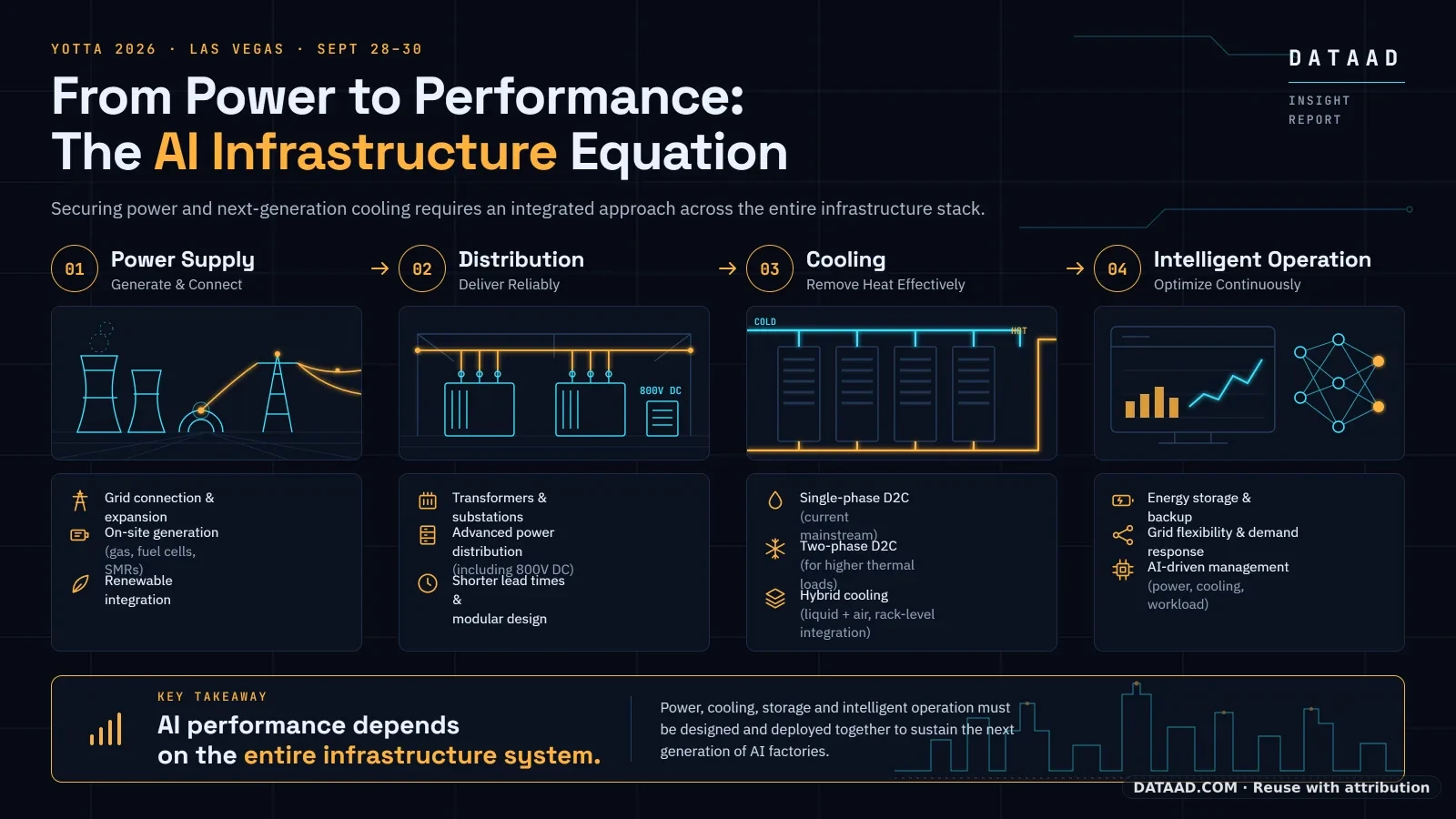
Electricity must be generated, transmitted and distributed. Heat must be transferred from individual processors through cooling networks and ultimately rejected from the facility.
As computing density increases, traditional single-phase D2C cooling will continue to evolve, while two-phase and hybrid cooling architectures offer additional options for demanding applications.
The central engineering question is no longer simply how much computing power can be installed. It is how effectively the complete infrastructure can deliver and sustain that performance.
For DATAAD, Yotta 2026 provides an opportunity to examine how energy, cooling, computing and industrial engineering are converging around this challenge.
The next generation of AI infrastructure will depend on the performance of the entire system, not just its most powerful components.
Sources & Editorial Disclosure
This article is an independent DATAAD editorial preview and technical analysis based on publicly available Yotta 2026 event information and general AI infrastructure engineering developments.
Event figures and industry estimates shown in the accompanying infographic are attributed to the event organizer and should not be interpreted as independently verified outcomes.
The cooling technology discussion represents DATAAD's independent technical analysis and should not be interpreted as a report of specific presentations or announcements made at Yotta 2026.
The accompanying graphics are independently created editorial illustrations. They do not depict actual conference scenes or specific operational facilities.
DATAAD is not affiliated with, sponsored by or endorsed by the event organizer.
Official event source:
Yotta 2026 — Official Event Website