
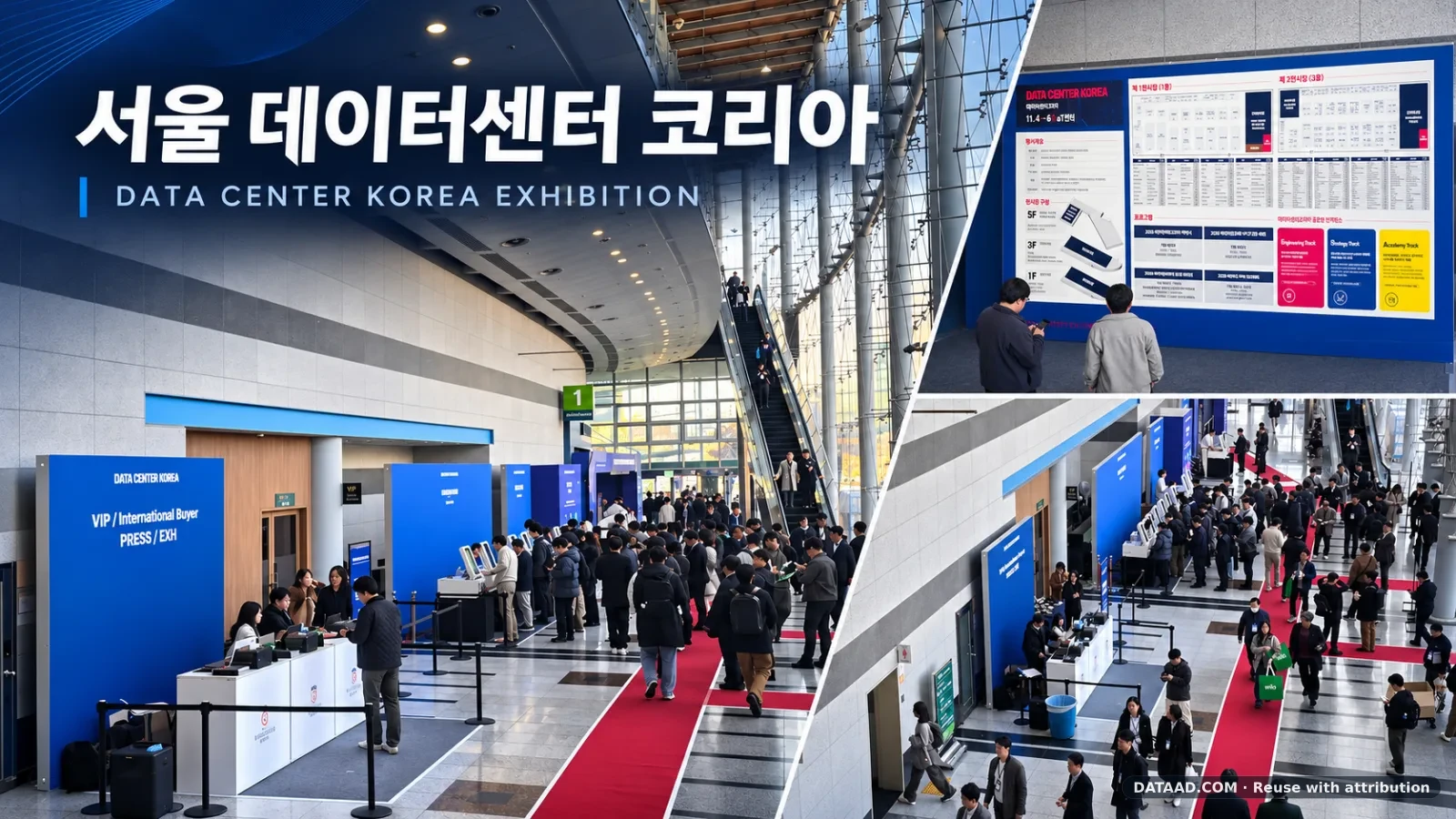
SEOUL, SOUTH KOREA — November 7, 2026
At Data Center Korea 2026, held from November 4 to 6 at Seoul's aT Center, the most important story was not simply the growing demand for GPU servers or increasingly powerful AI factories.
It was the emergence of a more diverse industrial ecosystem capable of supporting AI infrastructure with domestically developed cooling technologies, precision components, power equipment and manufacturing expertise.
Exhibits ranged from two-phase direct liquid cooling (DLC) connectors and miniature liquid-cooling interfaces for solid-state drives to advanced air-cooled chillers and single-phase cooling systems for high-density processors.
These technologies suggest an important strategic opportunity for South Korea: to use its existing industrial capabilities to become more than a purchaser and operator of AI infrastructure designed elsewhere.
The broader question is whether countries with sophisticated manufacturing industries can build their own AI infrastructure capabilities while remaining connected to international technology standards.
1. Beyond GPUs: AI Infrastructure Is an Industrial Supply Chain
Discussions about artificial intelligence often focus on GPUs, semiconductor performance, foundation models and the scale of computing investment.
Yet building a reliable AI data center involves an extensive network of industrial technologies: chillers, heat exchangers, cold plates, pumps, valves, hoses, quick disconnect couplings, power converters, transformers, monitoring systems and precision-manufactured components.
Each component influences operating efficiency, maintainability, reliability and total cost of ownership.
South Korea occupies an unusual position within this ecosystem. The country combines advanced semiconductor manufacturing with established capabilities in electronics, precision machinery, refrigeration, automotive components, shipbuilding, industrial automation and electrical equipment.
These capabilities do not automatically create an independent AI industry. However, they provide a foundation from which Korean companies can develop and manufacture much of the physical infrastructure required by future AI computing facilities.
Data Center Korea 2026 offered a useful view of that emerging possibility.
2. Two-Phase Direct Liquid Cooling: From Refrigeration Technology to AI Computing
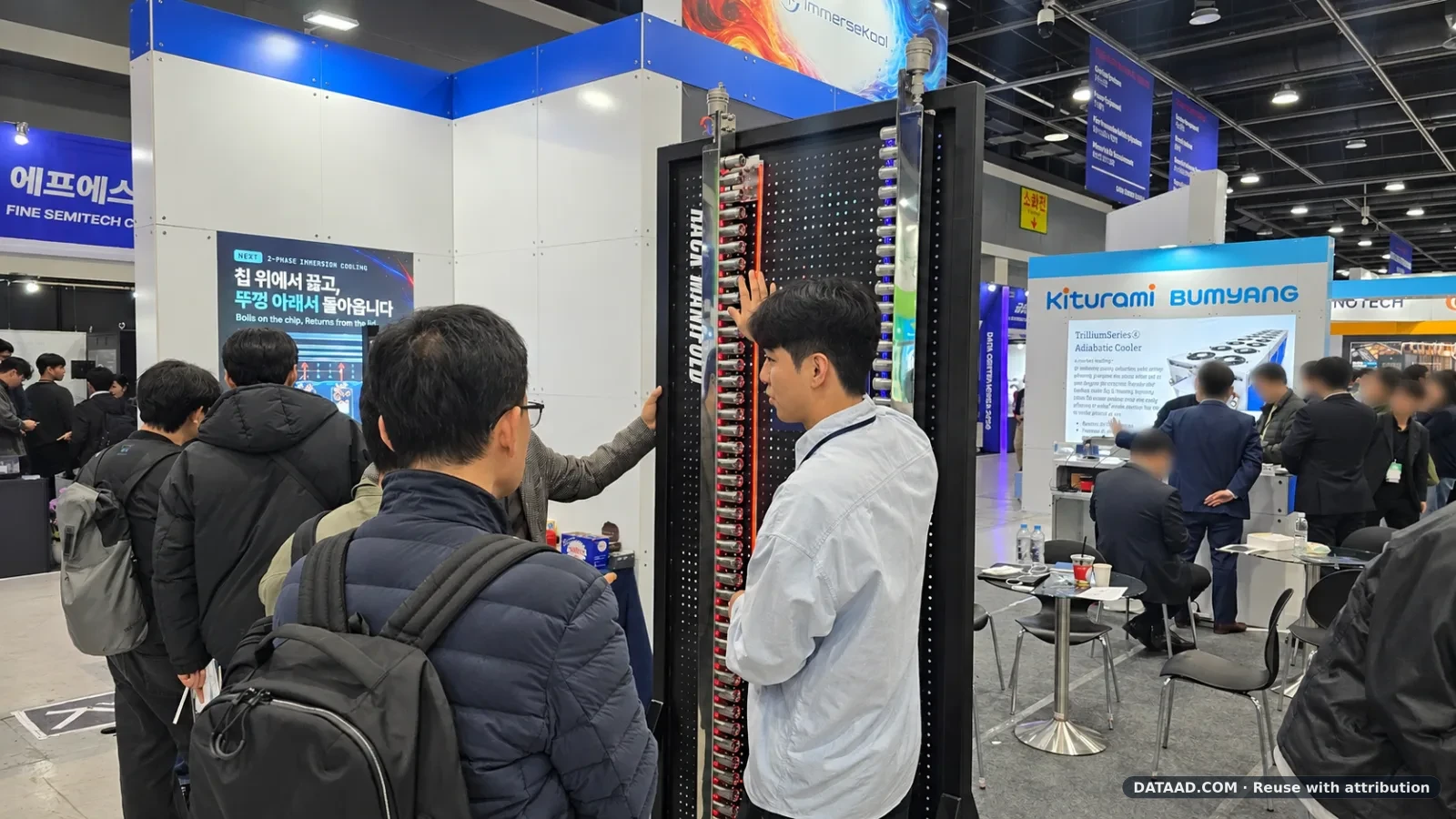
One notable development was the appearance of quick disconnect (QD) connectors designed for two-phase direct liquid cooling.
Unlike conventional single-phase systems, which transfer heat through a liquid that remains in the same phase, two-phase cooling uses the vaporization and condensation of a suitable working fluid to transport thermal energy.
When the fluid absorbs sufficient heat at a cold plate, part of it can evaporate. The vapor is subsequently condensed elsewhere in a closed thermal-management circuit.
This phase-change process creates opportunities for high heat-transfer performance, but it also introduces demanding engineering requirements involving pressure control, vapor management, fluid compatibility, material selection and leakage prevention.
The development of suitable quick disconnects is particularly important.
Two-phase couplings must be engineered for the actual operating fluid and pressure envelope, while maintaining reliable sealing and acceptable flow characteristics through repeated connection and disconnection cycles.
For Korea, this development connects two existing industrial strengths: refrigeration engineering and precision fluid connection technology.
The physical components displayed at the exhibition suggest that two-phase DLC is progressing beyond theoretical discussion toward practical subsystem development. However, commercial maturity will depend on testing, qualification and successful integration into operational computing platforms.

3. Cooling Moves Beyond GPUs: The Emerging SSD Micro-Liquid-Cooling Market
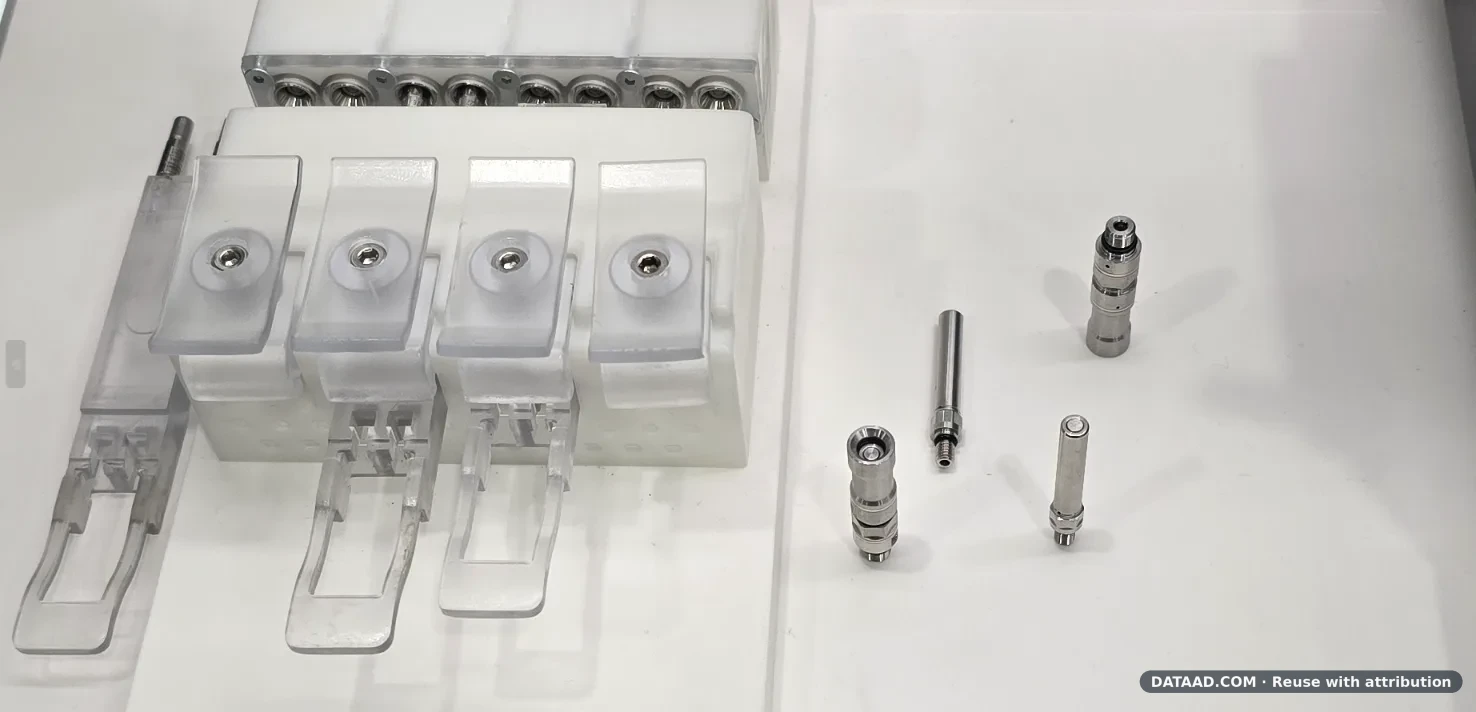
Another revealing exhibit concerned compact liquid-cooling components intended for solid-state drives, including miniature quick disconnects and cold-plate interfaces.
AI infrastructure generates heat far beyond the GPU package. CPUs, memory, networking equipment, power electronics and high-performance storage systems all contribute to the thermal burden of increasingly dense computing platforms.
Enterprise SSDs are becoming an important area of engineering attention as storage performance, data throughput and system density increase.
The use of miniature liquid-cooling interfaces introduces a different set of design challenges from conventional rack-level connectors.
Engineers must consider extremely limited installation space, repeated maintenance access, flow distribution, pressure drop, leakage control and mechanical reliability.
The Open Compute Project has established a DLC Integrated SSD workstream within its Cold Plate Sub-Project, illustrating growing industry interest in standardized liquid-cooling approaches for storage devices.
The Korean components displayed in Seoul therefore deserve attention not only as individual products but also as potential elements of a future high-volume manufacturing and interoperability ecosystem.
That opportunity remains conditional. Volume production will depend on server and storage architecture decisions, qualification requirements, cost competitiveness and acceptance by equipment manufacturers.
4. LG Demonstrates Why Cooling Innovation Is Not Limited to the Server Rack
Cooling innovation also extends outside the IT equipment itself.
LG's exhibition of an air-cooled, oil-free inverter turbo chiller illustrated how conventional HVAC expertise is being adapted to the demanding operating conditions of AI data centers.
The technology combines an oil-free magnetic-bearing compressor with inverter control and refrigerant-based free cooling.
By reducing mechanical friction and eliminating the need for compressor lubrication oil, the design can improve operating efficiency and reduce certain maintenance requirements.
Refrigerant free cooling can reduce compressor operation under suitable outdoor temperature conditions, offering another opportunity to lower cooling electricity consumption.
For AI infrastructure developers, air-cooled chiller technology is also relevant to water-resource management.
Unlike evaporative cooling towers, air-cooled chillers can reject heat without continuous cooling-tower water evaporation. This can reduce operational water consumption, although the overall cooling architecture may still use water or another liquid within closed circulation loops.
Water use, electricity consumption and thermal performance must therefore be evaluated together under site-specific operating conditions.
LG's technology demonstrates that the competitiveness of an AI data center cannot be measured only by processor efficiency. Facility-level thermal engineering plays an equally important role in lifecycle economics.

5. Single-Phase Liquid Cooling Remains Essential for High-Density AI Systems
While two-phase cooling attracted attention as an emerging technology, single-phase direct-to-chip cooling remains a central approach for high-density AI computing.
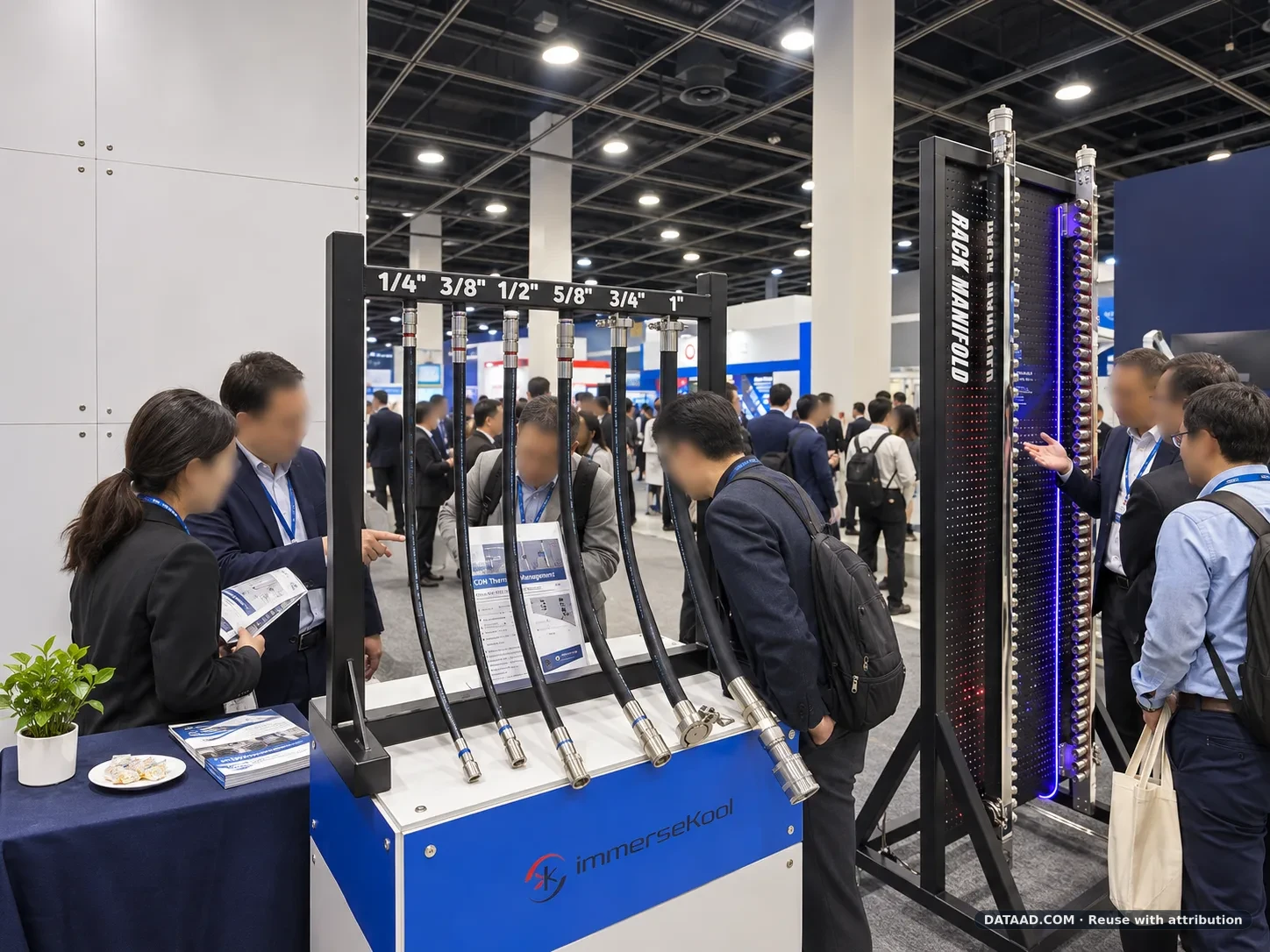
The exhibition included liquid-cooling equipment, connectors, distribution components and supporting infrastructure relevant to advanced GPU and AI accelerator platforms.
NVIDIA's Vera Rubin architecture exemplifies the increasing importance of integrated, high-density liquid-cooling infrastructure. At the same time, Korean AI accelerator developers, including Rebellions, represent efforts to develop alternatives within the AI compute ecosystem.
These processors have different architectures and system requirements. Their cooling approaches must be evaluated at the platform level rather than treated as interchangeable.
For Korean component manufacturers, the opportunity is to participate in developing the surrounding systems: cold plates, distribution manifolds, coolant distribution units, piping assemblies, hoses and standardized fluid connections.
A competitive domestic supply chain could help Korean system integrators and equipment manufacturers offer greater configuration flexibility, localized engineering support and more diversified procurement options.
However, participation in internationally recognized standards remains essential. Mechanical compatibility, thermal performance and long-term reliability require verification through actual system testing.
6. Korea's Industrial Advantage: Manufacturing Rather Than Complete Technology Independence
Today's advanced AI infrastructure is closely connected to a geographically concentrated global ecosystem.
US technology companies play a major role in accelerator architectures, AI software platforms and system design, while Taiwan occupies a critical position in semiconductor fabrication, advanced packaging and AI server manufacturing.
South Korea has its own substantial strengths, especially in memory semiconductors and industrial manufacturing, but it remains dependent on international partners for important parts of the AI computing stack.
The strategic opportunity is therefore not to reproduce every component domestically or to reject established global technology suppliers.
Instead, Korea could strengthen its influence by developing competitive components and integrated subsystems that can operate within multiple international AI computing platforms.
This approach could be particularly attractive to small and medium-sized manufacturers.
Unlike the development of a frontier GPU, many cooling and infrastructure technologies can build upon existing industrial equipment, manufacturing processes and engineering experience.
Precision machining companies can develop fluid connectors. HVAC manufacturers can adapt cooling equipment. Industrial equipment suppliers can produce modular systems. Electronics companies can contribute power conversion and control technologies.
The result could be a more diversified industrial ecosystem rather than dependence on a limited number of complete AI server architectures.
7. A Different Lesson for Europe, Japan and Southeast Asia
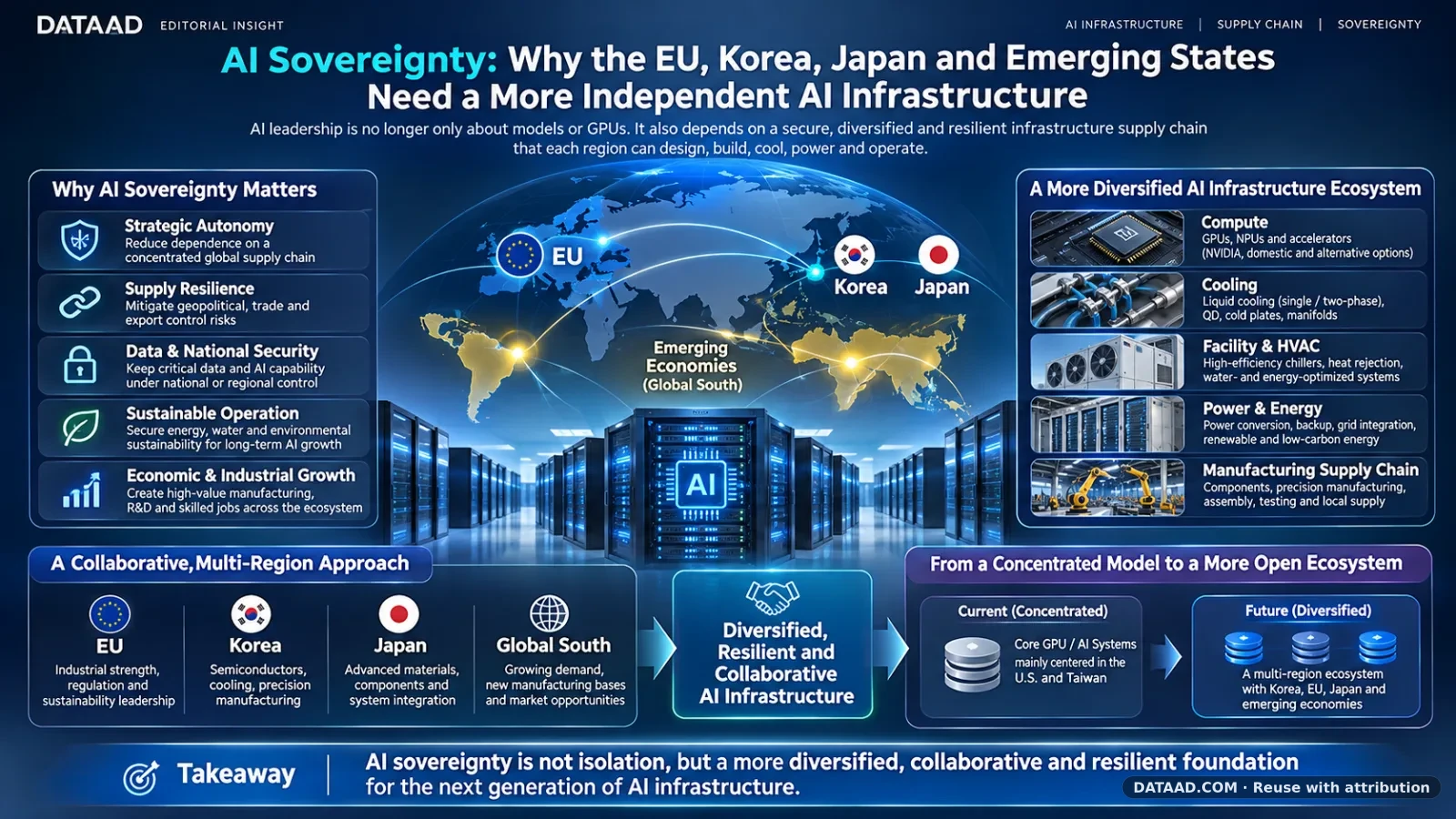
Korea's experience may offer useful lessons for other countries seeking greater control over their AI infrastructure.
Europe and Japan possess sophisticated industrial manufacturing, advanced electrical engineering and precision component capabilities. Southeast Asian economies are expanding their electronics, equipment manufacturing and data center activities, although their industrial capabilities differ significantly by country.
Not every economy can realistically manufacture advanced GPUs or establish leading-edge semiconductor fabrication facilities.
But many countries may be able to participate in the physical infrastructure surrounding AI computing.
This opens a different path to AI sovereignty: building domestic competence in infrastructure design, integration, operation, maintenance and selected critical components while maintaining international cooperation.
For countries facing constraints involving electricity availability, water resources, land, permitting and capital expenditure, smaller or modular AI data center facilities may also deserve consideration alongside hyperscale development.
Such approaches are not universally superior. Their feasibility depends on workload requirements, networking, utilization, energy economics and the benefits of scale.
Nevertheless, geographically distributed infrastructure and diversified suppliers could provide useful alternatives for certain national and industrial AI strategies.
8. From Exhibition Prototypes to an International AI Infrastructure Ecosystem
Data Center Korea 2026 demonstrated encouraging industrial activity, but exhibitions should not be confused with evidence of large-scale commercial deployment.
The next stage will require engineering validation, interoperability testing, international standards participation, reliable production capacity and long-term support.
South Korea's manufacturing strengths offer a foundation, but a successful AI infrastructure ecosystem must also compete on measurable technical performance, manufacturing consistency, price and lifecycle cost.
There is another important question: Can Korean suppliers cooperate with European, Japanese and Southeast Asian manufacturers to build more open and diversified AI infrastructure supply chains?
Such partnerships could provide an alternative sourcing structure without requiring countries to abandon leading global compute architectures.
DATAAD Perspective: AI Sovereignty Begins with Industrial Capability
One of the central lessons from Seoul is that AI sovereignty cannot be reduced to owning a national AI model, purchasing GPU clusters or constructing a large AI factory.
True operational capability also involves the knowledge and infrastructure needed to power, cool, connect, maintain and upgrade computing systems.
The two-phase connectors, SSD micro-cooling components, industrial chillers and single-phase cooling systems seen at Data Center Korea 2026 each represent one part of that larger challenge.
South Korea is not yet independent of the global AI infrastructure supply chain. Nor would complete independence necessarily be economically desirable.
But by converting its established manufacturing strengths into internationally competitive AI infrastructure technologies, Korea has an opportunity to broaden its role in the global AI industry.
For Europe, Japan and emerging AI infrastructure markets, the message is similarly relevant.
The future of AI sovereignty may depend as much on industrial engineering and supply-chain diversity as on the algorithms and processors themselves.