

Guest Commentary | Humberto Montes de Oca
Aviation Asset Strategist | AeroTraceSupply™ | Mexico
DATAAD Editor's Note: As artificial intelligence, advanced computing, and international manufacturing transform global supply chains, regulatory compliance is becoming an increasingly important part of infrastructure planning. In this guest commentary, Mexico-based aviation asset strategist Humberto Montes de Oca examines how trade regulations, technical traceability, and cross-border operations are shaping the movement of strategic technology assets.
Sources of Friction in High-Tech Supply Chains
Across technology-driven and highly regulated sectors, several recurring patterns consistently create operational friction.
One of the most frequent missteps is treating compliance as a late-stage formality. Organizations often pour significant resources into sourcing, commercial negotiation, and route planning well before undertaking a thorough regulatory assessment. By the time legal or trade bottlenecks surface, corrective measures are not only complex—they are exceptionally costly.
Traceability presents another critical challenge. As regulatory authorities raise the bar, industry stakeholders now demand full visibility into an asset's origin, ownership pedigree, technical logs, and physical movement. Incomplete or ambiguous documentation routinely stalls customs clearances, triggers extended audits, and delays licensing approvals.
Equally vital is the rigorous verification of end users and counterparty networks. Trade compliance bodies now expect businesses to demonstrate full visibility beyond the immediate purchaser, extending scrutiny to the final destination and intended application of controlled assets. Gaps in this diligence leave firms directly exposed to export control violations, trade sanctions, and severe reputational risk.
Ultimately, these dynamics point to a fundamental shift in high-tech logistics: the integrity of trade data has become just as critical as physical transport capabilities.
Mexico's Emerging Role in Strategic Trade Corridors
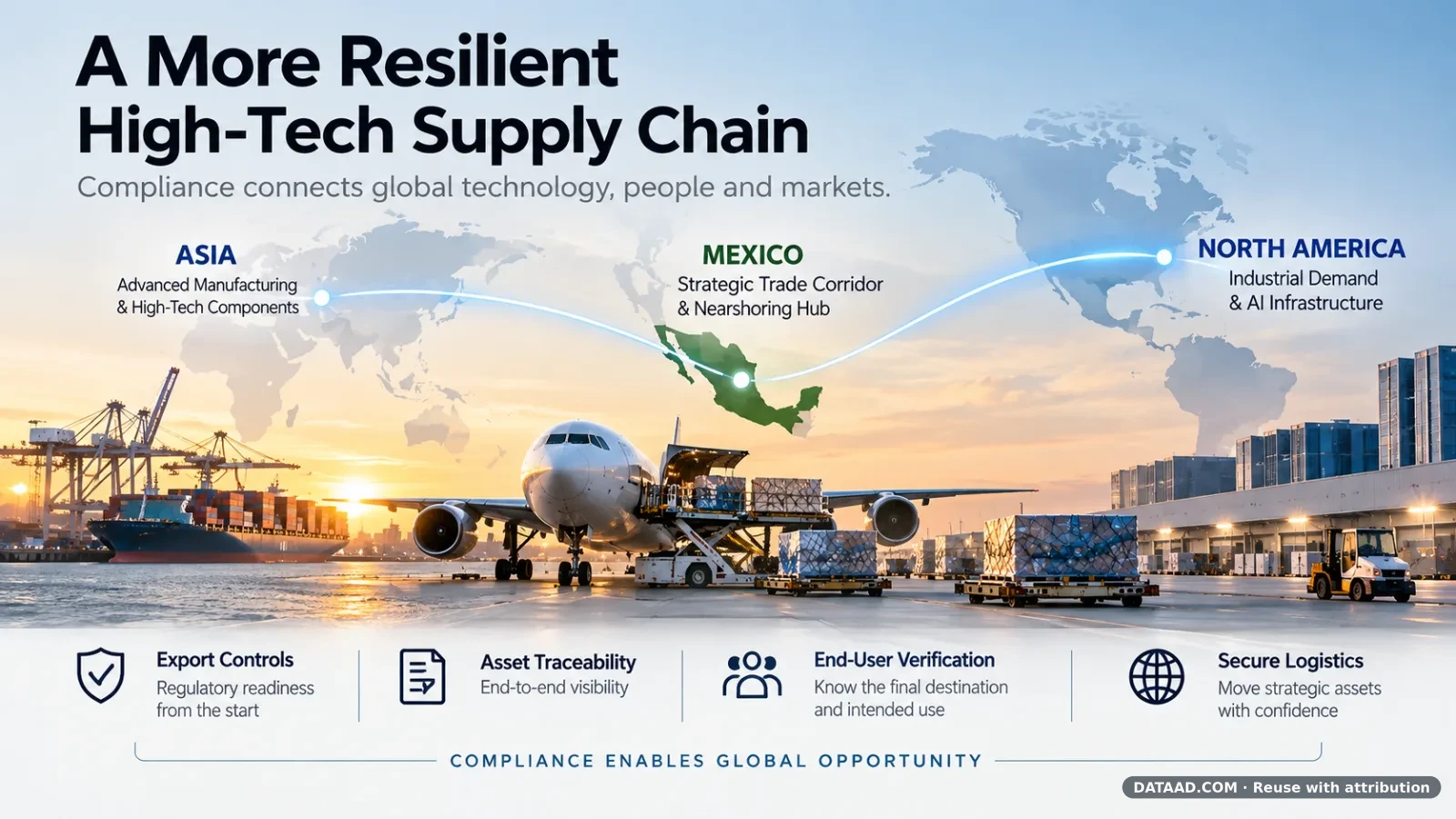
Driven by nearshoring dynamics, regional supply chain diversification, and shifting geopolitical realities, Mexico has emerged as a vital bridge connecting Asian manufacturing hubs with North American industrial demand.
The country's geographic proximity, expanding industrial infrastructure, and deep integration within North American trade networks offer unmistakable advantages for aerospace, advanced manufacturing, and high-tech sectors.
Yet, geographic advantage alone is not a guarantee of sustained success.
The long-term viability of Mexico's role in global supply chains hinges on how effectively local and international entities adapt to increasingly complex regulatory frameworks. Nearshoring creates real economic value not merely by shifting physical production, but by establishing operational models that seamlessly satisfy multi-jurisdictional compliance demands.
For industry leaders managing cross-border flows, technical asset management, logistics, and trade compliance can no longer operate in silos. They must function as a single, unified operational strategy.
Building Compliance-Centered Supply Chains
To build genuine resilience, forward-looking organizations must stop viewing compliance as an external constraint. Instead, it should be treated as core operational infrastructure—the framework that allows complex international trade to move without interruption.
In practice, this means embedding export control reviews into the earliest phases of procurement, enforcing uncompromising asset traceability, and cultivating deep in-house expertise to navigate fluid regulatory landscapes.
Moreover, executive leadership must recognize that compliance posture directly drives competitive advantage. The companies best positioned to lead are those that approach regulatory readiness as a strategic asset rather than an administrative burden.
Conclusion
The global race surrounding artificial intelligence, advanced computing, and critical technologies is fundamentally restructuring international trade. In this high-stakes environment, conventional supply chain metrics remain essential, but they are no longer enough on their own.
The capacity to demonstrate absolute operational transparency, technical traceability, and regulatory discipline is rapidly becoming the defining separator between reliable market leaders and high-risk operators.
Compliance is not a barrier to commerce—it is the ultimate enabler of secure, scalable, and trusted global operations. As high-tech trade grows more complex and regulatory oversight tightens, success will belong to those who can move strategic assets with total confidence, integrity, and speed.
About the Author
Humberto Montes de Oca is Principal Operator of AeroTraceSupply™ and SkyBridge Asset Trading™. Based in Mexico, he specializes in aviation asset management, technical traceability, regulatory compliance, and international supply chain operations.
His work focuses on commercial aircraft components, engine procurement, MRO support, and cross-border transactions involving highly regulated aerospace and technology assets across Europe, Asia, North America, and South America.
LinkedIn: Humberto Montes de Oca