
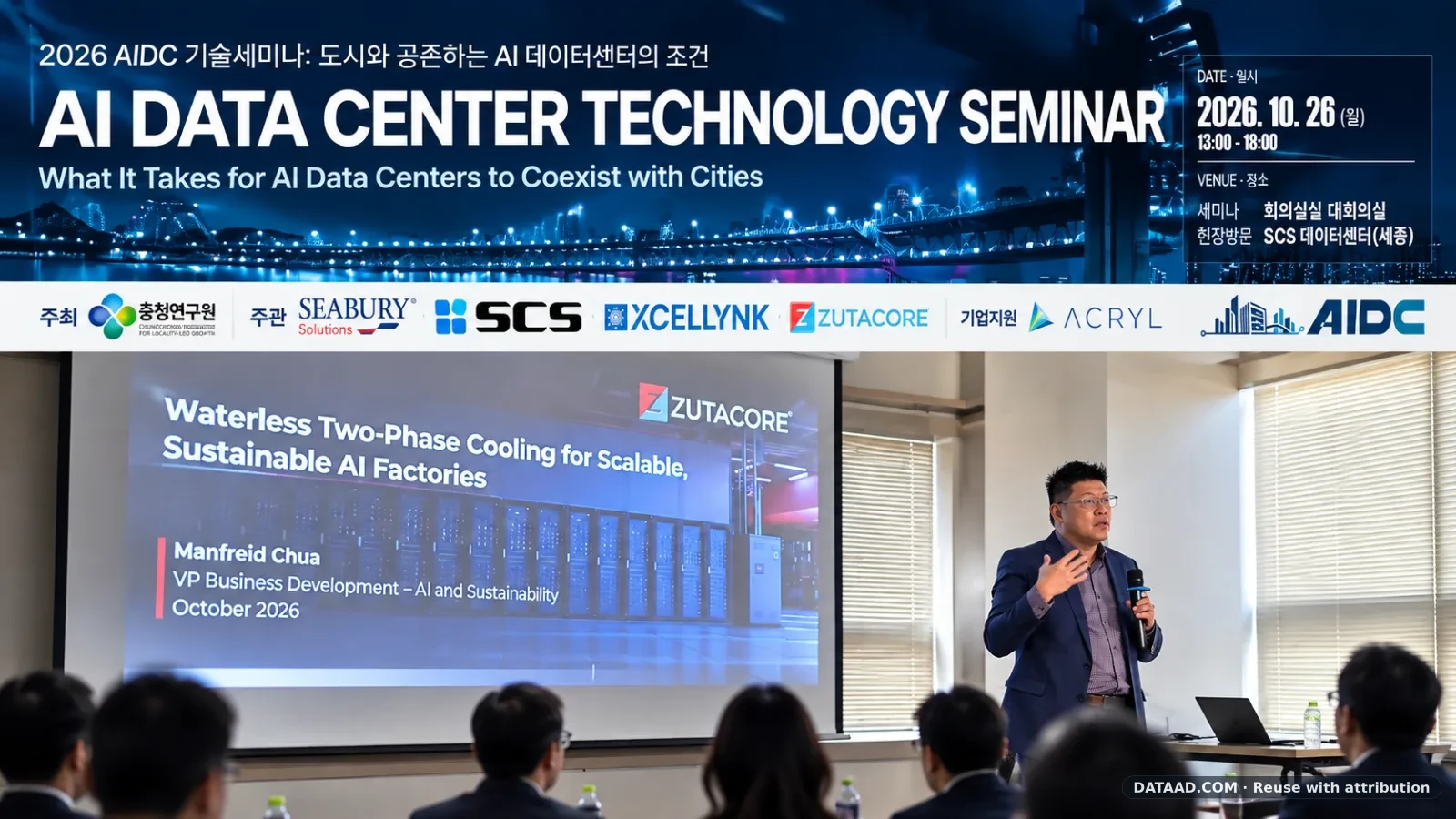
SEJONG, SOUTH KOREA — October 26, 2026. South Korea's AI infrastructure industry is confronting a fundamental challenge: how can the country deliver substantially more artificial intelligence computing capacity without proportionally increasing electricity consumption, cooling water demand and infrastructure costs?
That question was at the center of the 2026 AI Data Center Technology Seminar in Sejong, held under the theme "What It Takes for AI Data Centers to Coexist with Cities."
Hosted by the Chungcheong Research Institute, with participating organizations including SEABURY Solutions, SCS, XCELLYNK and ZutaCore, the seminar examined technologies and operating models for building more resource-efficient AI data centers.
Rather than focusing solely on constructing larger facilities, the discussion addressed how to extract greater value from electricity, cooling systems, high-performance semiconductors and existing regional infrastructure.
ZutaCore: More AI Computing with Less Water and Power
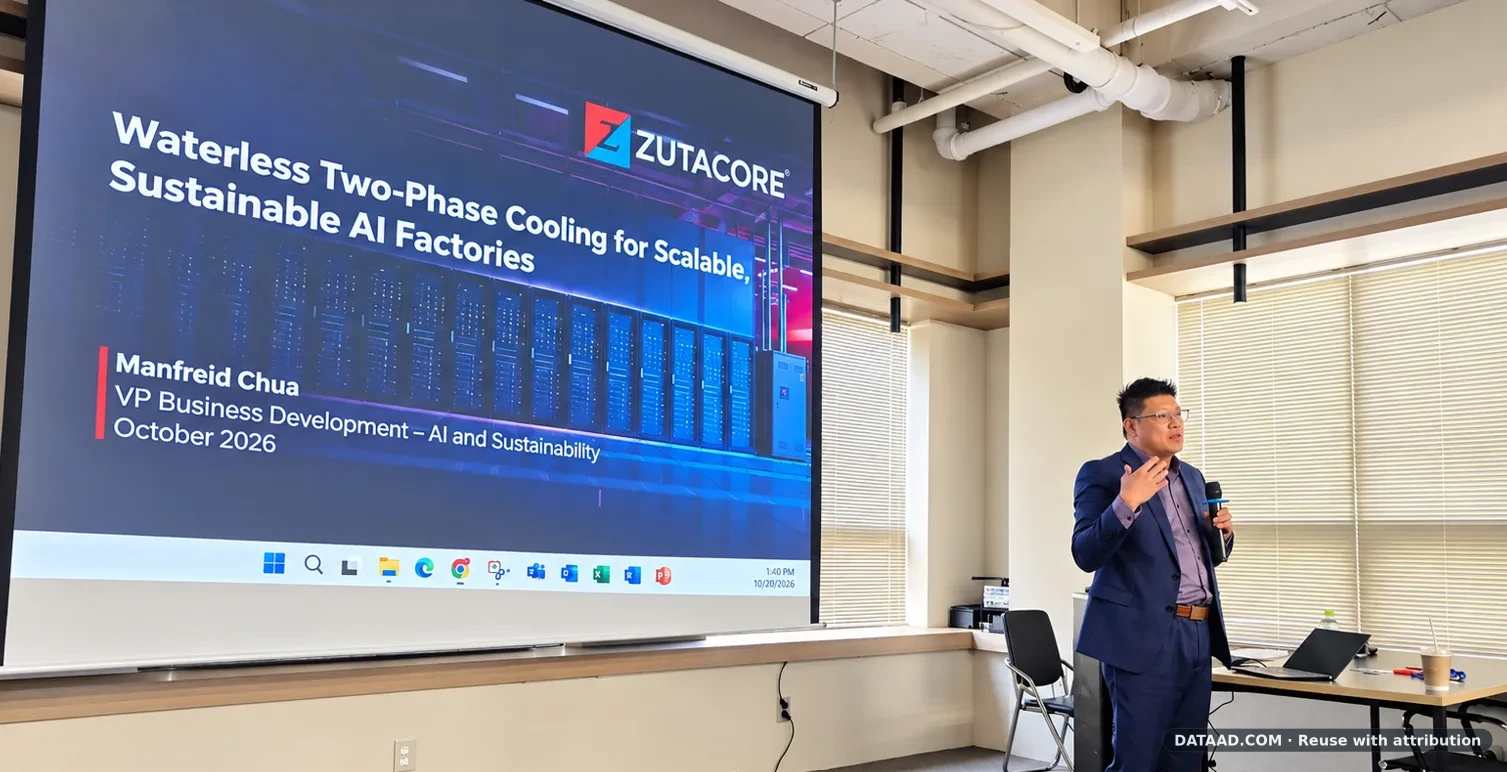
A central focus of the seminar was ZutaCore's waterless two-phase direct liquid cooling (DLC) technology.
Manfreid Chua, Vice President of Business Development for AI and Sustainability at ZutaCore, introduced the company's approach to managing the increasingly concentrated heat generated by high-performance AI processors.
Traditional air cooling and conventional chilled-water systems require substantial supporting infrastructure. As rack power densities rise, electricity used for cooling and heat rejection can become a significant constraint on computing capacity.
ZutaCore's two-phase technology uses a dielectric working fluid that absorbs heat through boiling at the processor surface. The resulting vapor transfers heat away from the chip before being condensed and recirculated.
By using latent heat during phase change, two-phase cooling can remove concentrated thermal loads with relatively low fluid flow requirements.
When integrated with suitable dry heat rejection equipment, this architecture may also eliminate the need for evaporative cooling water. The actual benefits depend on the overall facility design and operating conditions.
Same 100 MW Power Budget: 45.6% More AI Servers in ZutaCore's Scenario
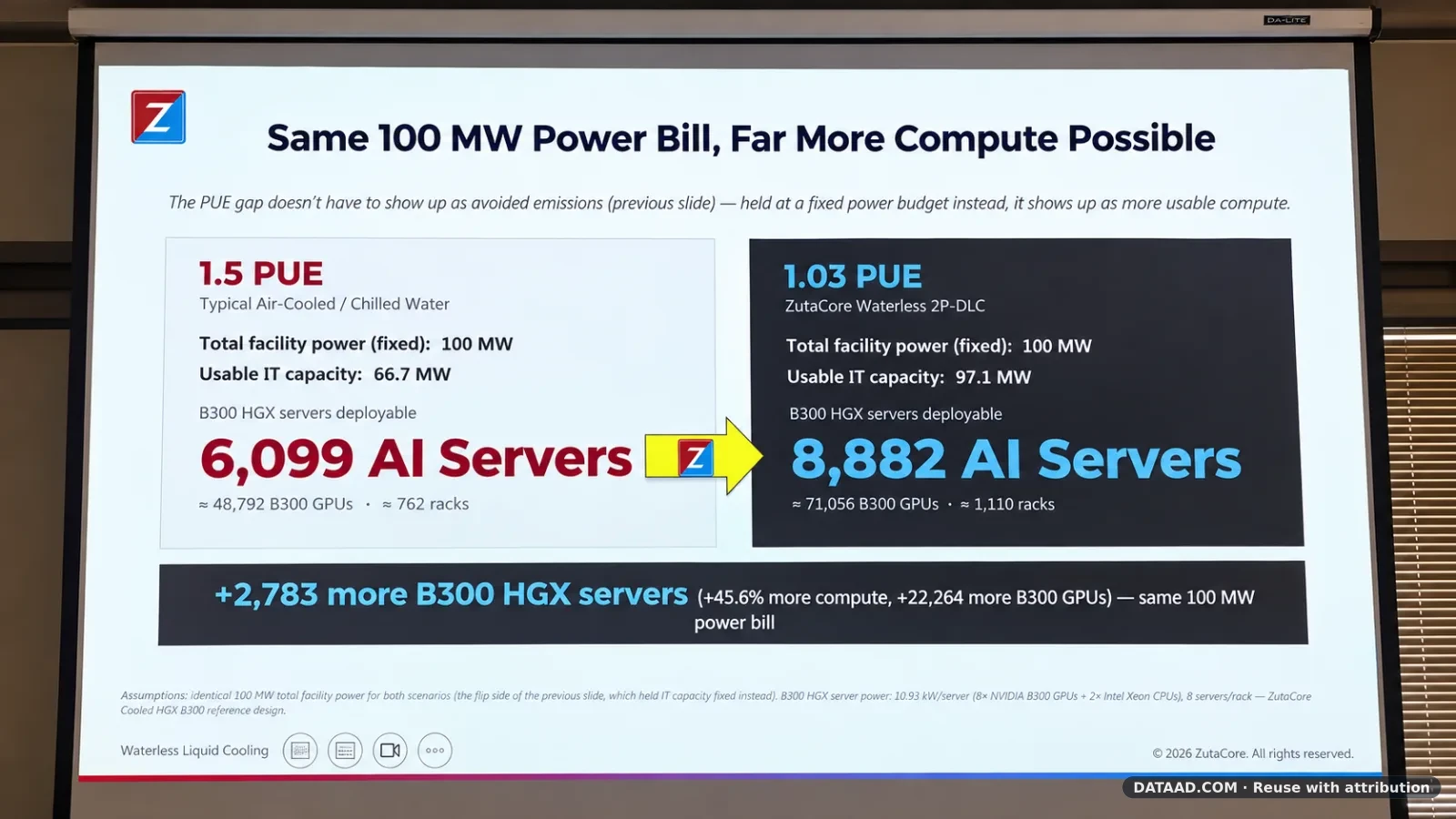
One of the most striking illustrations presented during the seminar compared two AI data center configurations operating under an identical 100 MW total facility power budget.
The conventional cooling scenario assumed a Power Usage Effectiveness (PUE) of 1.50, while ZutaCore's proposed two-phase cooling scenario used a PUE of 1.03.
Under these assumptions, reducing the non-IT power overhead allows substantially more electricity to be allocated to computing equipment.
The key implication is not simply lower cooling costs. It is the possibility of deploying more AI processing capacity within an existing power allocation.
However, the comparison should not be interpreted as proof that two-phase cooling alone guarantees 45.6% more useful AI output. PUE includes multiple infrastructure factors, and actual workload performance also depends on accelerator utilization, memory, networking and software efficiency.
GPU, NPU and TPU: Avoiding Waste of Expensive AI Computing Resources
The growing investment in GPUs, neural processing units (NPUs) and tensor processing units (TPUs) creates another challenge for AI infrastructure operators: ensuring that expensive processing resources are used efficiently.
Even when sufficient accelerators are installed, inadequate cooling, unstable power delivery and network limitations can reduce the computing capacity available to customers.
Thermal throttling can force processors to operate below their intended performance levels when temperature limits are reached.
Effective thermal management therefore becomes more than a facility engineering requirement. It directly affects the economic productivity of the computing infrastructure.
ZutaCore's presentation also addressed how different AI workloads generate different thermal patterns across a processor.
Dense matrix operations, long-context inference and mixed agentic workloads can concentrate heat in different regions of the same accelerator.
Two-phase cooling offers a potential advantage by responding to localized heat flux through boiling at the heat transfer surface.
Nevertheless, preventing thermal throttling is only one part of maximizing utilization. Efficient workload scheduling, memory bandwidth, storage performance and network orchestration remain essential.
For future AIDC operators, the appropriate performance target is not simply the number of GPUs installed, but the amount of useful AI computing delivered per unit of electricity, water and capital investment.
800 VDC: Next-Generation Power Distribution for AI Factories
Efficient cooling must be accompanied by equally efficient electrical infrastructure.
As AI rack densities continue to increase, traditional low-voltage power distribution faces greater challenges from high current, conductor size, conversion losses and protection requirements.
The industry's transition toward 800-volt direct current (800 VDC) architectures represents an important response to these limitations.
NVIDIA and its ecosystem partners are developing 800 VDC power architectures intended to reduce power conversion stages and improve electricity distribution efficiency for future high-density AI computing systems.
For Korea's next-generation AIDC projects, such developments highlight the importance of coordinating electrical infrastructure with server, rack and cooling system design.
Solid-State Transformers and Semiconductor-Based Circuit Protection
Power semiconductor technologies are expected to play an increasingly important role in future AI data center electrical systems.
High-performance solid-state transformers (SSTs) use power electronic converters and high-frequency magnetic components to provide controlled electrical conversion.
Depending on their architecture, these systems can support conversion between medium-voltage AC infrastructure and lower-voltage DC distribution, including emerging 800 VDC applications.
Wide-bandgap power semiconductor technologies, including silicon carbide (SiC) and gallium nitride (GaN), offer opportunities to increase switching frequency and power density while managing conversion efficiency.
Another important area is the solid-state circuit breaker (SSCB).
Unlike conventional mechanical circuit breakers, semiconductor-based protection devices can interrupt current electronically, potentially enabling very rapid fault detection and isolation.
This capability is particularly relevant to high-power DC distribution, where fault protection and interruption are technically demanding.
However, semiconductor-based protection also introduces design considerations involving conduction losses, thermal management, fault coordination, reliability and maintenance.
Solid-state transformers and circuit breakers should therefore be evaluated as part of the complete electrical system rather than as isolated efficiency solutions.
Combining efficient power conversion, properly coordinated protection and advanced liquid cooling could help future AI factories support higher computing densities within constrained electrical infrastructure.
SCS: A 100kW Liquid-Cooled Edge Data Center Demonstration in Korea
The seminar also highlighted the importance of practical domestic AI data center deployment experience.
SCS, represented by CEO Hyung-kyu Jin, shared perspectives associated with a pioneering 100kW-class liquid-cooled edge AI data center project in Sejong.
The Sejong facility was developed and opened by Wellmade Computer in July 2025. The company described it as a first-of-its-kind liquid-cooling-based infrastructure deployment in Korea.
The project applies direct liquid cooling to high-performance GPU infrastructure and provides a practical example of deploying AI computing resources at a regional scale.
According to Wellmade Computer's project announcement, the facility was designed around approximately 100kW of capacity, with a reported PUE target or performance level of around 1.2 and improved space efficiency compared with conventional air-cooled configurations.
The deployment illustrates how liquid cooling may support compact, high-density edge data centers without necessarily requiring the scale of a large hyperscale campus.
SCS's involvement in the seminar helped connect the discussion of advanced cooling and electrical technologies with the realities of operating regional AI infrastructure.
Such experience is especially relevant in Korea, where existing industrial facilities, advanced telecommunications networks and regional computing demand could support distributed edge AI infrastructure.
Importantly, the Sejong project's liquid-cooled deployment should not be confused with a completed demonstration of ZutaCore's two-phase technology. The domestic edge installation and ZutaCore's next-generation cooling proposals represent distinct parts of the broader technology discussion.
Korea's Semiconductor Industry: Cooling Beyond the GPU
Korea's semiconductor industry adds another dimension to the future of liquid cooling.
As AI systems become more dependent on high-bandwidth memory (HBM), advanced NAND flash and high-performance solid-state drives (SSDs), thermal management requirements are expanding beyond GPUs and CPUs.
HBM operates in close proximity to high-performance AI processing logic, making package-level heat dissipation increasingly critical.
Enterprise SSDs are also facing rising power densities as storage systems support larger AI workloads and higher data throughput.
These developments are encouraging new approaches to integrated package cooling, cold plates and liquid-cooled storage modules.
Future AI infrastructure may therefore require a more comprehensive cooling architecture covering processors, memory, storage and associated power electronics.
For Korea, this creates opportunities to connect semiconductor manufacturing expertise with domestic liquid cooling, electrical engineering and server integration capabilities.
A National Strategy for More Efficient AI Infrastructure
The broader significance of the Sejong seminar was its focus on improving the efficiency of future national AI infrastructure.
The participation of Chungcheong Research Institute, SEABURY Solutions, SCS, XCELLYNK and ZutaCore reflected the need for cooperation between research institutions, regional operators and international technology providers.
SEABURY Solutions representative Kyung-ik Ahn and SCS CEO Hyung-kyu Jin were among the industry participants contributing to this regional infrastructure discussion.
For South Korea, building AI data centers involves more than acquiring GPUs and securing land.
Electricity availability, water consumption, cooling performance, power distribution, semiconductor supply, utilization efficiency and community acceptance must be considered together.
Large centralized AI campuses will remain important for certain workloads, particularly large-scale model training. However, regional edge data centers could also play a valuable role in supporting inference, industrial AI and latency-sensitive services.
The opportunity is to design national AI infrastructure around complementary centralized and distributed computing resources, rather than assuming that every requirement must be met by increasingly large facilities.
Less Water, Less Wasted Power, More Useful Compute
The main lesson from the Sejong seminar was that the next stage of AI infrastructure development must focus on the efficient use of limited resources.
ZutaCore's two-phase cooling approach illustrates how changes in thermal architecture could reduce cooling overhead and increase the computing capacity supported by a given power budget.
Advanced 800 VDC distribution, solid-state transformers and semiconductor-based circuit protection offer additional pathways for improving electrical infrastructure.
Meanwhile, Korea's 100kW-class edge liquid cooling deployment provides practical experience that can inform future regional AI infrastructure projects.
As GPU, NPU and TPU investments continue to grow, the ultimate goal should be to convert expensive semiconductor resources into dependable and useful AI services without unnecessary consumption of electricity and water.
The future competitiveness of South Korea's AI data center industry may depend less on the total number of megawatts announced and more on how effectively those megawatts are converted into useful computing performance.
Sources and Editorial Notes
DATAAD field reporting, 2026 AIDC Technology Seminar, Sejong, South Korea, October 26, 2026.
ZutaCore, technical presentation on waterless two-phase cooling and 100 MW facility power comparison, October 2026.
NVIDIA, Why Scaling AI Compute Performance Requires a New Power Architecture, August 2026.
Wellmade Computer, 100kW-class liquid-cooled edge data center opening in Sejong, July 2025.
Editorial note: This independent field report combines observations from the Sejong seminar with relevant publicly available technical background. Vendor performance comparisons are attributed to their respective presenters. The 800 VDC, SST and SSCB discussion includes industry context and should not be interpreted as confirmation that any particular device was demonstrated at the event.