
SC26: The AI Infrastructure Race Moves Beyond Chips
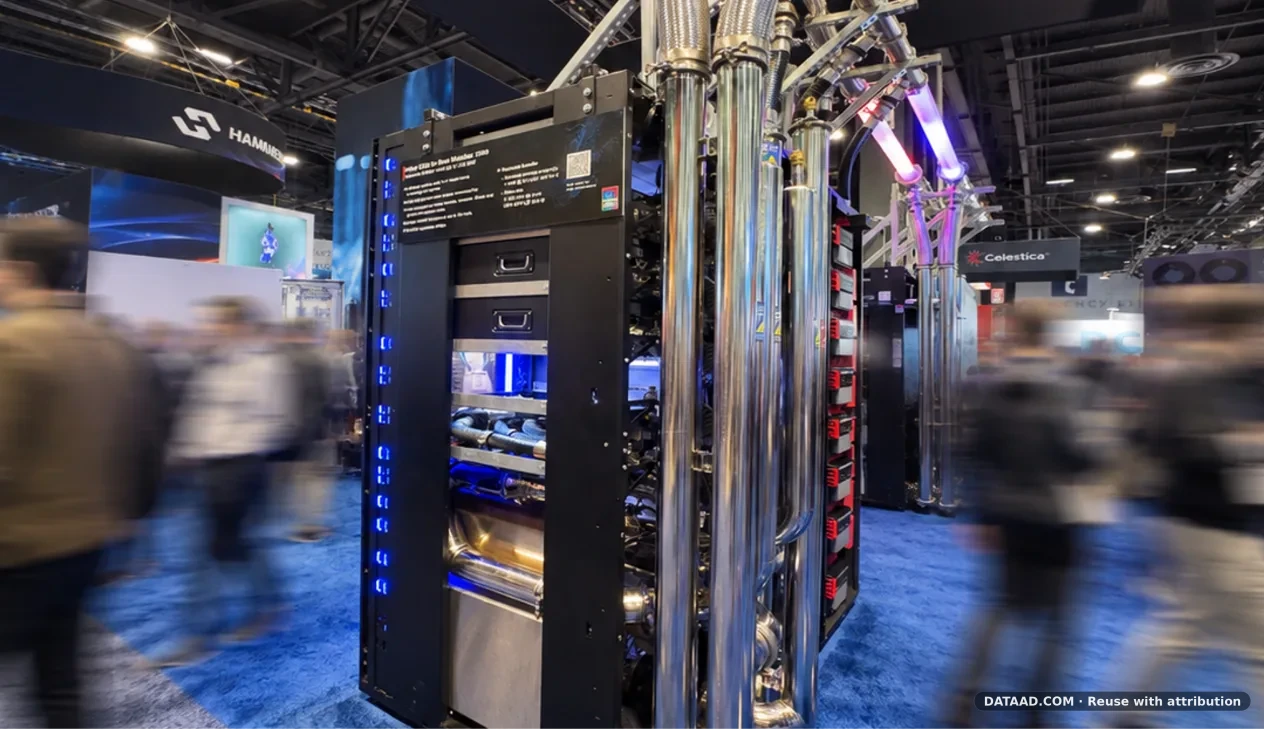
CHICAGO, November 2026 — At Supercomputing 2026 (SC26), the future of artificial intelligence was visible not only in advanced processors but also in the engineering infrastructure surrounding them: liquid-cooled servers, high-density racks, coolant distribution units, and increasingly sophisticated fluid connections.
Held at McCormick Place in Chicago, SC26 brought together the global high-performance computing community at a time when AI infrastructure is becoming both more powerful and more complex.
Meanwhile, a new U.S. export control rule, effective November 19, introduced another dimension to the industry: who can remotely access advanced computing capacity, and under what conditions?
These developments raise an important question: Is the next stage of AI competition about building more powerful chips, or controlling the complete infrastructure required to operate them?
1. NVIDIA Vera Rubin: Computing at Rack Scale
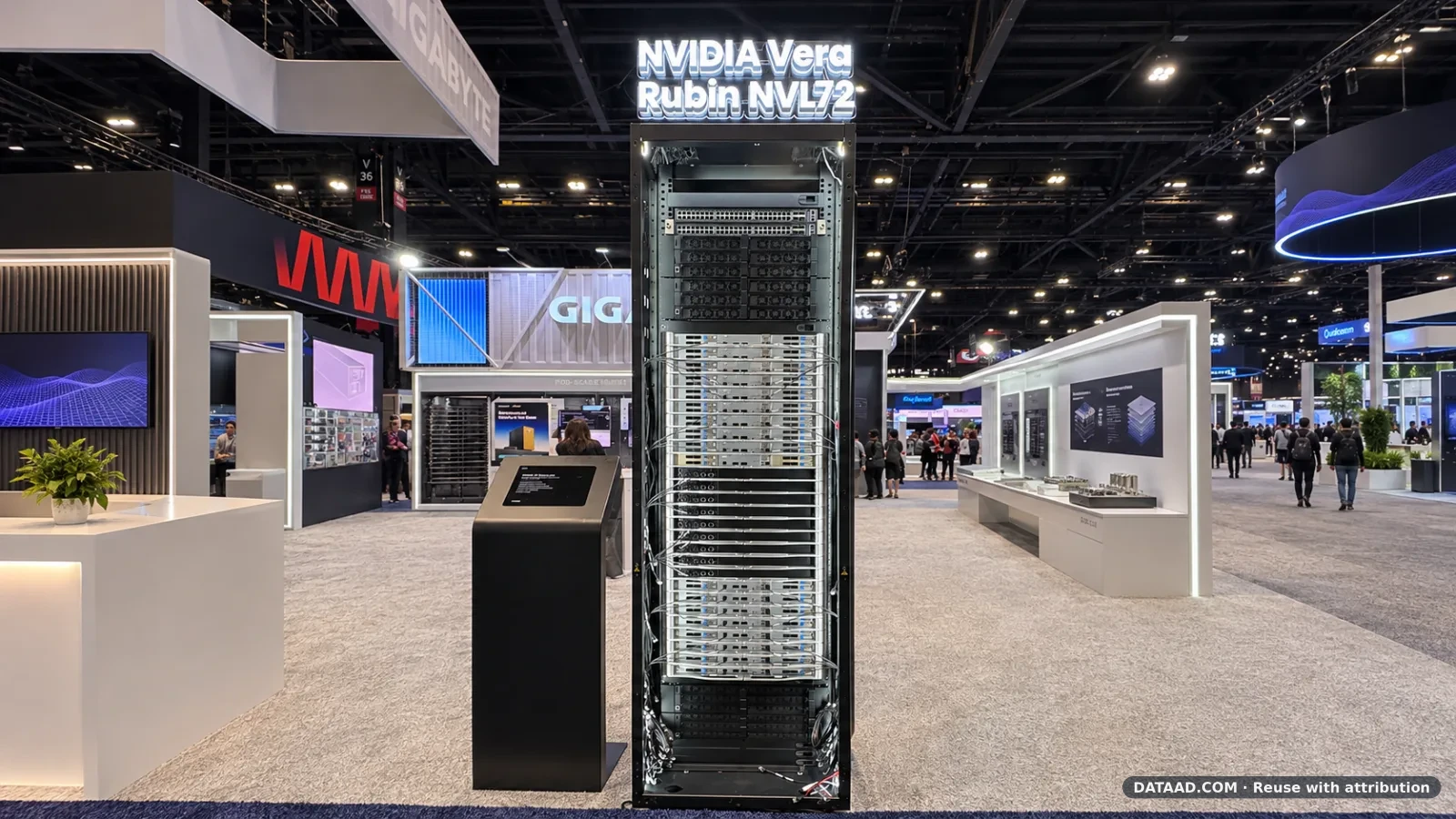
Among the prominent technologies at SC26 was NVIDIA's Vera Rubin NVL72 rack-scale architecture.
The rack illustrates how AI computing is evolving beyond individual accelerator cards toward tightly integrated systems combining processors, high-speed interconnects, memory, networking, power delivery, and thermal management.
As compute density increases, the rack becomes an important engineering unit. Server manufacturers and data center operators must consider not only computational performance but also heat removal, electrical capacity, maintainability, and system availability.
For AI infrastructure developers, this shift creates new requirements for cooling manifolds, fluid distribution, quick-disconnect couplings, and reliable service connections.
2. AMD and MiTAC: Liquid Cooling Becomes Essential

MiTAC Computing demonstrated an AMD Instinct MI355X 52U liquid-cooled AI rack alongside a two-phase direct liquid cooling solution developed with ZutaCore.
The exhibition offered a useful comparison between conventional single-phase direct liquid cooling and two-phase cooling architectures.
In a single-phase system, liquid coolant absorbs heat while remaining in the liquid state. A CDU transfers the heat to a facility cooling loop.
In a two-phase system, a dielectric working fluid absorbs heat through vaporization at the heat source and subsequently condenses as part of the cooling cycle.
MiTAC stated that its ZutaCore demonstration supports thermal design powers exceeding 4,000 watts and heat flux above 250 W/cm². These are vendor-reported design capabilities, not independently verified DATAAD measurements.
The comparison highlights a broader industry challenge: future AI accelerators will require cooling solutions that combine thermal performance, operational reliability, and practical serviceability.
3. Inside the AI Server: The Importance of Cold Plates and Fluid Connections
An AMD liquid-cooled server displayed at SC26 provided a closer look at the mechanical infrastructure supporting high-performance computing.
Copper cold plates, flexible coolant lines, fittings, and densely arranged electronic components demonstrate how thermal engineering has become inseparable from server architecture.
Each connection introduces engineering considerations involving pressure loss, material compatibility, leakage prevention, maintenance access, and long-term reliability.
For data center operators, these details can influence system availability as much as the specifications of the processors themselves.

4. From Cold Plates to CDUs: Cooling Becomes a Modular Infrastructure
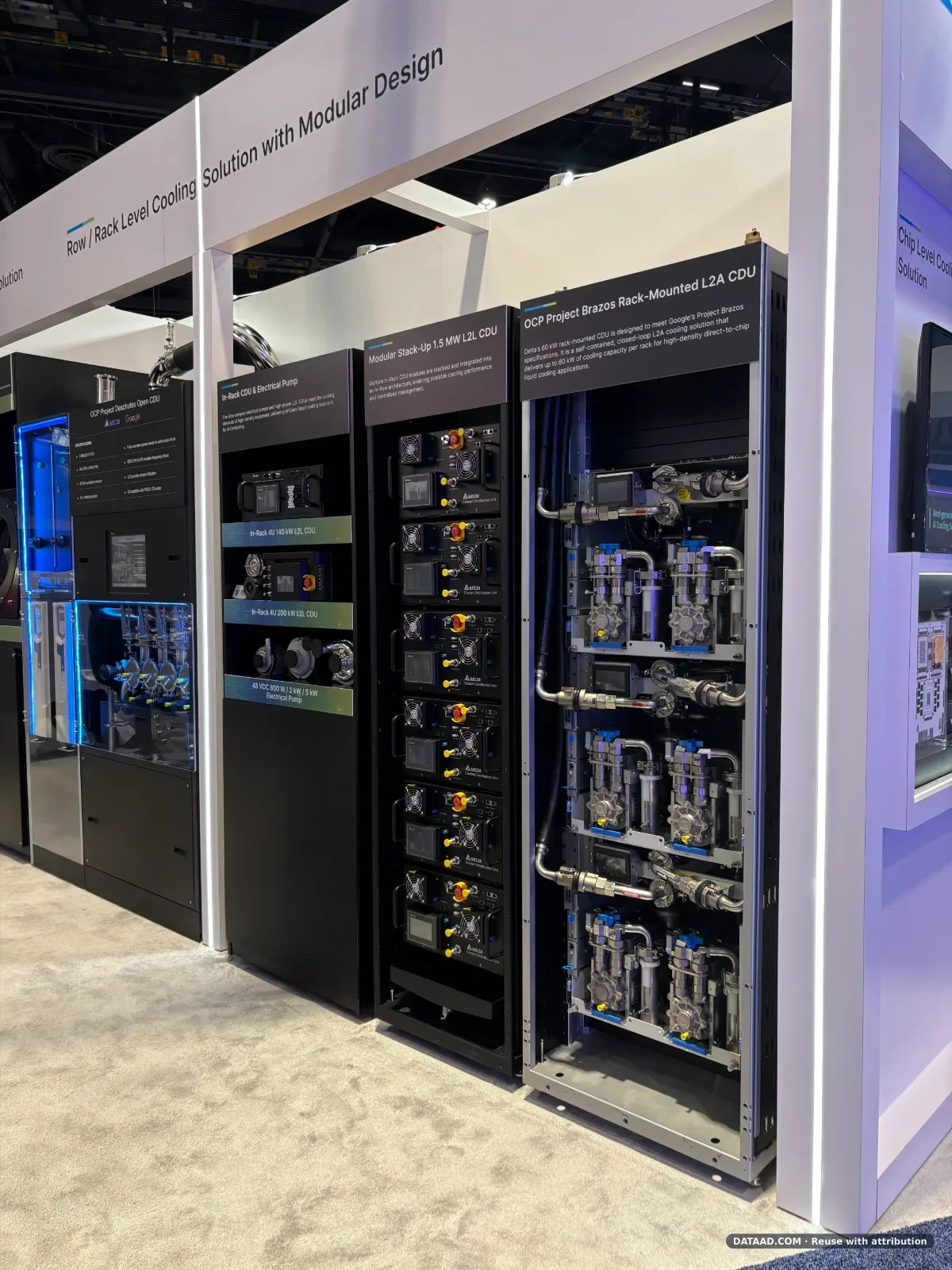
Delta's SC26 exhibition demonstrated how cooling infrastructure is becoming increasingly modular.
The displayed systems included in-rack cooling and electrical pump solutions, a modular stack-up liquid-to-liquid CDU, and an OCP Project Brazos rack-mounted liquid-to-air CDU.
Such architectures provide different approaches to managing heat transfer between computing equipment and the surrounding facility.
Rather than treating cooling as a separate utility, equipment manufacturers are increasingly integrating thermal management into rack-level design.
5. The Physical Challenge of High-Density AI Racks
Another high-density rack demonstration illustrated the growing complexity of coolant distribution infrastructure.
Large metallic pipes, flexible connections, and tightly arranged components are becoming familiar features of advanced AI computing installations.
These systems must deliver sufficient coolant flow while minimizing pressure losses and allowing equipment to be serviced without unnecessarily disrupting adjacent computing resources.
As rack power density increases, cooling system design becomes a central consideration in data center scalability.

6. Rebellions and the Expanding AI Hardware Ecosystem
SC26 also provided visibility for AI computing companies beyond the largest global processor suppliers.
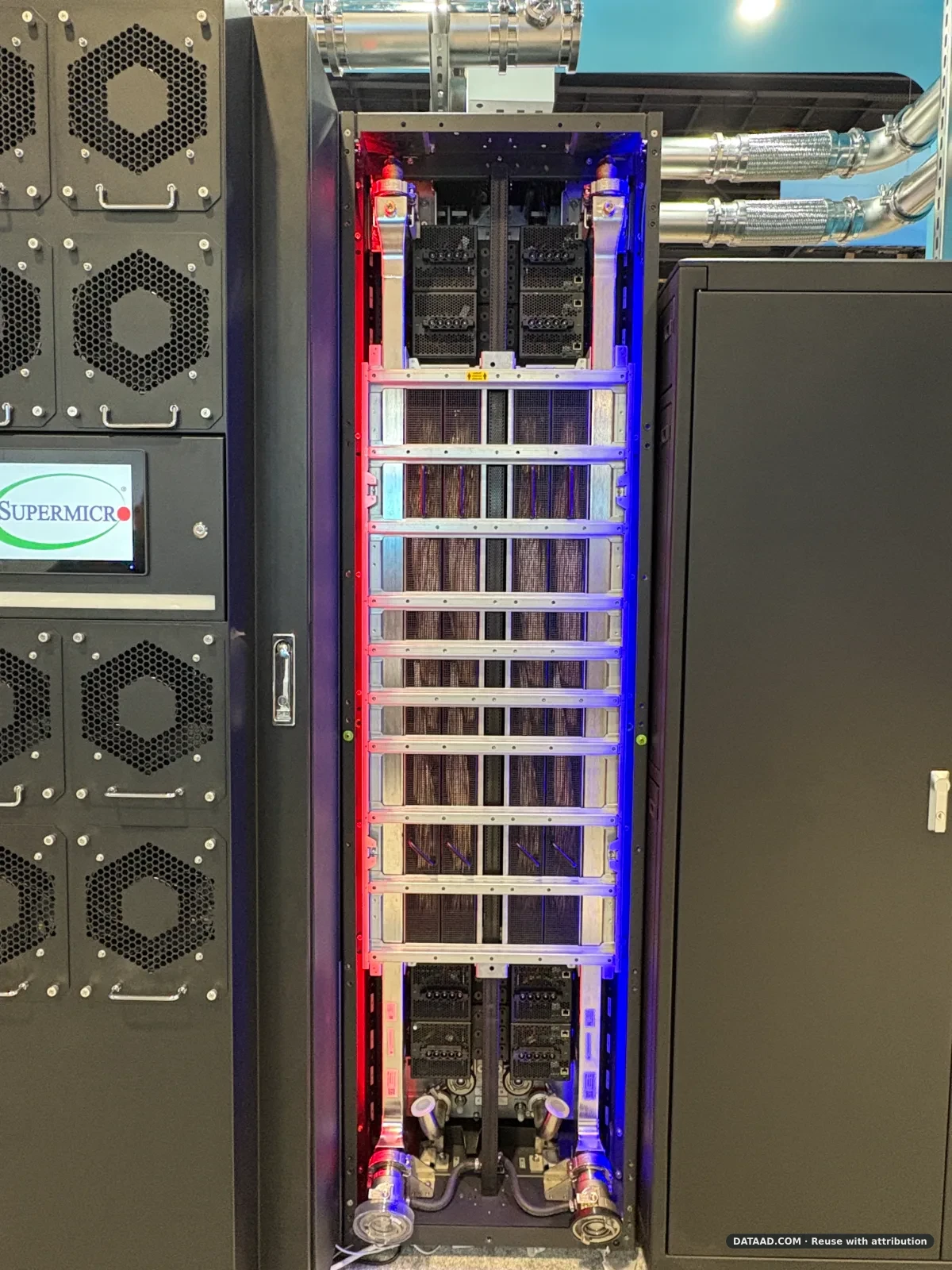
A rack featuring Rebellions branding illustrated the expanding participation of specialized AI hardware developers in the broader infrastructure ecosystem.
The development of alternative AI processors raises questions about software compatibility, deployment economics, energy efficiency, and the ability of emerging hardware platforms to operate within established data center architectures.
Ultimately, hardware competition will depend not only on chip performance but also on the maturity of complete computing platforms.
7. A New U.S. Rule Extends Export Controls to Remote Computing Access
While SC26 demonstrated advances in physical computing infrastructure, the U.S. Department of Commerce introduced a significant regulatory development affecting access to advanced computing resources.
On November 16, 2026, the Bureau of Industry and Security announced an interim final rule titled "Addressing Remote Access to Advanced Semiconductors" (RIN 0694-AK50). The rule took effect on November 19.
The regulation addresses circumstances in which advanced computing hardware located in overseas data centers provides substantial remote computing capacity to companies headquartered in, or ultimately controlled from, Country Group D:5 destinations or Macau.
One important threshold is more than 12 million aggregate Total Processing Performance (TPP), calculated across an individual data center or linked data centers.
The rule also addresses indirect arrangements in which third-country entities train or supply advanced AI models for companies covered by the restrictions.
It establishes a narrowly defined exception for qualifying commercial recommender systems, while excluding systems incorporating generative models from that definition.
Importantly, the rule does not impose a universal prohibition on remote cloud computing. It establishes licensing and compliance requirements for specified hardware, destinations, end users, and end uses.
8. Could Compute Controls Affect AI Model Distillation?
One potential consequence of the regulation concerns the development of AI models through remote computing services.
Knowledge distillation enables a smaller student model to learn from the outputs or behavior of a larger teacher model. Synthetic data generation can also support model training and improvement.
These techniques do not necessarily require the developer to own the hardware used to operate the larger model.
Restrictions on access to substantial overseas computing capacity could therefore complicate some cross-border model development arrangements, including those involving third-party training or model supply.
However, the regulation does not explicitly prohibit knowledge distillation as a technique, and its practical impact will depend on the specific hardware, customers, workloads, and licensing circumstances involved.
This distinction is important when evaluating the future of AI development in China and other markets affected by U.S. technology controls.
9. What This Means for the Global AI Data Center Industry
The developments at SC26 and the new U.S. regulation reveal two interconnected challenges.
The first is physical: how to supply power, remove heat, distribute coolant, and maintain increasingly dense AI computing systems.
The second is institutional: how governments, cloud providers, and infrastructure operators determine access to advanced computing resources.
For server manufacturers and cooling technology suppliers, the immediate engineering priorities remain clear: thermal performance, energy efficiency, interoperability, and reliability.
For data center operators, however, future infrastructure decisions may increasingly require consideration of customer due diligence, equipment sourcing, regulatory compliance, and the geographical distribution of computing capacity.
The implications extend beyond the United States and China. Countries investing in AI data centers must consider both the technical requirements of advanced computing and the rules governing access to critical technologies.
10. DATAAD Perspective: Who Will Control the Next Generation of AI Infrastructure?
SC26 demonstrated that the AI infrastructure race is no longer defined by processor performance alone.
Advanced chips depend on a complex physical ecosystem of servers, cooling systems, power infrastructure, networks, and engineering services.
At the same time, international regulation is increasingly shaping how that computing infrastructure can be accessed and operated.
The central question is therefore broader than which company produces the fastest AI accelerator.
Who will be able to build, operate, maintain, and access the computing infrastructure that supports the next generation of artificial intelligence?
As AI systems become more powerful, this question may become just as important as the technology itself.
Sources and References
- SC26 Official Exhibition Information
- NVIDIA at SC26
- MiTAC Computing SC26 Announcement
- U.S. BIS Interim Final Rule — RIN 0694-AK50
- BIS Implementation Guidance
Editorial disclosure: This independent DATAAD report combines exhibition photographs supplied to the publication, publicly available technical announcements, U.S. government regulatory documents, and editorial analysis. Vendor performance claims have not been independently tested. Photographs are used for technical illustration and do not imply commercial endorsement.