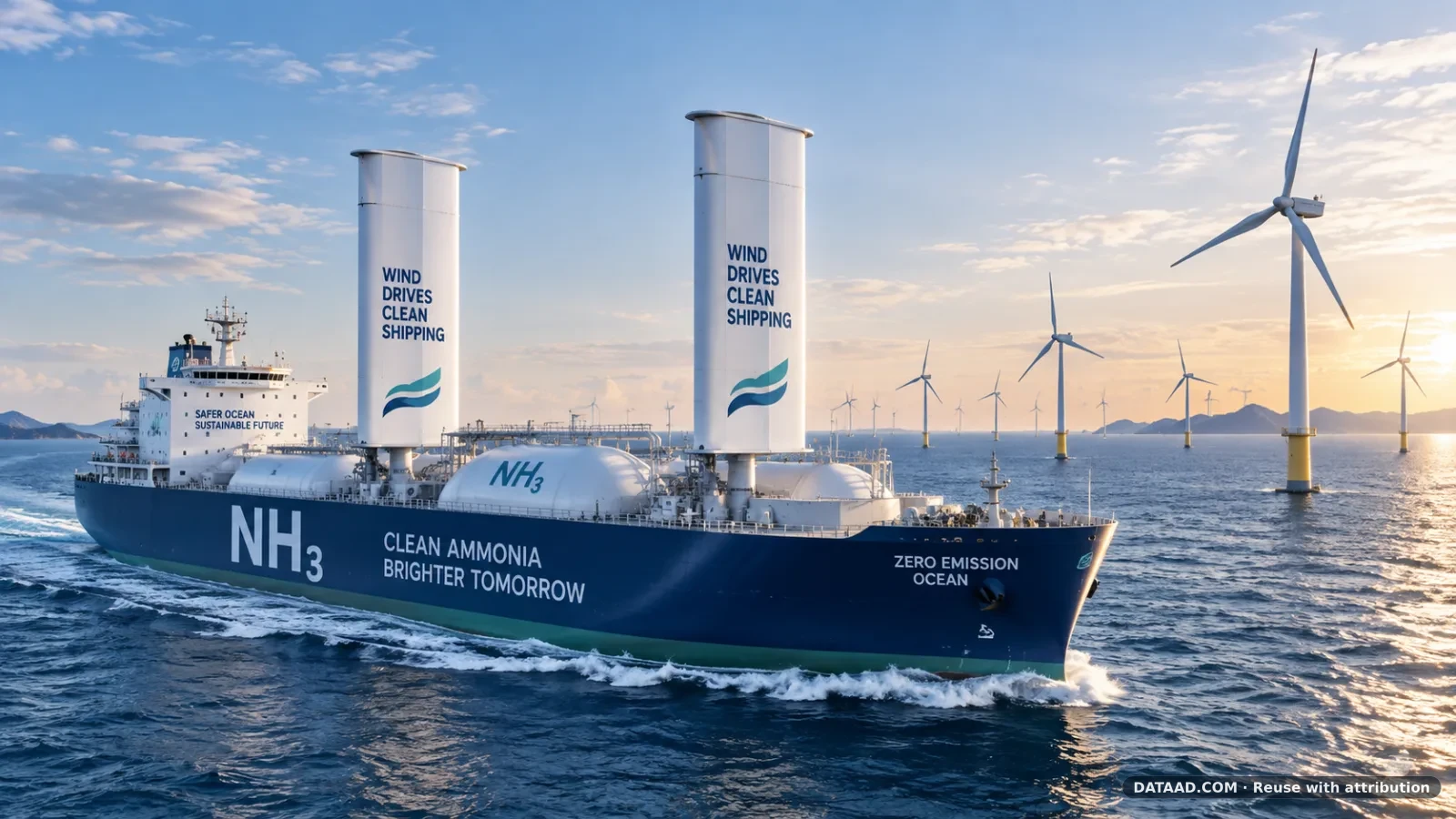
For more than a century, commercial shipping moved steadily away from sails. Steam replaced wind, diesel replaced steam, and ever-larger engines became the foundation of global maritime trade.
Now wind is returning — not as a replacement for the engine, but as part of a much more complex transition.
Across bulk carriers, tankers, LNG carriers and even container ships, shipowners and shipbuilders are experimenting with wing sails, hard sails and rotor sails that can reduce the amount of fuel required to move a vessel through the water.
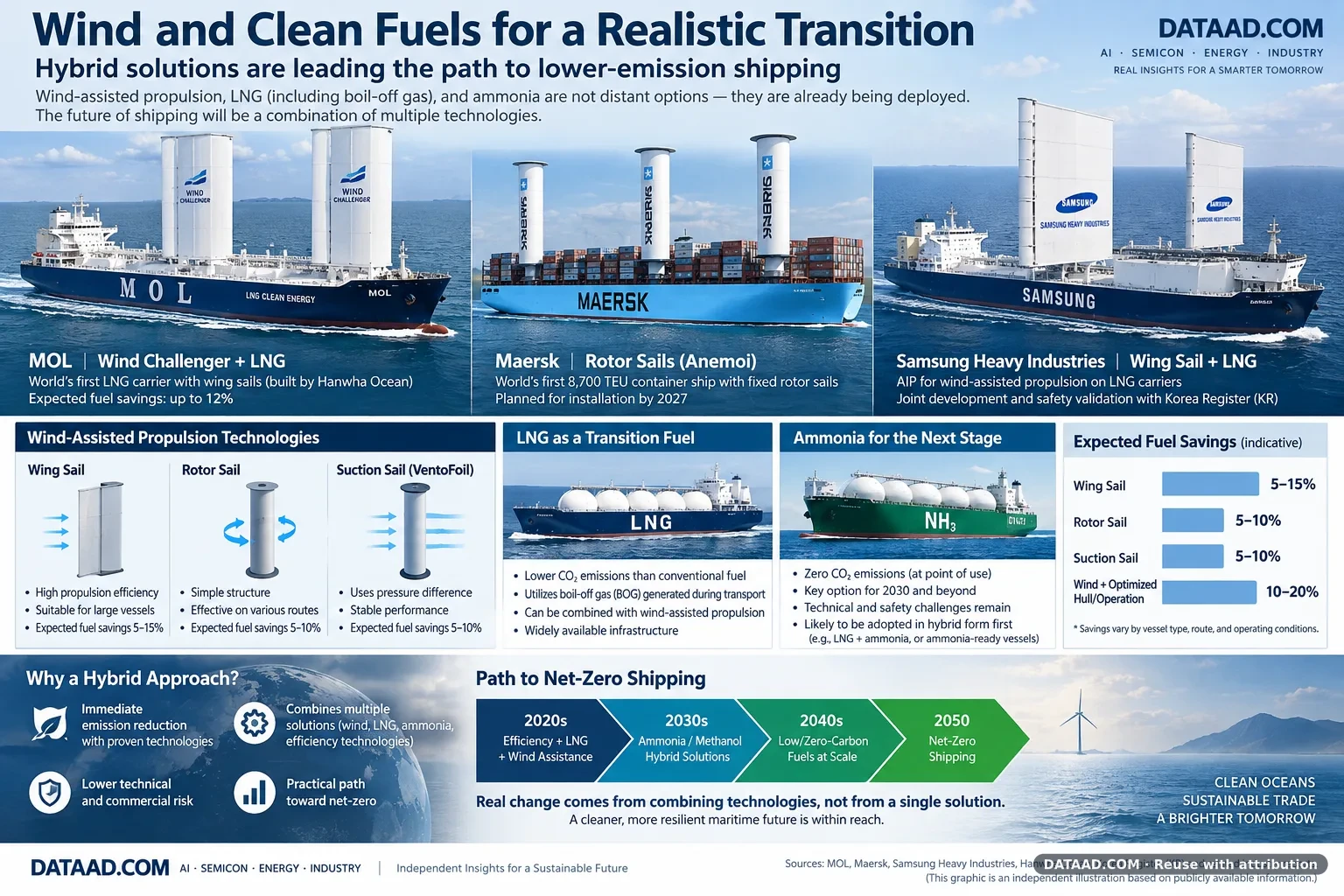
The emerging lesson is important: the decarbonization of shipping is unlikely to come from a single breakthrough fuel. Instead, the next generation of ships may combine several technologies — wind assistance, improved hull and propulsion efficiency, LNG or dual-fuel engines, boil-off gas utilization, and ultimately lower-carbon fuels such as ammonia.
The sail is returning — but the engine is staying
One of the clearest examples arrived in Korea in September 2026.
Mitsui O.S.K. Lines (MOL) named the world's first LNG carrier equipped with two Wind Challenger hard sails at Hanwha Ocean's Geoje shipyard. The vessel, Fujin Sailor, is scheduled for long-term charter service for Chevron.
The ship represents an unusual combination of old and new maritime technologies. It transports LNG using a modern membrane cargo system and a low-pressure LNG dual-fuel main engine, while two large telescopic sails provide additional propulsion whenever wind conditions are favorable.
The objective is not to sail without an engine. The objective is to reduce how hard the engine has to work.
That distinction may define the next phase of maritime decarbonization. Wind becomes an energy source that is available at no fuel cost, while the main propulsion system continues to provide the reliability, speed and operational flexibility required by commercial shipping.
Korean shipbuilders are moving in the same direction
Samsung Heavy Industries has also been developing LNG carrier concepts using wind-assisted propulsion.
A Samsung Heavy Industries design received Approval in Principle from the Korean Register and the Liberian Registry for an LNG carrier equipped with wing sails. The concept places the bridge toward the bow to address visibility issues created by large sails and combines wind propulsion with Samsung's SAVER Wind air-resistance reduction technology.
Samsung has also worked with MOL on next-generation LNG carrier designs incorporating multiple Wind Challenger units, showing how quickly wind propulsion is moving from experimental installations toward the design stage of large commercial vessels.
HD Hyundai is taking another route toward the same objective. Its wind-assisted propulsion system has entered real sea trials on an HMM-operated medium-range tanker. The approximately 30-meter-high wing sail generates aerodynamic lift to supplement engine propulsion, while operational data will be collected to determine the actual fuel-saving effect under different sea and wind conditions.
The significance of these projects is not the shape of the sail itself. It is that some of the world's largest shipbuilders and shipping companies are beginning to treat wind as another component of the propulsion system.
LNG also illustrates why the transition is complicated
LNG is sometimes presented simply as another fossil fuel, but on an LNG carrier the energy equation is more complicated.
Liquefied natural gas is transported at approximately -162°C. Even with heavily insulated cargo tanks, some LNG naturally evaporates during a voyage, creating what is known as boil-off gas, or BOG.
That gas must be managed. Depending on the vessel and propulsion architecture, it can be reliquefied and returned to the cargo tanks or used as fuel in the ship's engines.
Using boil-off gas for propulsion therefore allows an LNG carrier to recover energy from gas that is already being generated by the cargo system rather than treating it simply as an unwanted by-product.
It does not make LNG carbon-free. Burning methane still produces CO₂, and methane emissions must also be carefully controlled. But it demonstrates why shipping's transition cannot be reduced to a simple choice between "fossil" and "green." Efficiency, cargo management and propulsion technology all matter.
Wind and LNG can work together
This is where wind-assisted propulsion becomes particularly interesting.
If a ship can obtain part of its propulsion from wind, the main engine requires less fuel. For an LNG carrier, that can mean lower consumption of LNG or boil-off gas while maintaining the same commercial voyage.
The fuel remains important, but wind reduces the amount required. Hull optimization, air lubrication, shaft generators and improved route planning can reduce it further.
Instead of waiting for a completely new energy system, shipowners can stack efficiency technologies on top of existing propulsion systems.
This layered approach can produce emissions reductions before the global fuel infrastructure for truly low-carbon shipping is fully available.
Ammonia may represent the next fuel layer
Further ahead, ammonia is emerging as one of the major candidates for deep-sea shipping.
Unlike conventional hydrocarbon fuels, ammonia contains no carbon and therefore produces no CO₂ directly from the ammonia molecule during combustion. Its overall climate benefit, however, depends heavily on how the ammonia is produced and how emissions such as nitrogen oxides and nitrous oxide are controlled.
Safety is another major engineering challenge. Ammonia is toxic, requiring new fuel-handling systems, detection technology, ventilation, operating procedures and crew training.
Yet the technology is moving beyond drawings. In 2026, HD Hyundai Heavy Industries completed the world's first ammonia-powered medium-sized gas carriers using dual-fuel engines, demonstrating that ammonia propulsion is beginning to move into commercial shipbuilding.
The first generations of ammonia ships are therefore likely to look very different from the idea of a pure "zero-emission ship."
They may still use dual-fuel engines. They may combine ammonia with wind-assisted propulsion. They may incorporate advanced hull forms, energy-saving devices and digital voyage optimization.
In other words, ammonia itself may become part of another hybrid architecture.
Container shipping is also rediscovering wind
Wind propulsion is no longer limited to bulk carriers and tankers. Container shipping is beginning to investigate the same approach.
Maersk has moved toward a pilot installation of rotor-sail technology developed by Anemoi. Unlike a conventional sail, a rotor sail is a tall rotating cylinder that uses the Magnus effect to generate thrust from the wind.
Container ships present a particularly difficult engineering challenge because much of their deck area is already occupied by containers. But regular trading routes also offer an advantage: operators can analyze historic wind conditions and determine where wind assistance has the strongest economic case.
No single technology solves shipping
Ocean-going ships operate for decades. They cross different climates, call at ports with different infrastructure and must carry enormous loads reliably across thousands of kilometers.
That makes an immediate switch from conventional fuel to one completely new energy source extremely difficult.
The International Maritime Organization's current strategy calls for international shipping to reach net-zero greenhouse-gas emissions by or around 2050, with intermediate reductions during the 2030s and 2040s. Achieving that trajectory will require both new fuels and immediate improvements in energy efficiency.
Wind-assisted propulsion fits this reality particularly well because it does not require shipowners to wait for a completely new global fuel network. A sail can reduce the fuel requirement of an LNG vessel today and could perform the same function on an ammonia- or methanol-powered vessel in the future.
The future ship may be a system, not a fuel
For decades the maritime industry defined ships largely by their fuel: steam ships, diesel ships, LNG-fueled ships.
The next generation may be harder to describe.
A vessel could use an ammonia-capable dual-fuel engine, wind-assisted propulsion, optimized hydrodynamics, battery-supported auxiliary systems and AI-based route optimization simultaneously. An LNG carrier could use its own boil-off gas for propulsion while hard sails reduce overall engine demand.
The result is not one revolutionary technology replacing everything that came before. It is an increasingly integrated energy system.
That may ultimately be the more realistic picture of maritime decarbonization.
Wind is returning to shipping, but it is not returning alone.
The cleaner ship of the future is likely to combine the oldest source of maritime propulsion with some of the industry's newest fuels and technologies.