
For most of human history, the competition for natural resources took place on land.
Nations fought for oil fields, coal, iron ore, copper, gold and strategic metals.
The next major resource frontier may be very different.
It may lie 4,000 to 6,000 meters below the ocean surface.
And unlike the mines of the twentieth century, these future mines may contain very few people.
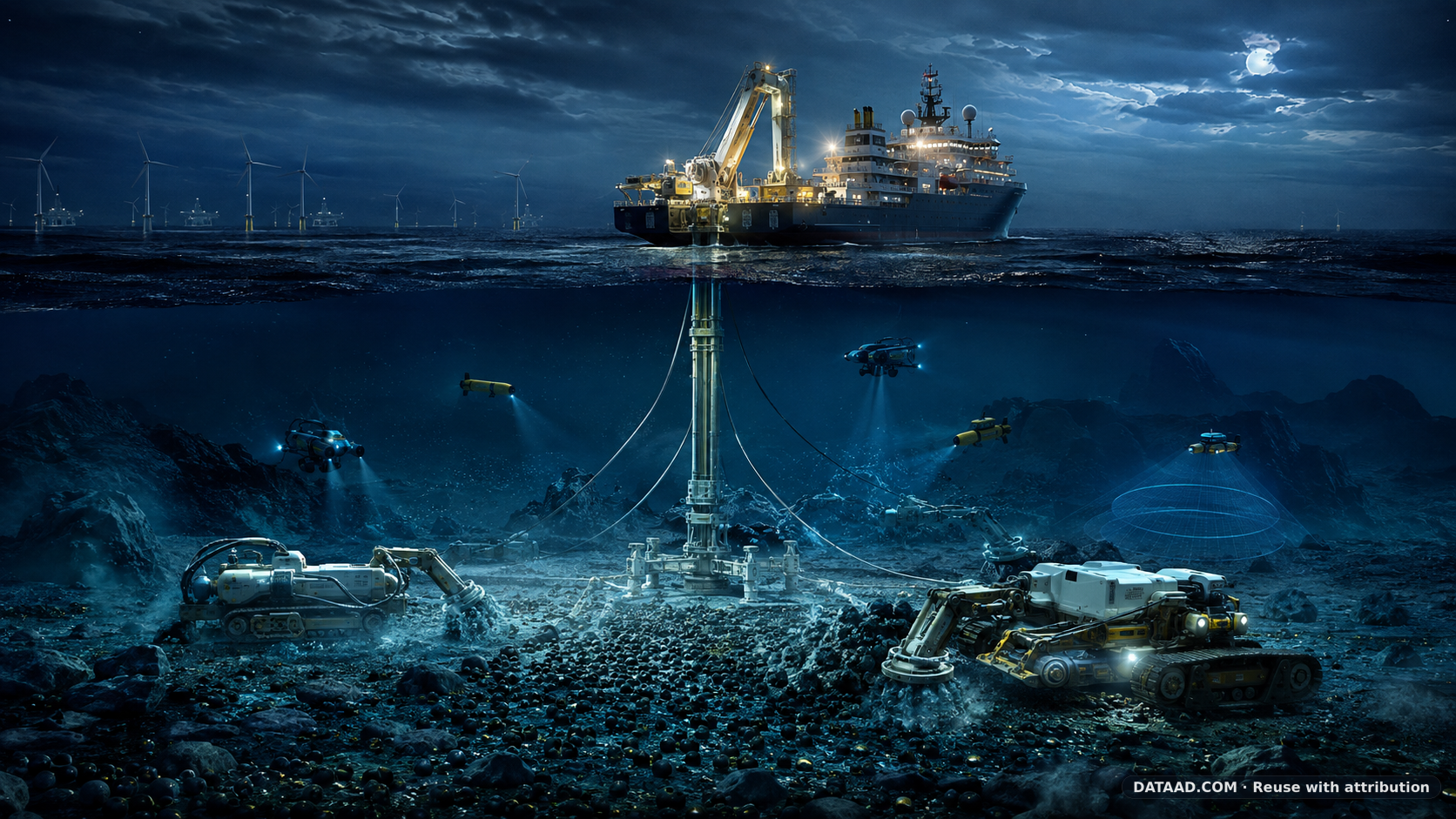
Instead, fleets of autonomous ships, unmanned underwater vehicles, robotic mining machines, subsea sensors and artificial intelligence could search for and recover minerals from the seabed.
The reason is simple.
Electric vehicles, batteries, power grids, wind turbines, semiconductors, AI data centers, robotics and defense systems are increasing demand for many of the same strategic materials.
Nickel.
Cobalt.
Copper.
Manganese.
Rare earth elements.
Zinc and other metals.
Some of these resources exist in extraordinary geological formations on the ocean floor.
The twenty-first-century resource race may therefore move from mountains and deserts into the deep ocean.
Why Critical Minerals Are Becoming an Energy-Security Issue
The transition from internal-combustion vehicles to EVs does not eliminate dependence on natural resources.
It changes which resources matter.
An oil-based transportation system depends heavily on petroleum.
An electrified transportation and energy system requires large quantities of lithium, graphite, nickel, copper, manganese, rare earths and other materials.
The International Energy Agency reported that global battery demand grew by more than 35% in 2025, surpassing 1.5 TWh.
Demand for key energy minerals has recently been increasing at close to 10% per year on average, far faster than traditional base-metal demand.
Lithium demand has been growing at approximately 25% annually over the past two years.
Under the IEA's current stated-policy outlook, total critical-mineral demand is expected to almost double by 2040, while lithium demand could rise more than threefold.
| Critical Mineral Trend | IEA Outlook |
|---|---|
| Global battery demand in 2025 | More than 1.5 TWh |
| 2025 battery-demand growth | More than 35% |
| Recent key energy-mineral demand growth | Approx. 10% annually |
| Lithium recent annual growth | Approx. 25% |
| Critical-mineral demand to 2040 | Almost 2× under stated policies |
| Lithium demand to 2040 | More than 3× |
The problem is not simply whether enough minerals exist.
It is where they exist, who controls extraction, and especially who controls refining.
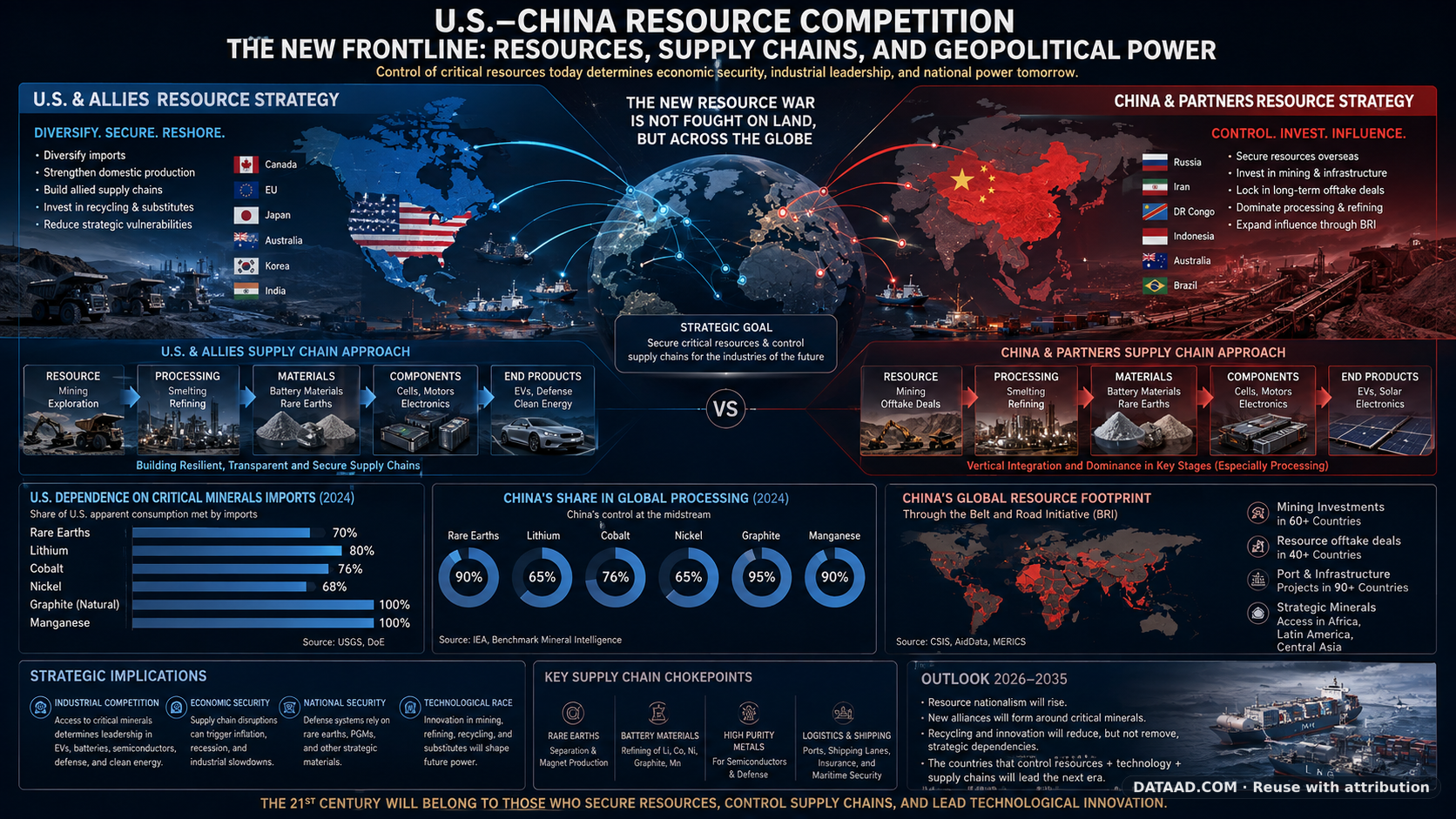
The IEA says concentration in critical-mineral refining reached new records in 2025, with the leading refined supplier accounting for roughly 70% on average across key energy minerals.
That transforms minerals from commodities into strategic assets.
There Is Another Mineral Province Under the Ocean
The deep seabed contains several different types of mineral resources.
Three are particularly important.
1. Polymetallic Nodules
These are rock-like formations lying on abyssal plains, generally several kilometers beneath the ocean.
They can contain combinations of:
- Manganese
- Nickel
- Copper
- Cobalt
- Other trace metals
The Clarion-Clipperton Zone in the Pacific Ocean is the world's best-known area for polymetallic-nodule exploration.
2. Cobalt-Rich Ferromanganese Crusts
These hard mineral layers develop on underwater mountains and seamounts.
They can contain cobalt, manganese, nickel and rare-earth-related materials.
3. Seafloor Massive Sulfides
Hydrothermal systems can create deposits containing copper, zinc and other metals around volcanic and tectonic regions of the seabed.
NOAA notes that more than half of the minerals classified as critical by the United States can occur in deep-seafloor deposits.
This does not mean they are automatically economically recoverable.
But it explains why governments increasingly view the deep ocean as part of future industrial strategy.
The Mine Could Be 5 Kilometers Below the Ship
Traditional mining equipment operates where humans can physically inspect machinery relatively easily.
A deep-seabed mining system faces a radically different environment.
At 5,000 meters depth, pressure is roughly 500 times atmospheric pressure.
There is no sunlight.
Temperatures are low.
Radio communication does not function underwater the way it does through the atmosphere.
A machine failure can occur several kilometers below its support vessel.
This makes the deep sea an almost ideal environment for automation.
Humans remain on the vessel or potentially thousands of kilometers away while machines perform the dangerous work.
The Future Mine Will Actually Be a Fleet
The word “mining machine” may eventually become misleading.
A commercial deep-ocean resource system is more likely to operate as a network of machines.
| System | Future Function |
|---|---|
| Satellite | Navigation, communications and ocean observation |
| Autonomous Surface Vessel | Survey, communications relay and monitoring |
| Mining / Production Vessel | Command, mineral handling and logistics |
| AUV | Autonomous mapping and resource surveying |
| ROV | Inspection, repair and intervention |
| AI Mining Collector | Locate and recover mineral resources |
| Environmental Robot | Measure sediment, water and biodiversity impact |
| Riser / Lifting System | Transfer material from seabed to vessel |
| AI Control System | Coordinate the entire subsea operation |
The offshore vessel therefore becomes something similar to a floating factory and data center.
Beneath it operates a distributed robotic workforce.
First the Robots Map the Resource
Before mining begins, operators must understand what is actually on the seabed.
This is where autonomous underwater vehicles become extremely important.
An AUV can travel without being physically connected to the ship and collect data using sonar, cameras, magnetometers and other sensors.
Instead of manually examining thousands of square kilometers of seabed imagery, future AI systems could automatically identify geological patterns and classify potential deposits.
A simplified workflow could look like this:
Satellite → Survey Vessel → AUV Fleet → AI Geological Model → Resource Map
The AI does not simply create a picture.
It can potentially combine:
- Bathymetry
- Sonar
- Visual images
- Sediment information
- Mineral samples
- Historical exploration data
- Ocean-current data
- Environmental observations
The result is a continuously improving digital model of the seabed.
Then AI Decides Where the Collector Should Move
A traditional mining machine follows a planned route.
A future autonomous mining robot could continuously modify its route.
Computer vision could identify individual nodules.
AI could classify areas according to expected mineral concentration.
The control system could then calculate the best route based on:
- Mineral grade
- Energy consumption
- Collector speed
- Seabed topography
- Sediment conditions
- Machine condition
- Environmental exclusion zones
This is where deep-sea mining begins to resemble Physical AI rather than conventional heavy industry.
The machine perceives its environment, interprets the situation and performs a physical action.
Selective Robotic Mining Could Be More Important Than Bigger Machines
The first instinct in mining is often to build a larger machine.
AI may create another strategy.
Build many smaller intelligent machines.
In 2026, Deep Sea Minerals Corp. announced an agreement with U.S. marine-technology company Impossible Metals to evaluate autonomous robotic systems designed for selective polymetallic-nodule collection.
Impossible Metals has been developing its Eureka autonomous underwater vehicle architecture since the early 2020s.
The idea is fundamentally different from simply driving one massive machine across the seabed.
An autonomous robot can potentially identify and selectively collect target material while avoiding certain areas.
Whether such technology ultimately proves commercially competitive remains to be demonstrated.
But the direction is important.
Deep-sea mining could evolve from mechanical excavation toward robotic precision harvesting.
The Surface Vessel Could Also Become Increasingly Unmanned
Automation will not stop at the seabed.
The surface fleet itself will gradually change.
Today's offshore resource operations normally require large crews.
But autonomous navigation, remote machinery monitoring, predictive maintenance and satellite communications are already reducing the need for continuous human intervention in many maritime operations.
Future deep-sea mining could use several vessel types:
- Large production and lifting vessels
- Autonomous survey vessels
- Unmanned environmental-monitoring vessels
- Robotic-support vessels
- Remote logistics vessels
A human command team could supervise multiple vessels and dozens of subsea robots simultaneously.
That would create an entirely different offshore labor model.
Japan Has Already Recovered Material From Around 6,000 Meters
One of the most important developments occurred in early 2026.
Japan successfully recovered rare-earth-rich mud from approximately 6,000 meters below the Pacific Ocean near Minamitorishima.
The demonstration used the scientific drilling vessel Chikyu.
Japan's project is particularly interesting because it adapted technology derived from oil and natural-gas drilling.
The system uses a closed-circulation approach intended to lift seabed material while reducing the spread of suspended sediment.
| Japan Minamitorishima Demonstration | Data |
|---|---|
| Test year | 2026 |
| Approx. water depth | 6,000 m |
| Resource | Rare-earth-rich mud |
| Primary vessel | Chikyu |
| Strategic objective | Domestic rare-earth supply capability |
This was not yet full commercial mining.
Japan itself emphasizes that extraction, separation, refining and economic feasibility still need to be demonstrated.
Nevertheless, it proves something important:
ultra-deep seabed resource recovery is moving from laboratory discussion toward real ocean engineering.
The United States Is Also Accelerating
The competition is not limited to Asia.
In April 2025, the United States issued Executive Order 14285 directing agencies to accelerate seabed-mineral exploration and commercial-recovery capabilities.
The strategy explicitly links seabed resources with:
- Economic security
- Energy security
- Manufacturing
- Defense
- Critical-mineral supply chains
In August 2026, NOAA opened the federal review process associated with an application from The Metals Company USA covering exploration and commercial recovery of polymetallic nodules.
As of August 2026, NOAA lists no existing U.S. commercial recovery permit as having been issued.
But the regulatory process itself is significant.
The competition is moving closer to potential commercial decisions.
China, Japan, Korea, Europe and the United States Are All Watching the Seabed
This is why deep-sea mining should not be viewed simply as a mining-sector story.
It is becoming part of industrial geopolitics.
The International Seabed Authority has issued exploration contracts covering polymetallic nodules, polymetallic sulfides and cobalt-rich crusts to government and corporate contractors from multiple countries.
The Republic of Korea has been unusual in having exploration involvement across all three major ISA seabed-mineral categories:
- Polymetallic nodules
- Polymetallic sulfides
- Cobalt-rich ferromanganese crusts
Korea's history of deep-seabed exploration therefore gives the country a potentially important technological base.
In May 2026, KIOST and the International Seabed Authority also brought experts from 15 countries together in Busan to discuss environmental-management planning for Western Pacific deep-seabed resources.
For a country that imports most of its energy and mineral resources but possesses world-class shipbuilding, batteries, semiconductors, robotics and heavy industry, the strategic logic is obvious.
Korea Could Build the Machines Even Before It Mines the Minerals
There is another way to view the opportunity.
Korea does not have to become the world's largest deep-sea mining operator to benefit from this industry.
It could become one of the world's largest suppliers of the equipment.
Korea already possesses industrial capabilities in:
- Large offshore vessels
- Shipbuilding
- Subsea equipment
- Hydraulic systems
- High-pressure equipment
- Electric motors
- Power electronics
- Batteries
- Semiconductors
- Cameras and sensors
- Industrial robotics
- AI computing
A future autonomous seabed-mining industry requires almost all of them.
This could create opportunities for Korean shipyards and equipment companies comparable to the offshore oil-and-gas equipment industry that developed during the previous energy era.
The Offshore Mining Vessel Becomes an AI Data Center
The most overlooked part of this future market may be computing.
Consider the information generated by one autonomous mining fleet.
Every AUV produces sonar and image data.
Every mining robot generates pressure, vibration, temperature and motor data.
Environmental robots continuously analyze water and sediment.
Cameras monitor the machines.
Navigation systems calculate position.
AI models compare mineral targets with environmental constraints.
Predictive-maintenance systems analyze equipment health.
The support vessel therefore needs substantial computing infrastructure.
The ship itself becomes a floating edge-AI data center.
Some computation will take place directly inside the subsea robots because communicating every raw data point back to the ship is inefficient.
This creates a three-level computing architecture:
Subsea Edge AI → Vessel AI Control Center → Satellite / Onshore Cloud
That architecture looks remarkably similar to the distributed AI infrastructure now emerging in factories, autonomous vehicles and robotics.
One Human Could Eventually Supervise Many Robots
The greatest economic impact of AI may ultimately be labor productivity.
A conventional offshore project requires people to operate, monitor and maintain many individual systems.
Future AI systems could change the ratio between people and machines.
Instead of:
One operator → One machine
the industry could move toward:
One operator → Multiple autonomous machines
and eventually:
One control team → Entire autonomous mining fleet.
Humans would intervene when machines encounter unexpected situations, while routine navigation, inspection, collection and monitoring are increasingly automated.
The Real Competition May Be for Data, Not Only Minerals
Before anyone can mine the ocean economically, they must know where the valuable resources are.
That makes marine geological data extraordinarily valuable.
Countries that spend decades mapping the seabed accumulate something competitors cannot instantly reproduce:
high-resolution geological knowledge.
AI increases the value of these historical datasets because old maps, samples and sonar records can be combined with new information.
This suggests that the coming competition has at least three layers.
| Resource Race | Strategic Asset |
|---|---|
| Layer 1 | Seabed exploration rights |
| Layer 2 | Geological and environmental data |
| Layer 3 | Autonomous mining and processing technology |
A country controlling all three will have a much stronger position than one that simply purchases minerals after they are mined.
But There Is a Major Problem: The Deep Sea Is an Ecosystem
The technological opportunity should not hide the environmental risk.
Deep seabed ecosystems are among the least understood environments on Earth.
Polymetallic nodules themselves develop extremely slowly and can provide habitat for deep-sea organisms.
Collector vehicles disturb sediment and create tracks on the seabed.
Recent scientific studies demonstrate that these impacts cannot be dismissed.
A 2025 industrial-scale collector study published in Nature Ecology & Evolution reported that macrofaunal density in directly mined tracks fell by approximately 37%, while species richness declined about 32% shortly after the disturbance.
Another long-term study found that biological and physical effects remained detectable decades after earlier experimental seabed disturbances.
Environmental concerns include:
- Destruction of seabed habitats
- Sediment plumes
- Disturbance of benthic organisms
- Noise
- Artificial light
- Potential impacts on midwater ecosystems
- Uncertainty about long-term recovery
This is why the future of deep-sea mining cannot be predicted only by engineering capability.
AI Could Also Become the Environmental Regulator
Interestingly, the same technologies enabling autonomous mining may also make environmental controls much more sophisticated.
Imagine hundreds of low-cost autonomous monitoring robots surrounding a mining area.
They continuously measure:
- Sediment concentration
- Ocean currents
- Noise
- Water chemistry
- Temperature
- Biological activity
- Machine position
An AI environmental-control system could compare this information with operating limits in real time.
If sediment exceeds an allowed level, the mining robot slows down.
If a protected habitat is detected, the route changes automatically.
If an unusual biological event is identified, operations stop.
This suggests that future mining licenses may eventually regulate not only where companies can mine but also the autonomous algorithms controlling how they mine.
The International Rules Are Still Not Finished
This is one of the biggest uncertainties.
Resources in international seabed areas beyond national jurisdiction fall under the framework of the International Seabed Authority established under the United Nations Convention on the Law of the Sea.
As of mid-2026, the ISA was still negotiating the exploitation regulations commonly referred to as the Mining Code.
Environmental rules, financial terms, inspections, compliance and other major issues remain part of continuing negotiations.
At the same time, organizations including the International Union for Conservation of Nature continue to call for a moratorium until environmental risks are better understood and adequate protections are established.
The technology may therefore become commercially ready before the international political consensus is ready.
DATAAD Forecast: The Development Will Probably Come in Three Stages
DATAAD does not expect thousands of autonomous deep-sea mining robots to suddenly appear in the ocean.
A more realistic transition is gradual.
| Period | DATAAD Scenario |
|---|---|
| 2026–2030 | Mapping, exploration, environmental monitoring, pilot recovery and regulation |
| 2030–2035 | Selective commercial projects, increasingly autonomous AUV/ROV and collector systems |
| 2035–2045 | Potential emergence of integrated AI-controlled offshore mining fleets if economics and regulation permit |
This is a DATAAD scenario, not an industry production forecast.
The timing could move substantially depending on mineral prices, environmental regulation, battery chemistry, recycling, terrestrial discoveries and geopolitical conditions.
LFP Batteries Change the Equation — But Do Not End the Mineral Race
There is an important counterargument.
EV batteries are increasingly moving toward lithium iron phosphate, or LFP, chemistry.
LFP dramatically reduces or eliminates the need for nickel and cobalt in the cathode.
This could reduce some of the economic argument traditionally presented for polymetallic-nodule mining.
But the broader mineral problem does not disappear.
Copper is still required for electrification.
Rare earths are critical for many permanent-magnet motors and wind turbines.
Nickel remains important in high-energy-density battery applications and many industrial alloys.
Cobalt has applications beyond EV batteries.
Manganese and other materials remain strategically important.
And demand from defense, robotics, AI infrastructure and power networks is expanding simultaneously.
The future resource race will therefore be much broader than one battery chemistry.
Recycling Will Compete With the Ocean
Deep-sea mining also has another competitor: the circular economy.
As the first large generations of EV batteries reach end of life, recycling will return lithium, nickel, cobalt, copper and other materials into industrial supply chains.
Better battery chemistry may also reduce the quantity of some minerals required per vehicle.
That means the final economic equation will not simply be:
Land mining vs. ocean mining.
It will be:
Land mining + recycling + material substitution + seabed resources.
The cheapest and most secure combination will differ by mineral and by country.
The Ocean Could Become the Next Autonomous Industrial Zone
There is a broader technological story behind all of this.
AI began as software.
It is now moving into the physical world.
Cars are becoming autonomous.
Factories are becoming autonomous.
Warehouses are becoming autonomous.
Construction equipment is becoming autonomous.
Ships are becoming increasingly autonomous.
The deep ocean may ultimately become one of the largest environments for Physical AI because it is precisely where human labor is most difficult, dangerous and expensive.
Once autonomous systems become reliable enough, the same technologies developed for seabed mining can spread into:
- Offshore wind maintenance
- Subsea cable inspection
- Pipeline maintenance
- Carbon-storage monitoring
- Offshore energy facilities
- Marine scientific research
- Defense and surveillance
The market could therefore become much larger than mining alone.
DATAAD View
The twentieth-century resource industry was built around people operating very large machines.
The twenty-first-century offshore resource industry may be built around large numbers of intelligent machines supervised by relatively few people.
The mining vessel will remain important.
But the real technological value may move underneath the ship.
AUVs will map.
AI will analyze.
Robots will collect.
ROVs will inspect and repair.
Autonomous surface vessels will monitor.
Environmental robots will watch the ecosystem.
And AI software will coordinate the entire operation.
This could transform the ocean floor into a new kind of industrial territory — one controlled less by the number of workers a country can deploy and more by its capabilities in robotics, AI, shipbuilding, sensors, energy systems and data.
Japan's 6,000-meter rare-earth recovery test demonstrates that ultra-deep resource development is technically moving forward.
The United States is accelerating its regulatory and exploration strategy.
China has spent decades developing ocean-resource capabilities.
Korea has accumulated deep-seabed exploration experience while possessing some of the world's strongest shipbuilding, battery and semiconductor industries.
The competition for tomorrow's minerals may therefore look very different from yesterday's oil competition.
There may be no workers standing beside the mine.
There may be no mine visible from land.
Thousands of meters beneath the waves, machines may be searching, deciding and working almost by themselves.
The next resource race may be fought not with more miners, but with better AI.
DATAAD Future Scenario: The 2030–2045 development stages described in this article are DATAAD analytical scenarios rather than official market forecasts. Commercial deep-sea mining remains subject to major economic, environmental, technological and regulatory uncertainties.
Data Note: No commercial-scale deep-seabed mining industry is operating globally on the scale of conventional terrestrial mining as of 2026. Most current activity consists of exploration, environmental research, collector testing, engineering demonstrations and regulatory preparation.
Sources: International Energy Agency Global Critical Minerals Outlook 2026; International Seabed Authority; NOAA Ocean Exploration and National Ocean Service; Japan Agency for Marine-Earth Science and Technology (JAMSTEC); Japan Ministry of Economy, Trade and Industry; Korea Institute of Ocean Science & Technology; Nature Ecology & Evolution; Nature Communications; Impossible Metals; public deep-sea robotics and mining technology disclosures.
DATAAD analysis is intended for technology and market intelligence. It does not constitute an investment recommendation or an endorsement of commercial deep-sea mining. Environmental impacts and international governance remain central unresolved issues.