

The 14th Busan International Port Conference, BIPC 2026, was held on September 15–16 at the Busan Port International Exhibition & Convention Center under the theme “Blueprints into Action: Driving Innovation for a Resilient Future.”
The conference brought together port executives, maritime specialists and industry leaders to discuss container shipping resilience, port decarbonization, artificial intelligence, port safety and the future of Arctic shipping.
Among the most tangible parts of the program was the final Busan Port tour on September 16 aboard an electric-powered vessel. It provided a practical view of how maritime electrification is moving from policy discussions and pilot projects into real-world operation.
Participants at the 14th Busan International Port Conference 2026, held at BPEX in Busan on September 15–16.
e-Green: Electric Propulsion Already Operating in Busan
Busan Port Authority’s e-Green is an all-electric port guidance vessel designed to operate entirely from onboard battery power.
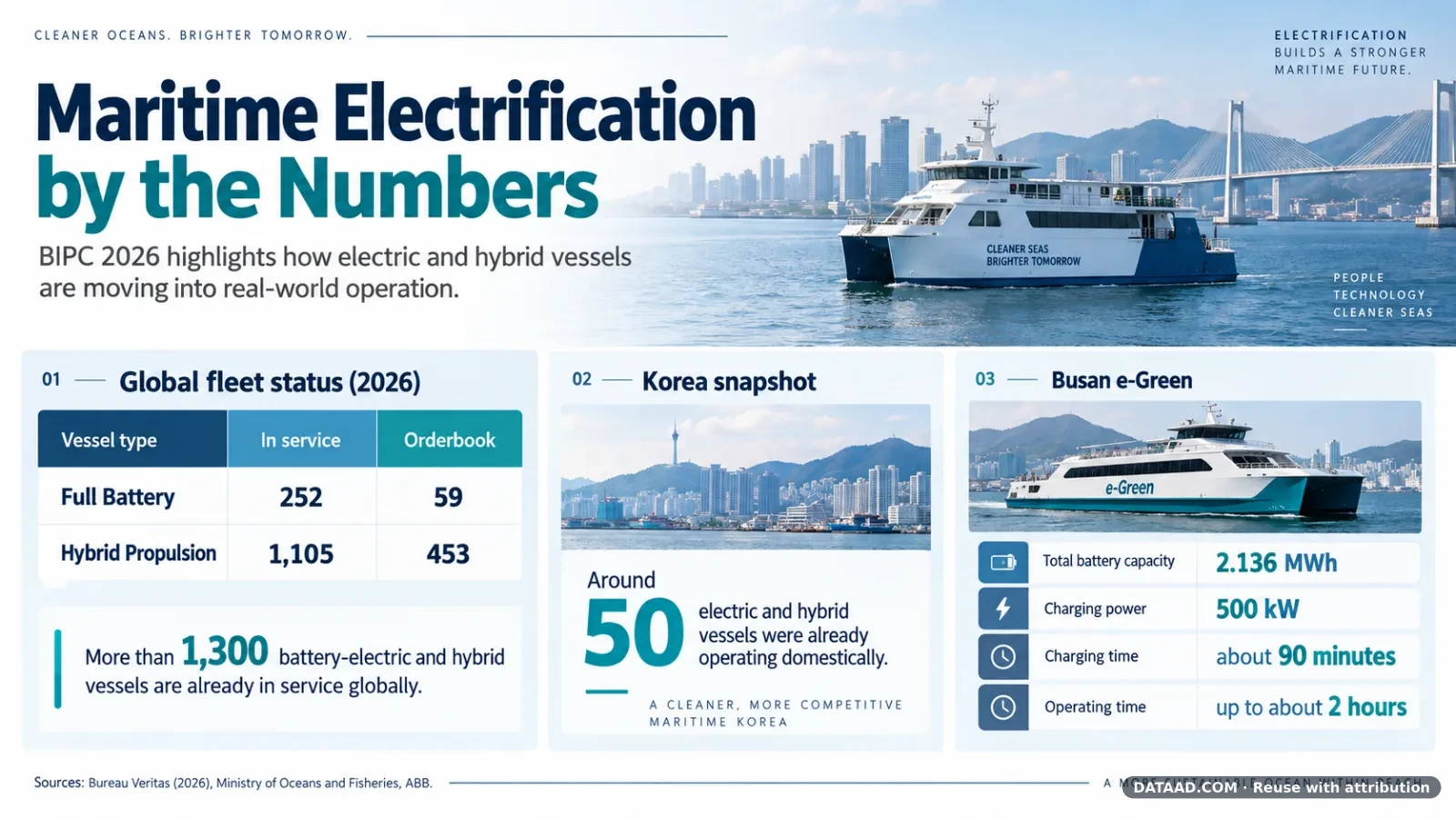
The vessel uses two 1,068 kWh battery packs, giving it approximately 2.136 MWh of total battery capacity. According to ABB, the vessel can be charged at 500 kW in about 90 minutes and can then operate for up to approximately two hours.
But the significance of e-Green goes beyond the batteries themselves.
The vessel incorporates an Onboard DC Grid together with a power and energy management system that controls and optimizes the flow of electrical energy throughout the vessel. Remote monitoring and diagnostics also allow operational data and system conditions to be continuously assessed.
Battery → DC Distribution → Power Electronics → Electric Motor → Energy Management → Shore Charging → Digital Monitoring
This architecture shows why an electric vessel should not simply be viewed as a conventional ship with a battery replacing a diesel engine. It is increasingly an integrated electrical and digital platform.
Korea Is Moving Beyond Demonstration Projects
South Korea’s electric-vessel market is still small compared with its conventional shipbuilding industry, but commercial and government-operated vessels are steadily expanding.
In 2025, Korea’s Ministry of Oceans and Fisheries reported that around 50 electric-propulsion vessels, including hybrid vessels, had already been built and were operating domestically.
The government has also strengthened its electric-vessel standards, including requirements related to battery-room fire safety, gas detection, redundancy of critical electrical equipment and the application of newer propulsion technologies.
Electric-Hybrid Propulsion Reaches Fishing Vessels
In 2026, Korea also introduced its first pilot electric-hybrid propulsion fishing vessel.
The 20.95-meter, 9.77-gross-ton vessel combines a 630 hp diesel engine, a 105 kW electric motor and a 160 kWh battery system.
Its operating concept is particularly practical. The diesel engine can be used while travelling between port and fishing grounds, while the electric motor can be used during fishing operations. This allows the propulsion system to be matched more closely to different operating conditions.
The project also demonstrates why hybridization is likely to remain important in maritime applications where full battery propulsion cannot yet provide sufficient range or operating flexibility.
Full Electric for Short Routes, Hybrid for Longer Missions
Electric propulsion is particularly attractive for ferries, harbor vessels, workboats and other ships operating on predictable short routes. These vessels can return regularly to charging infrastructure and can therefore operate with relatively manageable battery capacities.
For large ocean-going ships, however, battery weight, volume, range and charging requirements remain major engineering constraints.
This is one reason hybrid propulsion currently represents a much larger market than full battery propulsion.
| Propulsion Type | In Service | Orderbook |
|---|---|---|
| Full Battery | 252 | 59 |
| Hybrid Propulsion | 1,105 | 453 |
According to Bureau Veritas’ 2026 Maritime Electrification Report, more than 1,300 battery-electric and hybrid vessels are already in service globally, with hundreds more on order.
The Port Must Electrify With the Ship
The transition to electric shipping is not only a vessel technology issue. Ports must also provide the infrastructure needed to support it.
High-power charging, shore-side electrical distribution, grid capacity, safety systems and intelligent energy management all become increasingly important as vessel battery capacities grow.
BIPC 2026 reflected this broader shift through its dedicated session on “The Next Frontier in Port Decarbonization,” involving senior representatives from ports including Rotterdam, Los Angeles, Seattle, Barcelona and HAROPA.
The message is increasingly clear: maritime decarbonization cannot be addressed by the ship alone. The vessel, port and energy infrastructure must evolve together.
Marine Engineering Is Becoming More Electrical and Digital
For more than a century, marine engineering has been dominated by mechanical systems such as engines, fuel systems, gearboxes, pumps and shafts.
Those technologies will remain important, but electrification is adding a new layer of engineering around batteries, high-voltage distribution, power conversion, cooling, software, sensors and energy-management systems.
There are similarities with changes already seen in electric vehicles and AI data centers, where electrical power, thermal management and digital control increasingly have to be designed as one integrated system.
For ships, this transition also creates new opportunities for suppliers of battery systems, cooling equipment, pumps, valves, hoses, connectors, power electronics, sensors and digital monitoring technologies.
From Blueprint to Operation
The importance of BIPC 2026 was therefore not simply that another maritime conference discussed decarbonization.
In Busan, an electric vessel was already operating outside the conference hall.
The e-Green does not mean that large container ships will immediately abandon conventional engines and operate entirely on batteries. The energy requirements of long-distance ocean shipping remain very different from those of short-range harbor vessels.
But it demonstrates where full electrification can already work today, while the growing hybrid fleet shows how battery technology can progressively enter larger and more demanding vessel classes.
The next phase of maritime electrification will therefore not be decided by batteries alone.
It will depend on the ability to integrate batteries, electric propulsion, power electronics, shore charging, thermal management, safety systems and intelligent energy control into one reliable marine platform.
In Busan, that transition is no longer only visible in engineering drawings. It is already sailing.