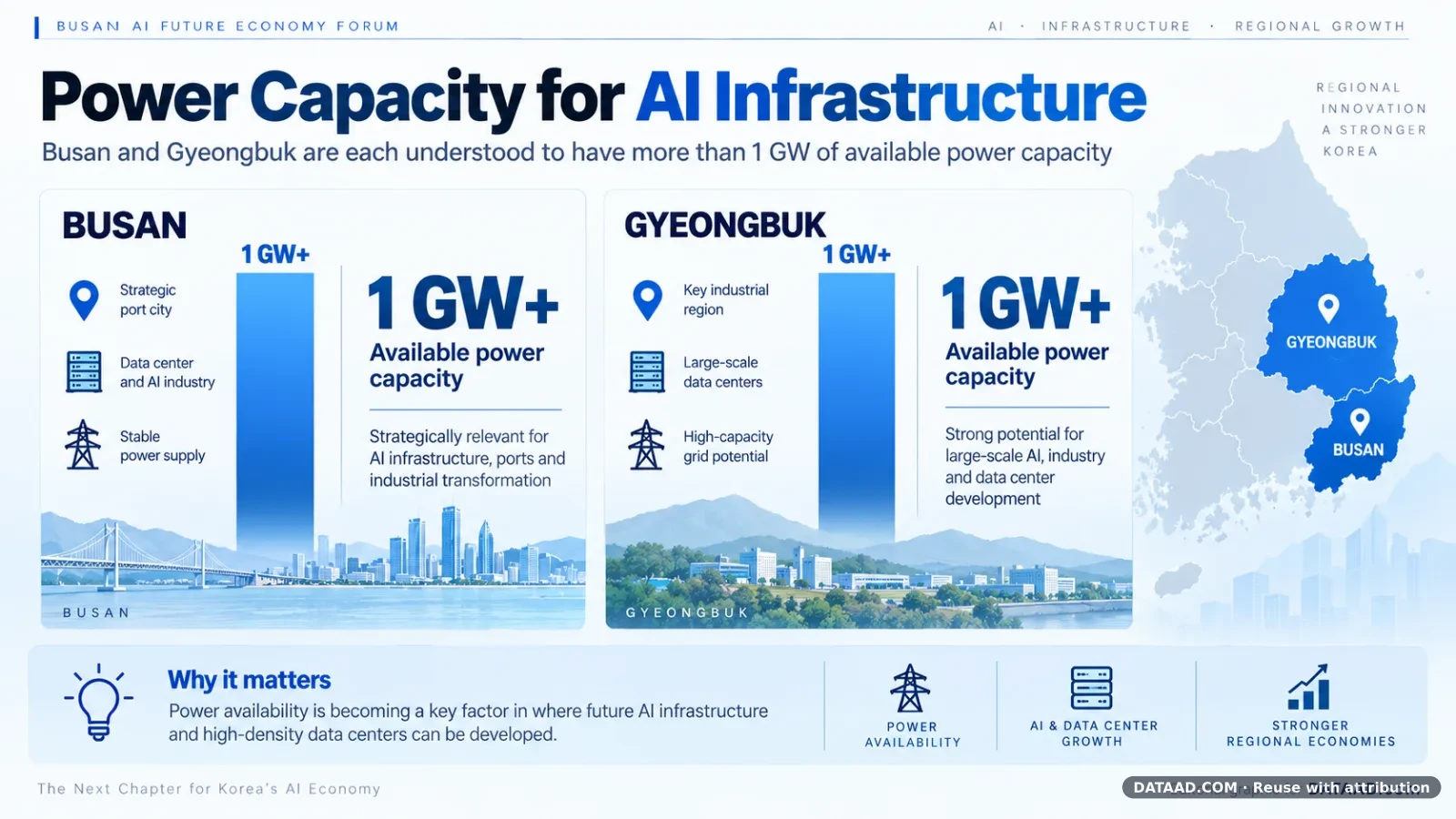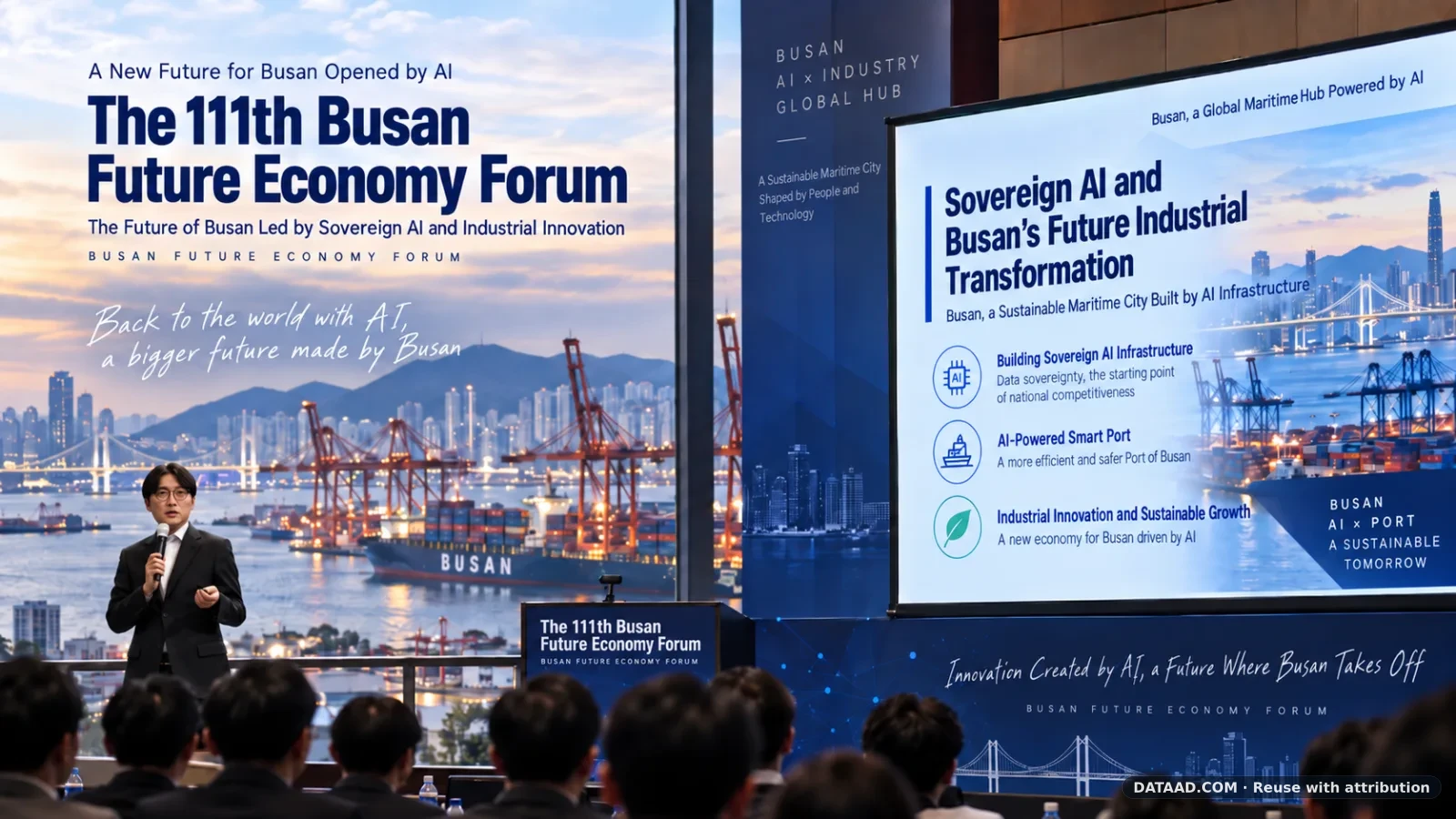
BUSAN, South Korea — Artificial intelligence is increasingly becoming a physical infrastructure challenge as much as a software one.
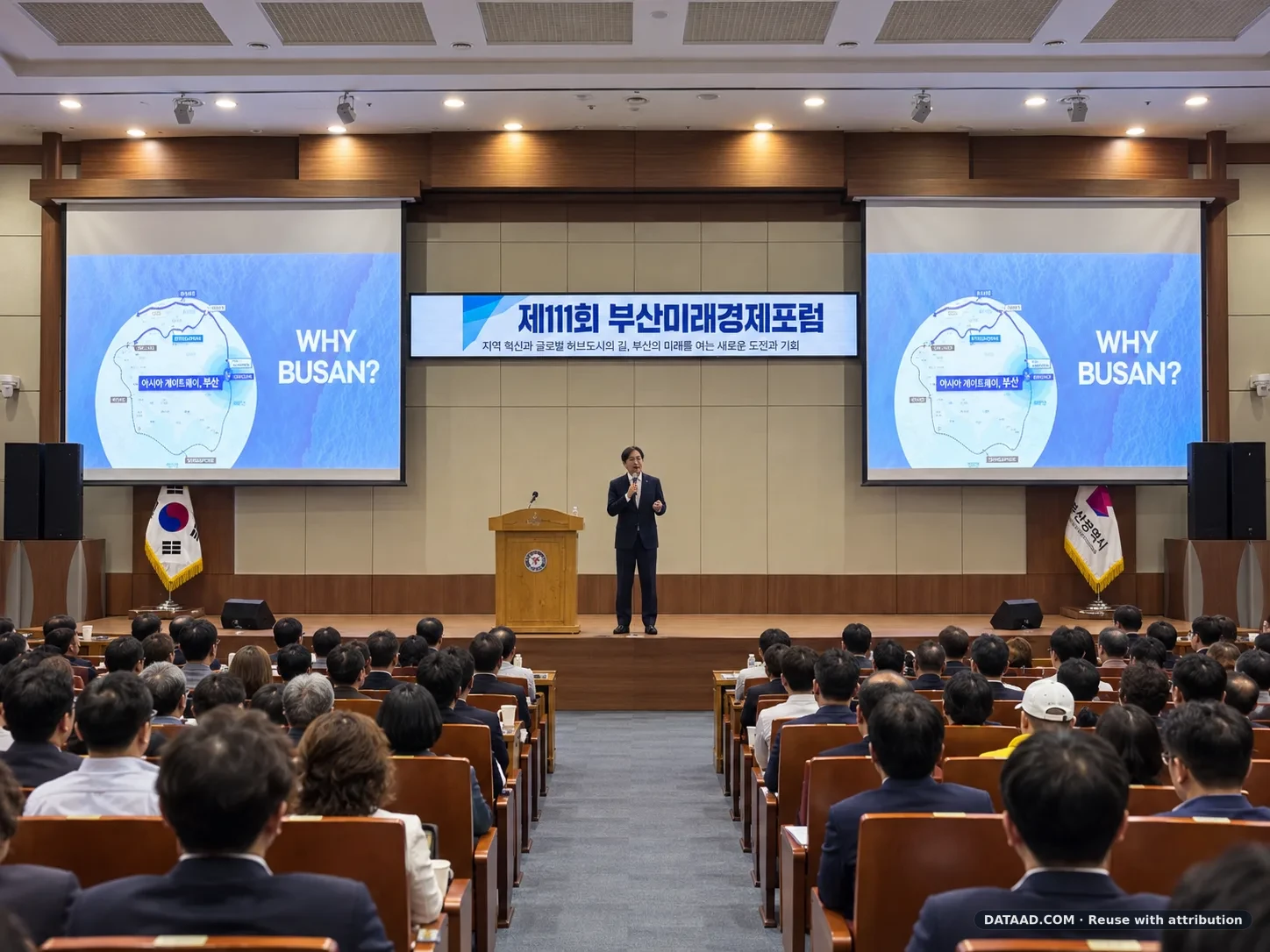
That message was visible at the 111th Busan Future Economy Forum, held at Busan City Hall on September 22, where Ha Jung-woo, Vice Chair of Korea’s National AI Strategy Committee, delivered a presentation on “Busan’s AI Transformation.”
The forum brought together around 300 participants from government, public institutions, universities and industry to discuss how Busan can connect Korea’s national AI strategy with the city’s existing industrial base.
From AI Models to Sovereign AI Infrastructure
One of the most important themes presented at the forum was the growing importance of sovereign AI.
AI competitiveness is no longer determined only by who develops the best model. Increasingly, it depends on whether a country can secure the full infrastructure stack required to train, operate and deploy artificial intelligence at scale.
That stack includes advanced semiconductors, GPUs and NPUs, data, cloud infrastructure, high-speed networks, electricity and increasingly large-scale AI data centers.
In other words, the AI race is moving from software alone into physical infrastructure.
AI competitiveness increasingly depends on the ability to connect computing power, data centers, energy, data and industrial applications into one functioning ecosystem.
This direction is also visible in Korea’s broader national policy. Expansion of AI computing infrastructure, advanced GPU capacity, AI semiconductors and national-scale AI infrastructure are increasingly seen as essential pillars of competitiveness.
Why Busan?
A presentation slide at the forum posed a simple question: “Why Busan?”
The answer may lie less in trying to reproduce Seoul’s technology ecosystem and more in using the industries Busan already has.
Busan sits at the center of one of Northeast Asia’s most important maritime and industrial regions. Together with neighboring Ulsan and South Gyeongsang Province, the region contains globally significant capabilities in shipbuilding, marine engineering, ports, logistics, automotive manufacturing and heavy industry.
These industries are now becoming major candidates for AI transformation.

Ports can use AI for container-flow optimization and autonomous logistics. Shipyards can apply computer vision, robotics and predictive maintenance. Shipping companies can improve voyage optimization and fleet operations. Manufacturing facilities can connect operational data with industrial AI models.
This creates a different kind of AI opportunity from the consumer internet economy.
Busan’s opportunity may be Industrial AI.
AI Data Centers Become Part of the Equation
Industrial AI also raises an infrastructure question.
AI models require computing resources, and those resources ultimately require data centers, electricity, networking and cooling. As GPU density rises, the physical design of AI data centers is changing rapidly.
High-density racks are placing growing pressure on traditional air-cooling architectures and accelerating interest in direct liquid cooling, coolant distribution units, manifolds, hoses and high-flow quick disconnect systems.
This means that a regional AI strategy cannot be separated indefinitely from questions about where computing capacity will be located and how it will be powered and cooled.
Busan’s Existing Industries Could Be an Advantage
Busan also has something that many newly emerging AI hubs do not: decades of experience with large industrial infrastructure.
The wider southeast industrial corridor understands power systems, piping, fluid control, heat management, precision manufacturing, shipbuilding and large-scale engineering projects.
Those capabilities may become increasingly relevant as AI infrastructure moves beyond conventional server rooms toward facilities requiring sophisticated thermal and energy management.
The same engineering ecosystem that has historically supported ships, offshore facilities, factories and power-intensive industry could potentially participate in the emerging AI infrastructure supply chain.
This is where the connection between AI, energy, data centers and industrial manufacturing becomes particularly important.
From Port City to Physical AI Hub?
Busan’s strongest AI proposition may therefore not be to become another general-purpose software cluster.
It could instead develop as a location where AI meets the physical economy.
Shipping, autonomous vessels, smart ports, robotics, factories and logistics systems all generate enormous amounts of real-world data. As physical AI develops, those data sources could become increasingly valuable for training, simulation and autonomous operation.
The strategic chain could eventually look something like this:
Industrial Data → AI Computing → AI Data Centers → Industrial Models → Robotics & Autonomous Systems
For Busan, that creates the possibility of connecting its maritime heritage with the next generation of computing infrastructure.
The Bigger Question
The 111th Busan Future Economy Forum was not primarily a data-center conference. Its subject was broader: how Busan should respond to Korea’s accelerating AI transformation.
But the discussion also highlighted something increasingly difficult to ignore.
AI policy, industrial policy, energy policy and data-center strategy are beginning to converge.
Countries and cities that want to participate meaningfully in the AI economy will need more than algorithms. They will need computing capacity, electricity, cooling infrastructure, industrial data, engineering capability and real-world applications.
Busan already possesses several pieces of that puzzle.
The next question is whether those pieces can be connected into a coherent AI infrastructure ecosystem.
Reporting and field photography: DATAAD.com, Busan, South Korea.