Artificial intelligence is beginning to break that assumption.
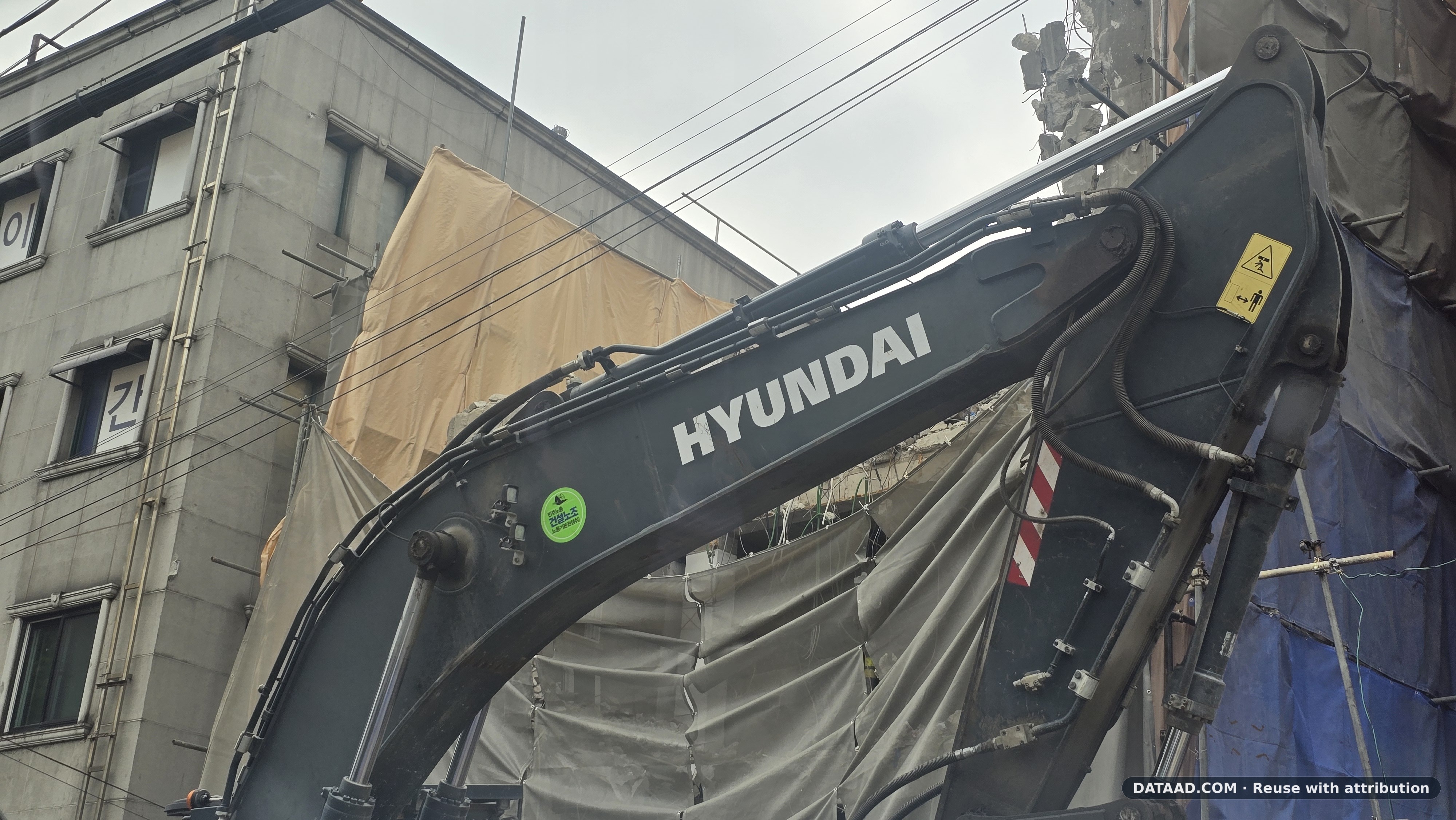
Autonomous construction equipment is moving beyond experimental demonstrations. HD Hyundai has developed its Real-X autonomous excavator technology, capable of sensing its surroundings, planning work and carrying out excavation, loading and movement with limited human intervention. In 2026, HD Hyundai Site Solution and autonomous-equipment specialist Gravis Robotics deployed an unmanned excavator at a real construction site in Switzerland.
Caterpillar is moving in the same direction, developing autonomous excavators and loaders capable of trenching, grading, loading and material handling.
This represents something larger than another improvement in construction machinery.
It is the arrival of Physical AI at the construction site.
The First Impact May Not Be Mass Unemployment
The immediate effect of autonomous excavators may be different from what many people expect.
South Korea already has a serious construction labor problem. The country's skilled construction workforce fell to approximately 1.34 million workers in 2025, down about 8% from the previous year. The average age of skilled construction workers has risen to roughly 51.7 years, while workers aged 60 or older account for around 28% of the workforce.
Young people are increasingly reluctant to enter physically demanding and hazardous construction occupations.
In this environment, autonomous machines may initially replace missing workers rather than existing workers.
This distinction is important.
A construction company struggling to find three excavator operators may not immediately dismiss three employees after purchasing autonomous machines. Instead, it may operate three machines with one experienced operator supervising them remotely, supported by technicians and site personnel.
The job does not disappear overnight. The nature of the job changes.
From Excavator Driver to Fleet Supervisor
Today's excavator operator controls hydraulic functions directly from inside the cab.
The operator of the future could sit inside a remote operation center supervising several machines through cameras, sensors, digital maps and AI systems.
Some occupations could therefore evolve:
- Excavator Operator → Remote Equipment Operator
- Machine Operator → Autonomous Fleet Supervisor
- Field Mechanic → Robotics and Sensor Technician
- Site Foreman → AI Construction Operations Manager
- Safety Supervisor → Human-Machine Safety Controller
The physical workplace could change as well. Workers would no longer necessarily sit inside machines exposed to dust, vibration, heat, noise, falling objects or unstable ground.
Construction machinery could increasingly be controlled from offices located kilometers — or eventually hundreds of kilometers — away.
Then What Happens to Labor Unions?
This is where autonomous construction becomes not only a technology issue but also a labor-structure issue.
If unions continue to organize workers according to traditional occupations such as excavator operators, truck drivers and equipment operators, automation could gradually reduce their membership base.
But unions do not necessarily disappear.
They may have to redefine what they represent.
The future construction union could increasingly represent remote operators, automation technicians, equipment maintenance specialists, software-supported supervisors and other workers managing autonomous fleets.
The union's negotiating agenda would also change.
Traditional negotiations have concentrated heavily on wages, working hours and employment conditions. AI-era negotiations could increasingly include:
- mandatory consultation before autonomous equipment deployment;
- retraining programs for existing equipment operators;
- minimum human supervision requirements;
- rules governing AI-based worker monitoring;
- ownership and use of worker-generated operational data;
- safety responsibility when an autonomous machine causes an accident;
- wage premiums for workers supervising multiple machines;
- sharing productivity gains created by automation.
The International Labour Organization has increasingly emphasized this type of "just transition," arguing that collective bargaining can play an important role in retraining workers and managing technological change rather than attempting simply to stop it.
The Productivity Question Could Become the Biggest Labor Issue
Consider a hypothetical construction site where ten machines currently require ten operators.
If autonomous technology eventually allows several machines to operate under the supervision of a smaller number of people, productivity per worker could rise dramatically.
The critical economic question then becomes:
Who receives the productivity gain?
If almost all of the benefit goes to equipment owners and construction companies while employment falls, resistance to automation will likely increase.
But if some productivity gains are returned to workers through higher wages, shorter working hours, retraining or improved working conditions, unions could become participants in automation rather than opponents of it.
Automation Could Also Weaken Traditional Union Power
There is another possibility.
Autonomous machines could fundamentally reduce the bargaining power traditionally created by shortages of skilled operators.
Today, an experienced excavator operator possesses knowledge developed over years: how soil behaves, how a structure moves during demolition, how the machine responds near its stability limits and how conditions change during rain, freezing temperatures or unexpected ground movement.
That knowledge gives skilled workers economic value.
Physical AI companies are effectively attempting to convert portions of this experience into sensors, software, algorithms and machine data.
Once that knowledge becomes embedded in machines, part of the bargaining power may move away from individual operators toward the companies that own the algorithms, equipment fleets and operational data.
This could become one of the most important labor questions of the Physical AI era.
However, Construction Is Much Harder to Automate Than a Factory
A factory robot typically operates inside a highly controlled environment.
A construction site changes constantly.
People move unpredictably. Soil conditions vary. Trucks enter and leave. Underground utilities may not match drawings. Weather changes visibility and ground conditions. Buildings undergoing demolition can behave unexpectedly.
For this reason, the transition toward complete autonomy is likely to be gradual.
The more realistic progression is:
Human Operator → Remote Operation → AI-Assisted Operation → Supervised Autonomy → Full Autonomy.
Human judgment will therefore remain important for many years, particularly for complex or dangerous operations.
DATAAD Outlook: The Union May Survive, But the Job Title Will Change
DATAAD does not expect autonomous excavators to suddenly eliminate construction workers.
The first major driver of adoption will likely be the shortage and aging of skilled labor, together with demands for safer and more productive construction sites.
However, once autonomous equipment becomes reliable enough for large-scale deployment, the number of workers required to operate a given fleet of machines could decline substantially.
That will inevitably challenge traditional labor organizations.
The successful union of the Physical AI era may therefore look very different from today's union.
Instead of protecting only the job of the person sitting inside the excavator, it may need to protect the worker who supervises the AI, maintains the robot, manages its data and accepts responsibility when automation fails.
The fundamental conflict may no longer be "worker versus machine."
It could become a negotiation over how the economic value created by humans and machines is divided.
And that question will extend far beyond excavators.
Autonomous trucks, agricultural machinery, forklifts, cranes, mining equipment, ships and eventually humanoid robots will create the same debate across almost every physical industry.
The rise of Physical AI may therefore reduce some traditional jobs — but it could also force labor unions to reinvent themselves for an economy in which one human increasingly manages many machines.