

For most of the current AI data-center buildout, the cooling transition has been relatively straightforward.
Air cooling gave way to liquid. Direct-to-chip cold plates became the preferred architecture for increasingly dense GPU servers, while single-phase water or water-glycol loops provided a practical way to move heat from processors through cold plates, hoses, quick disconnects, rack manifolds and coolant distribution units into the facility water system.
But the next transition may be fundamentally different.
The question is no longer simply air versus liquid. It is increasingly becoming single-phase liquid versus two-phase liquid.
And NVIDIA's Vera Rubin generation may arrive almost exactly at the point where that question becomes unavoidable.
Single-Phase D2C Is Still the Main Architecture
There is an important distinction to make first: single-phase direct-to-chip cooling is not suddenly obsolete.
As of 2025, IDTechEx described single-phase D2C as the dominant thermal-management solution for high-end GPUs. The architecture is mature, comparatively straightforward to service, and increasingly familiar to server manufacturers, data-center operators and cooling-equipment suppliers.
The thermal chain is now becoming standard across high-density AI infrastructure:
GPU / CPU → Cold Plate → Hose → Quick Disconnect → Rack Manifold → CDU → Facility Water
This architecture is one of the main reasons liquid cooling has been able to move rapidly from specialist HPC installations into mainstream AI infrastructure.
Vera Rubin therefore does not mean that every AI rack must immediately abandon single-phase cooling. What it does mean is that the engineering margin available to conventional single-phase systems is getting tighter.
The 1,500W–2,000W Threshold Matters
This is where the thermal roadmap becomes particularly important.
According to IDTechEx, discussions with chip manufacturers, cold-plate suppliers and system integrators indicate a broad industry view that single-phase D2C begins to encounter significant challenges at around 1,500W TDP, while approximately 2,000W may represent a practical upper boundary for conventional implementations.
This should not be interpreted as a hard physical wall. A 2,001W processor does not suddenly become impossible to cool with single-phase liquid.
Higher flow rates, more aggressive microchannels, better thermal-interface materials, improved cold-plate geometry, reduced coolant temperature and higher operating pressure can all extend the performance envelope.
But every improvement introduces another trade-off.
Higher flow requires more pumping power. Smaller channels increase pressure drop. Larger hoses and connectors consume valuable rack space. Lower coolant temperatures may increase facility cooling energy. More aggressive cold-plate designs can also create manufacturing, reliability and serviceability challenges.
At some point, continuing to scale the same architecture becomes increasingly expensive and complex.
IDTechEx therefore expects two-phase direct-to-chip cooling to begin moving toward larger-scale adoption around 2026–2027 as processor TDP continues to rise.
Vera Rubin Lands Directly in the Transition Zone
NVIDIA's official Vera Rubin specifications demonstrate just how dense the next generation of AI computing is becoming.
A Vera Rubin NVL72 system integrates 72 Rubin GPUs and 36 Vera CPUs. Each Rubin GPU provides 288GB of HBM4 memory with bandwidth reaching 22TB/s, placing enormous compute and memory capability within a tightly integrated thermal footprint.
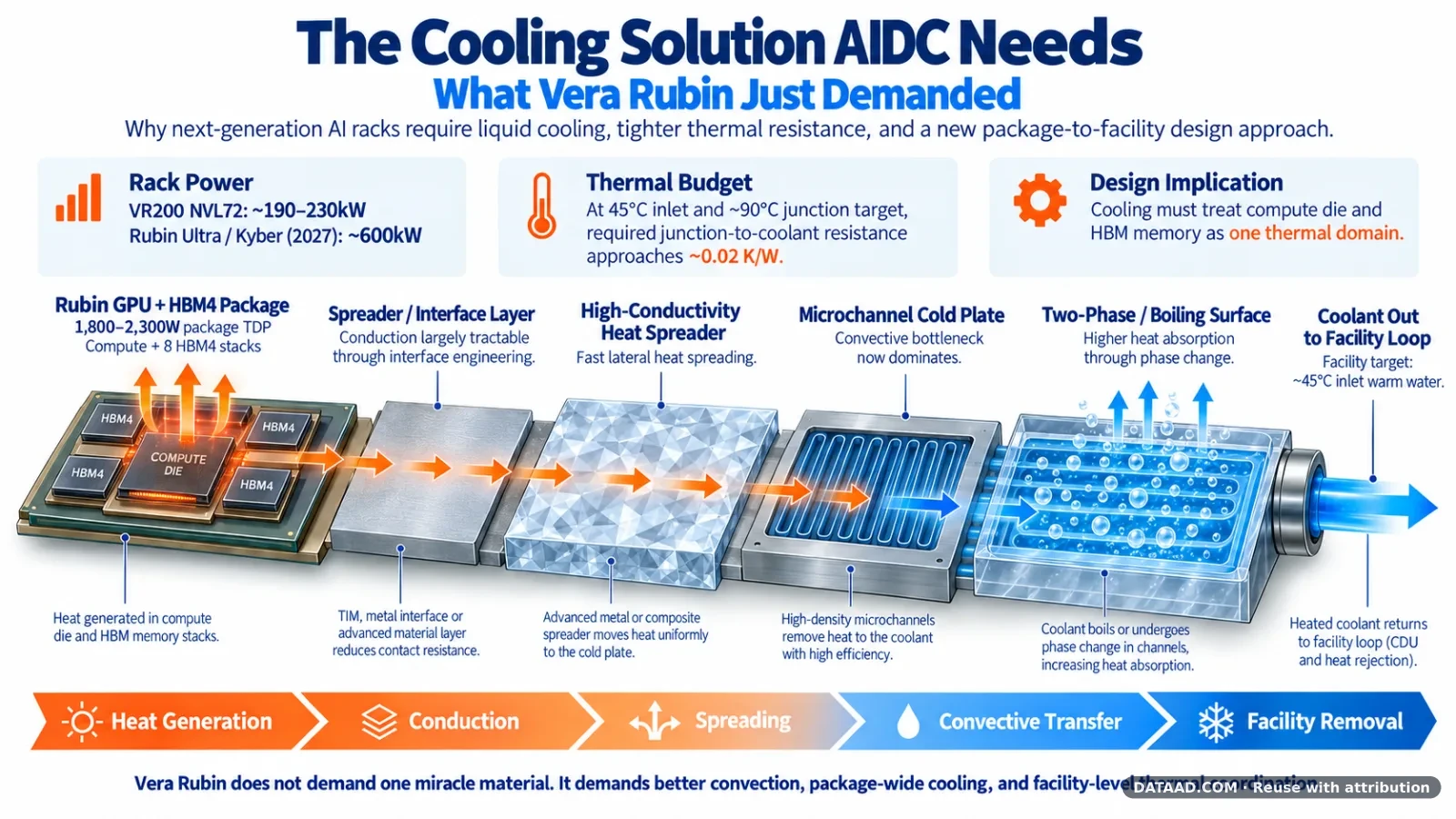
NVIDIA does not publish the GPU TDP in the same specification table. Independent industry analysis from SemiAnalysis estimates Rubin operating configurations of approximately 1,800W in Max-Q mode and up to 2,300W in Max-P mode, with rack-level power modeled at roughly 180–220kW depending on configuration.
Those numbers are industry estimates rather than NVIDIA's official published TDP specifications, but their significance is clear: Rubin falls directly into the range where the practical limits of conventional single-phase D2C are being debated.
Why Two-Phase Changes the Cooling Equation
Single-phase liquid cooling removes heat primarily by increasing the temperature of a continuously circulating liquid.
Two-phase cooling introduces another mechanism: phase change.
As coolant absorbs heat at the cold plate, part of the liquid changes into vapor. This allows substantial thermal energy to be absorbed through latent heat rather than relying only on the temperature rise of the circulating liquid.
At very high heat flux, that distinction becomes increasingly valuable.
Instead of continually increasing coolant flow through a cold plate as GPU power rises, a two-phase architecture can use evaporation directly near the heat source to absorb more energy with a comparatively lower fluid-flow requirement.
This is why the transition from single-phase to two-phase cooling is more than a change of coolant. It changes the thermal mechanism inside the cold plate itself.
The Real Bottleneck Is Moving Toward the Chip
The challenge is also broader than total watts.
Modern AI accelerators concentrate compute, memory and power delivery into an increasingly small physical area. As power density rises, cooling becomes a problem of heat flux and thermal resistance, not simply total rack power.
The heat path can be simplified as:
Silicon → Thermal Interface → Heat Spreader → Cold Plate → Coolant → Rack Loop → Facility Loop
Advanced thermal-interface materials and high-conductivity spreaders can reduce the resistance between silicon and the cold plate.
But once those layers are optimized, one of the critical remaining bottlenecks is the point where thermal energy must cross from a solid surface into moving coolant.
This is why microchannels, engineered boiling surfaces, direct-die cooling and two-phase cold plates are attracting increasing attention.

HBM Is Now Part of the Thermal Problem
Another important change is occurring around memory.
HBM can no longer be treated simply as a secondary thermal load surrounding the GPU.
Rubin combines extremely high compute capability with HBM4 delivering up to 22TB/s of bandwidth per GPU. Compute and memory therefore increasingly occupy the same thermal domain.
Future cold plates may need to manage heat across the entire package footprint rather than concentrating most cooling capacity directly above the compute die.
This could require more uniform channel coverage, improved flow distribution and increasingly package-specific cold-plate designs.
In that sense, the cold plate is gradually evolving from a relatively independent heat exchanger into part of the semiconductor package and server architecture itself.
Two-Phase Does Not Mean Zero Risk
There is another important engineering distinction.
Many two-phase systems use dielectric working fluids, which can reduce the immediate electrical-short-circuit consequences of a fluid leak compared with conductive water-based coolant.
But this should not be interpreted as meaning that two-phase cooling is inherently leak-free or operationally simpler.
Two-phase systems introduce their own requirements involving pressure management, seals, fluid compatibility, vapor containment, recovery procedures, environmental regulation and maintenance practices.
The working fluid itself can also have a substantial impact on system cost and environmental compliance.
As a result, evaluating two-phase cooling only at the cold-plate level can be misleading. The entire fluid loop needs to be engineered as one system.
2028 Could Be an Inflection Point — Not a Deadline
Publicly available industry research does not establish 2028 as a formal deadline for the transition to two-phase cooling.
IDTechEx instead points to 2026–2027 as the beginning of significant adoption.
However, 2028 can still be viewed as a plausible market inflection period rather than a fixed technical milestone.
By that stage, several developments could converge: single-phase D2C infrastructure will have been deployed at much greater scale, data-center operators will have accumulated more experience bringing liquid directly into AI racks, accelerator power may increasingly exceed the 1.5–2kW range, and two-phase systems may have developed sufficient operating history to reduce perceived deployment risk.
The likely result is not a complete replacement of one architecture by another.
Instead, the market may segment.
Single-phase D2C could remain the preferred solution for a broad range of AI systems, while two-phase D2C increasingly addresses the highest heat-flux accelerators and ultra-dense racks.
Air cooling will also remain relevant for lower-density equipment, storage, networking and other auxiliary systems.
Cooling transitions in data centers are rarely binary.
The Bigger Opportunity Is the Entire Cooling Chain
The implications extend well beyond the cold plate.
If two-phase D2C expands, almost every component in the liquid-cooling ecosystem must evolve with it:
Cold Plate → Coolant → Hose → Quick Disconnect → Manifold → CDU / Condenser → Controls → Facility Heat Rejection
Seal materials must remain compatible with new fluids. Quick disconnects need extremely low leakage while operating across different pressures and fluid conditions. Hoses and tubing must accommodate changes in fluid chemistry and operating temperature.
Manifolds may need to manage increasingly complex liquid-vapor behavior, while CDU architectures could evolve toward refrigerant distribution, condensation and more sophisticated fluid management.
In other words, the next generation of AI cooling will not be won by the cold plate alone.
It will be won by the complete thermal chain.
Beyond Two-Phase: A Longer Cooling Roadmap
Two-phase D2C is likely to be one of the most important near-term responses to increasing AI heat density, but it may not represent the end of the cooling roadmap.
Future research could increasingly focus on controlling heat closer to the point where it is generated.
Potential directions include higher-conductivity heat-spreading structures, engineered phonon transport, micro- and nano-scale boiling surfaces, acoustic or electric-field control of bubbles, transient thermal storage, predictive cooling control and more efficient waste-heat recovery.
At the computing-architecture level, optical interconnects, in-memory computing and, over a much longer horizon, cryogenic or superconducting computing could also reduce the amount of electrical energy ultimately converted into heat.
These technologies are at very different stages of maturity and should not be interpreted as one commercial roadmap. Some are already entering engineering development, while others remain research concepts.

Cooling Is Becoming Part of the Computer
The first liquid-cooling transition moved data centers from cooling the air around servers toward moving liquid directly to the processors.
The next transition could move phase change even closer to the silicon.
Single-phase D2C is building the infrastructure, operational knowledge and supply chain required to bring liquid reliably into AI racks.
Two-phase D2C may inherit much of that ecosystem while changing the physics occurring inside the cold plate.
Vera Rubin does not prove that single-phase cooling is finished.
It does something more important.
It pushes AI computing into the thermal range where the industry can no longer assume that today's cooling architecture will scale indefinitely.
And that may mark the real beginning of the two-phase era.
DATAAD Insight
The future of AI cooling may ultimately be defined by a simple change in perspective.
Instead of asking how to cool an increasingly hot server, engineers may need to ask how thermal energy can be captured at the moment it is generated and moved through the lowest-resistance path possible.
That shifts cooling from a facility utility to a core part of computing architecture.
In the AI infrastructure race, compute performance and thermal architecture are increasingly becoming the same engineering problem.
Editorial note: Vera Rubin GPU power values referenced in this article are based on independent industry analysis and should not be interpreted as official NVIDIA TDP specifications. Future-cooling illustrations are conceptual and intended to support technology discussion.