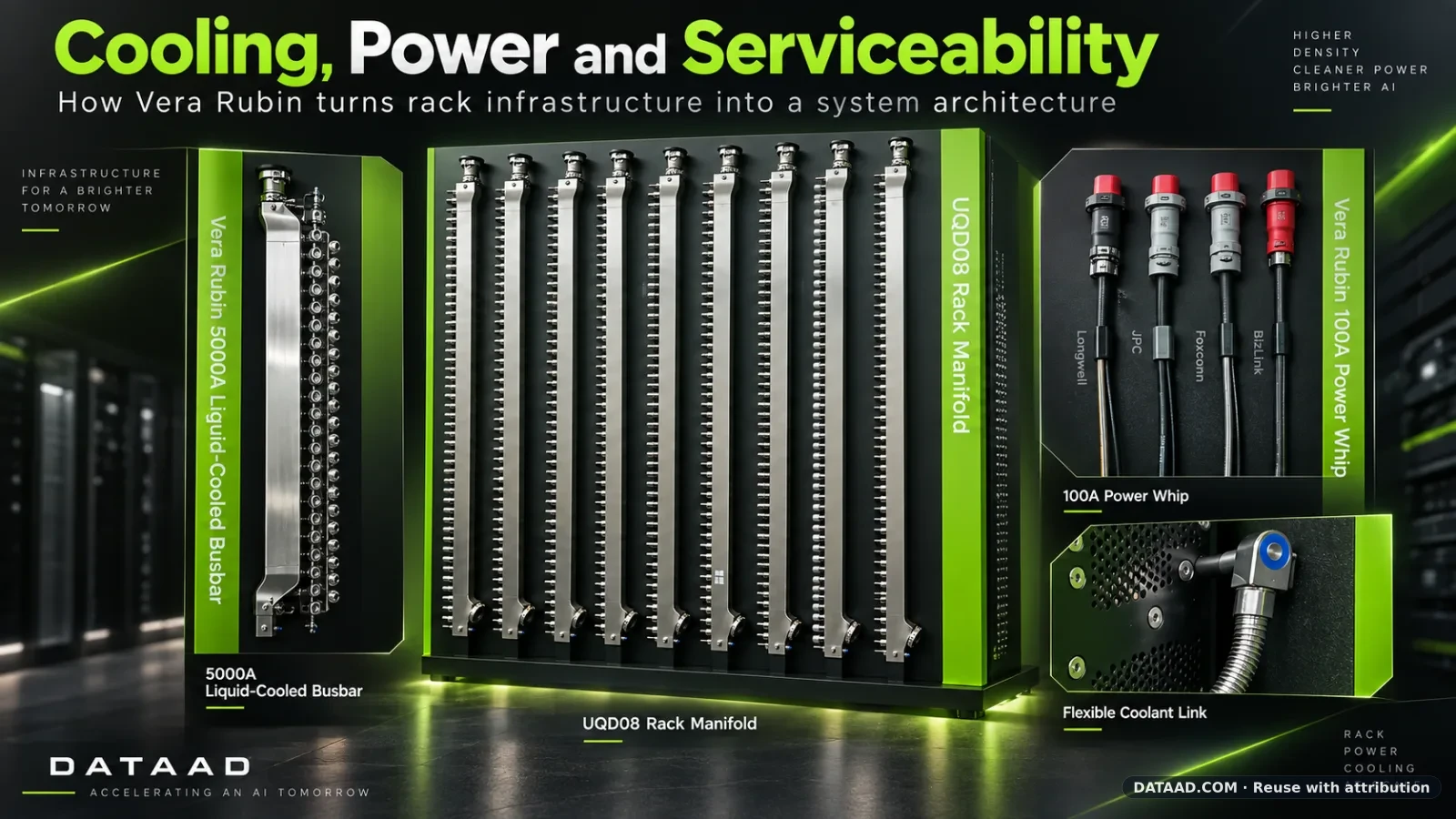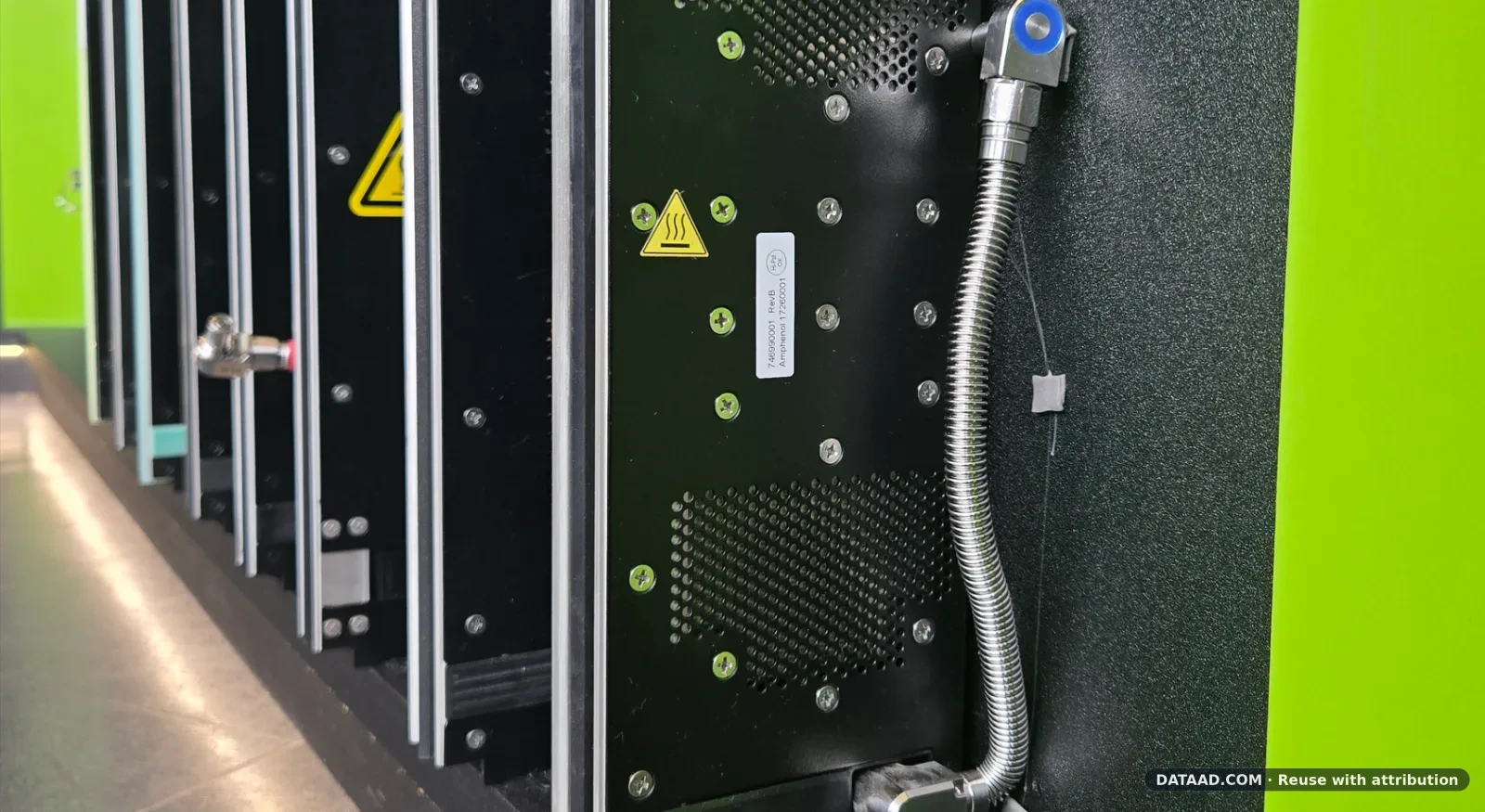
The next generation of AI infrastructure is becoming easier to understand when viewed from the back of the rack rather than from the front.
The GPUs may receive most of the attention, but the physical systems behind them increasingly determine how much computing power can actually be installed, cooled, serviced and operated inside an AI data center.
Field images of Vera Rubin rack infrastructure provide a close look at that transition. They show rack-level UQD08 liquid manifolds, tray-level coolant distribution, high-current power whips and a 5,000-amp liquid-cooled busbar — components that would once have been treated as supporting infrastructure but are now becoming fundamental elements of the rack architecture itself.
From a Server Rack to an Integrated Infrastructure Machine
NVIDIA Vera Rubin NVL72 integrates 72 Rubin GPUs and 36 Vera CPUs together with NVLink 6, ConnectX-9 networking and BlueField-4 DPUs. But the compute architecture is only part of the engineering challenge.
As power density rises, conventional approaches based on large numbers of cables, hoses and separately installed distribution hardware become increasingly difficult to scale.
NVIDIA describes the third-generation MGX rack used for Vera Rubin as introducing new internal tray manifolds, rack-level UQD08 manifolds and liquid-cooled busbars capable of supporting currents of up to 5,000 amps.
This is an important architectural change. Cooling and power distribution are no longer peripheral utilities connected to the server. They are increasingly engineered as part of the server platform itself.
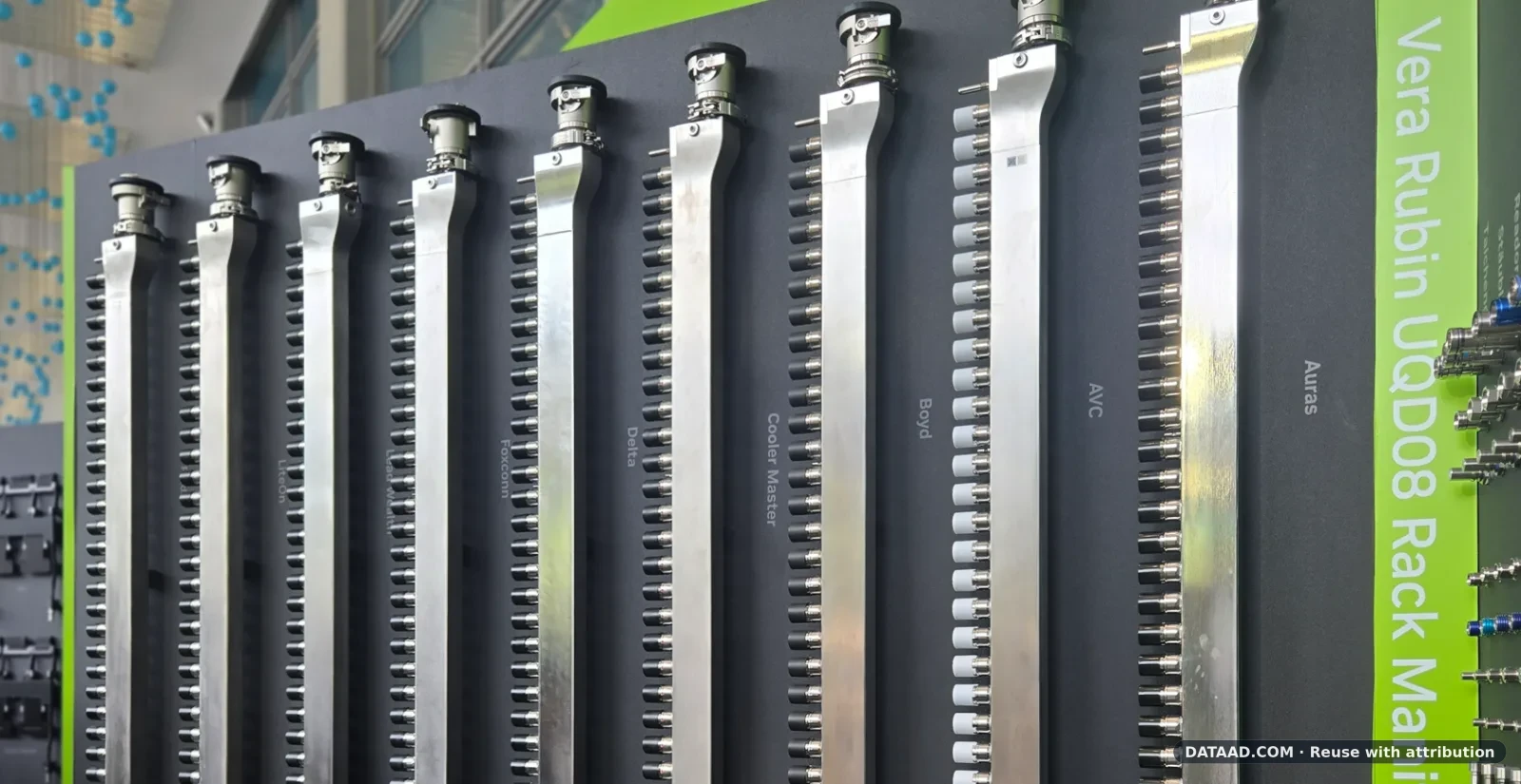
UQD08 Moves Liquid Distribution to Rack Scale
One of the most visible changes is the rack manifold.
The displayed Vera Rubin UQD08 rack manifolds are long vertical distribution assemblies with multiple branch connections serving compute trays throughout the rack. Instead of building coolant distribution through numerous individually routed hoses, the manifold creates a standardized vertical liquid backbone.
The implications extend beyond plumbing.
A standardized rack manifold can simplify installation, reduce routing variability and make tray replacement more predictable. It can also create a clearer interface between the rack and the facility-side cooling system.
For the liquid-cooling supply chain, this means that quick disconnects, seals, manifolds, hoses and coolant chemistry are becoming increasingly important reliability components. A failure in a relatively small fluid connector can potentially affect equipment carrying extremely high compute value.
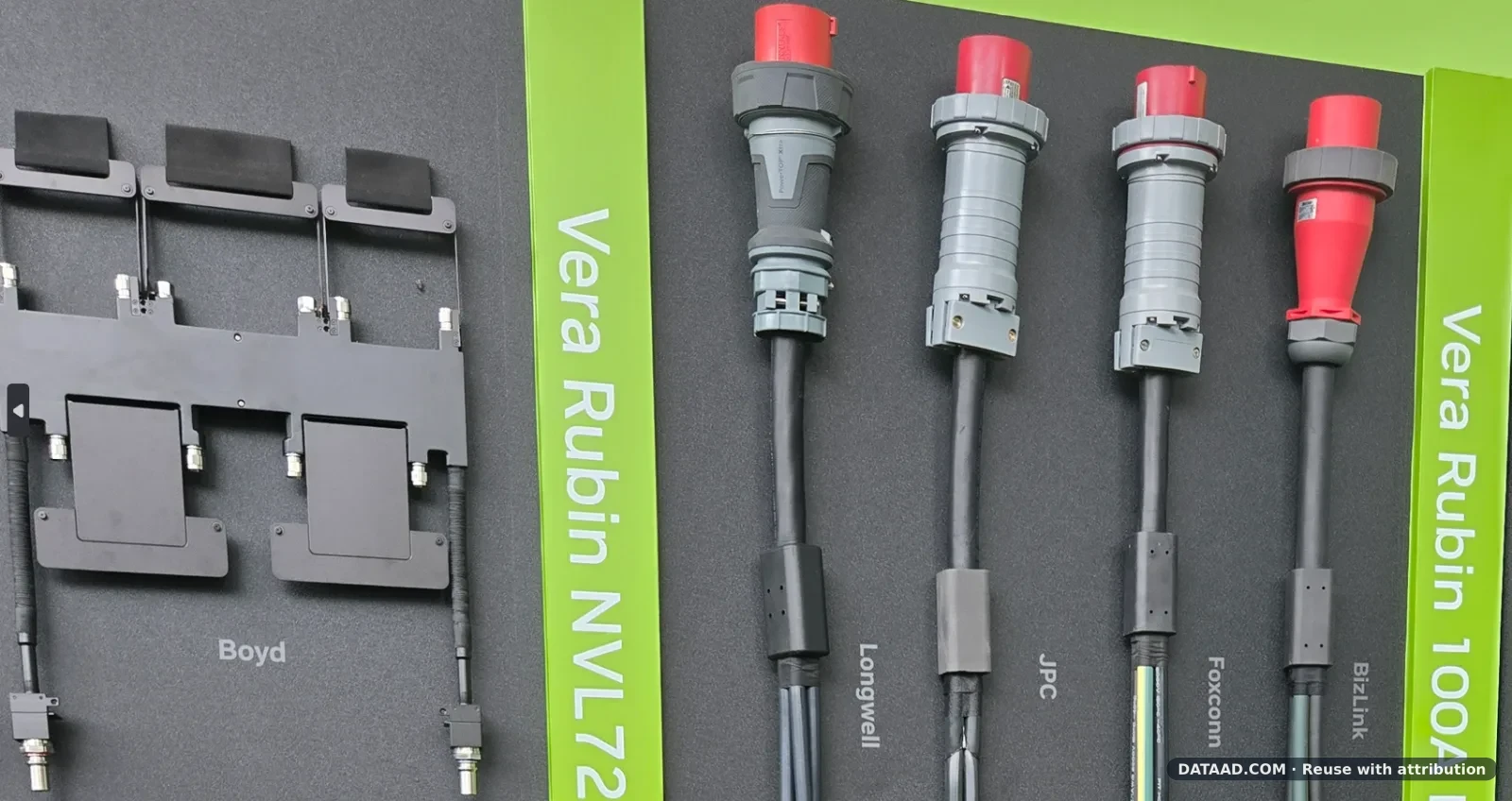
The Tray Is Changing Too
Vera Rubin also introduces changes inside the compute tray.
The displayed NVL72 tray inner manifold suggests a move toward increasingly structured internal fluid distribution. NVIDIA has said that its latest rack-scale codesign eliminates conventional hoses, cables and fans from the compute tray itself, while using integrated cooling and connection structures to simplify assembly and servicing.
The direction is clear: as rack density increases, mechanical complexity must decrease.
The industry therefore appears to be moving from individually assembled cooling loops toward highly repeatable modules that can be inserted, connected and replaced with less manual routing inside the rack.
5,000 Amps Changes the Power Architecture
Cooling is only half of the problem.
AI racks are also forcing a redesign of electrical distribution. The Vera Rubin reference display includes a 5,000A liquid-cooled busbar, illustrating the scale of electrical current that next-generation rack infrastructure must manage.
At these current levels, electrical resistance itself becomes a thermal-management issue. Conductors generate heat, and simply increasing the amount of copper is not always the most practical solution because weight, space and material usage all increase.
Liquid cooling the busbar therefore represents the convergence of the rack's two most important infrastructure systems: electricity and thermal management.
The coolant loop is no longer responsible only for removing heat from CPUs and GPUs. It can also help manage the thermal load generated by the infrastructure delivering electricity to those processors.
100A Power Whips and the Last Meter of Power
Another revealing component is the Vera Rubin 100A power whip.
The cables may appear less technologically dramatic than GPUs or optical networking, but they represent one of the practical challenges of high-density AI infrastructure: delivering enormous amounts of electrical power through equipment that still needs to be installed, replaced and maintained safely.
As rack-level power increases, connectors, cable assemblies and busbars must handle higher current while remaining compact and serviceable.
This creates opportunities not only for semiconductor and server companies but also for suppliers specializing in electrical connectors, thermal interfaces, flexible hoses, quick disconnects and precision mechanical components.
Higher Coolant Temperatures Could Change the Data Center
Vera Rubin also points toward another important change: higher-temperature liquid cooling.
NVIDIA has designed Vera Rubin around liquid cooling with inlet coolant temperatures reaching approximately 45°C. This makes it possible in suitable climates and facility designs to reject heat using dry coolers rather than relying continuously on traditional chiller-based cooling.
The impact therefore extends beyond the rack.
Higher coolant temperatures can influence CDU design, facility water loops, heat exchangers, pumps and potentially overall data-center water consumption. Cooling architecture may increasingly be optimized from the silicon package all the way to the building's exterior heat rejection system.
A New Supply Chain Is Forming Around the GPU
Perhaps the most important lesson from these components is that AI infrastructure competition will not be determined by GPUs alone.
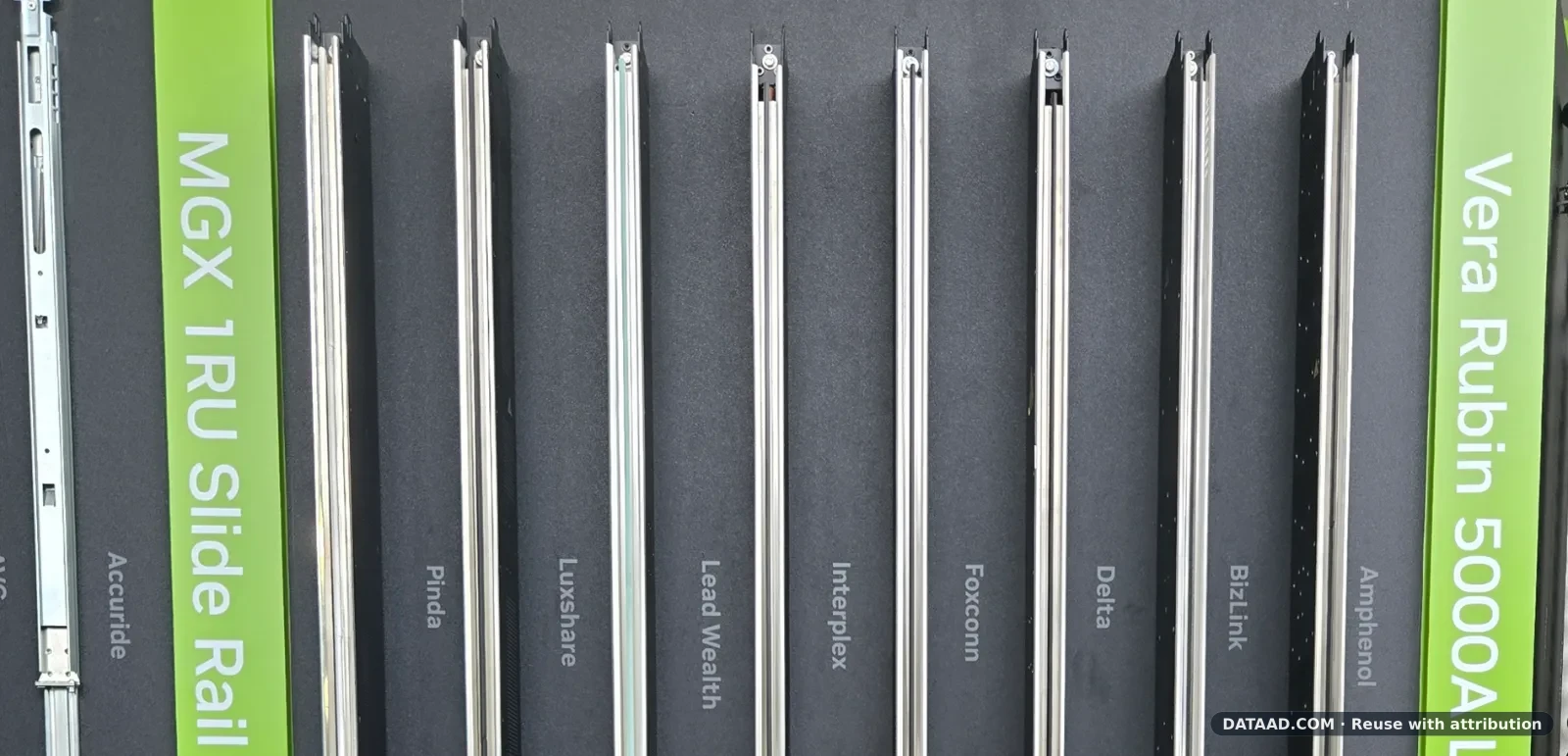
The surrounding ecosystem is becoming strategically important: cold plates, rack manifolds, UQD connectors, hoses, valves, pumps, CDUs, busbars, power connectors, slide rails and service interfaces all have to work as a coordinated system.
NVIDIA says more than 80 MGX ecosystem partners are participating in the Vera Rubin platform, while its rack architecture is designed around increasingly standardized and open interfaces.
That creates a potentially significant industrial opportunity. As AI factories expand globally, many components that once represented relatively small portions of a server bill of materials may become high-volume infrastructure products.
DATAAD View
The evolution from Blackwell to Vera Rubin should not be viewed only as another GPU-generation transition.
It represents a broader change in how computing infrastructure is engineered.
At extreme rack densities, compute, cooling, electrical power and mechanical serviceability can no longer be designed independently. The rack itself is becoming a highly integrated machine in which electrons and coolant must be distributed with almost the same architectural discipline as data.
For the data-center industry, this may be one of the most important consequences of the AI infrastructure boom.
The next battle will not simply be about who produces the fastest accelerator. It will also be about who can reliably deliver thousands of amps of electricity and remove hundreds of kilowatts of heat from a rack — repeatedly, safely and at industrial scale.
Sources:
NVIDIA Vera Rubin NVL72 platform information and NVIDIA technical materials on the third-generation MGX rack architecture, liquid cooling and rack-scale power distribution.
Field photographs supplied to DATAAD.