

The next phase of the AI infrastructure race is moving beyond the GPU server. As compute density rises, server manufacturers are increasingly being asked to deliver not only compute, but also networking, power distribution, liquid cooling and deployment architecture as part of a complete AI factory.
That shift will be visible in Singapore on 29–30 September 2026, when Tech Week Singapore brings together Data Centre World Asia, Big Data & AI World Asia, Cloud & AI Infrastructure Asia and other co-located technology events at Marina Bay Sands.
Among the companies worth watching are Supermicro and Giga Computing, a subsidiary of GIGABYTE. Both are moving aggressively toward rack-scale AI infrastructure, but their current strategies highlight different ways of reaching the same destination.
Supermicro Moves Vera Rubin Into the DLC-2 Era
Supermicro has announced that it is now shipping NVIDIA Vera Rubin NVL72 racks integrated with its Data Center Building Block Solutions, or DCBBS, and its second-generation direct liquid cooling architecture, known as DLC-2.
A Vera Rubin NVL72 rack integrates 72 NVIDIA Rubin GPUs and 36 NVIDIA Vera CPUs. Supermicro is positioning the system not simply as a liquid-cooled server rack, but as part of a much larger infrastructure architecture connecting cold plates, manifolds, cooling distribution units and facility-side cooling.
This distinction is important. Traditional direct-to-chip cooling has concentrated primarily on the largest heat sources such as CPUs and GPUs. The direction of advanced DLC architectures is increasingly toward capturing a greater percentage of total server heat, including heat generated around memory, voltage regulation, switching and power-delivery components.
TECH WEEK SINGAPORE 2026 · 29–30 SEPTEMBER 2026 · MARINA BAY SANDS, SINGAPORE
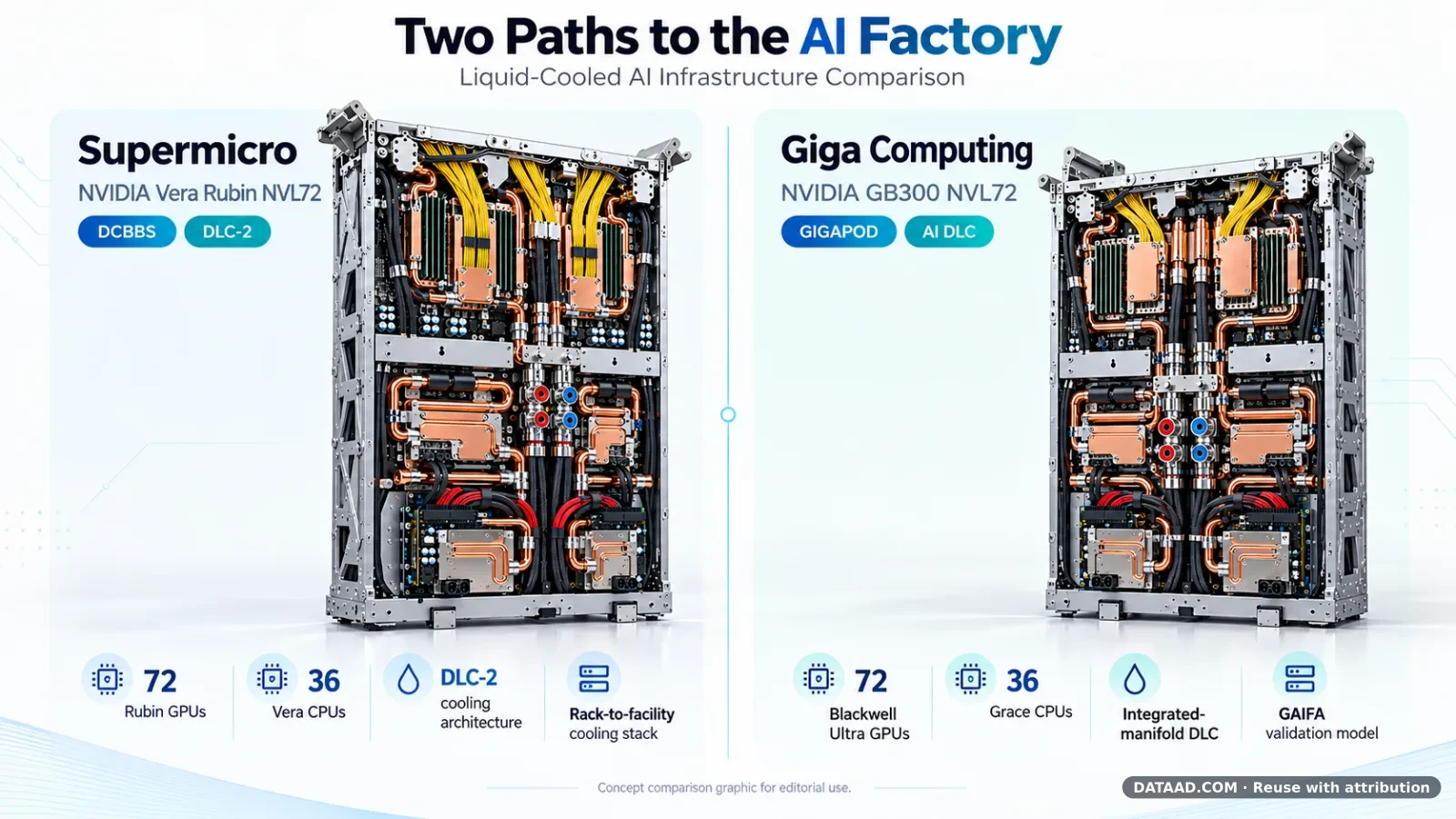
Supermicro's broader message is therefore about the connection between the chip and the data centre. Its architecture extends from the compute tray through the rack and CDU infrastructure toward the cooling plant itself. The company has also described scalable configurations extending from multi-megawatt deployments toward much larger AI infrastructure environments.
Giga Computing Takes a Modular AI Factory Approach
Giga Computing is approaching the same problem from a somewhat different direction. Its GIGAPOD platform is designed around modular AI and HPC infrastructure, including rack-scale direct liquid cooling.
One of its current flagship configurations is the NVIDIA GB300 NVL72 GIGAPOD AI DLC rack-scale solution, combining 72 NVIDIA Blackwell Ultra GPUs with 36 Grace CPUs. The company is also offering liquid-cooled B300-class systems with integrated manifold designs and leak-detection capability.
But Giga Computing's strategy extends beyond the hardware rack itself. The company has established GAIFA — GIGABYTE AI Factory Accelerator in New Taipei City, Taiwan, as its first AI data centre.
The initial GAIFA deployment has approximately 700 kW of power capacity and combines compute, storage, networking and direct liquid cooling infrastructure. Its purpose is particularly significant: customers can validate rack-scale AI infrastructure and software before moving into larger production deployments.
Two Different Routes Toward the Same Destination
The comparison between the two companies should not be reduced to Vera Rubin versus Blackwell Ultra. The more important change is happening one level above the processor.
Supermicro is increasingly presenting the AI data centre as a collection of tightly integrated building blocks: compute racks, cooling, power, networking and facility infrastructure. Giga Computing, meanwhile, is emphasizing modular GIGAPOD deployment combined with an AI factory environment where complete configurations can be validated before deployment.
| Area | Supermicro | Giga Computing |
|---|---|---|
| Current AI Platform | NVIDIA Vera Rubin NVL72 | NVIDIA GB300 NVL72 |
| Infrastructure Strategy | DCBBS | GIGAPOD |
| Cooling Direction | DLC-2 integrated from rack toward facility cooling | Rack-scale DLC with integrated manifold architecture |
| Deployment Model | Integrated data-centre building blocks | Modular AI factory deployment and validation |
| Validation Approach | Rack, cluster and facility integration | GAIFA AI Factory Accelerator |
The Real Competition Is Moving Beyond the Server
For years, competition among AI server manufacturers largely focused on how quickly the newest GPU platforms could be integrated into production systems. That remains important, but the competitive boundary is expanding.
A modern AI factory requires servers, accelerators, high-speed networking, storage, power delivery, coolant distribution, monitoring and facility heat rejection to operate as one system. As rack densities continue to rise, liquid cooling increasingly becomes the physical architecture connecting these layers.
This means that the future winners in AI infrastructure may not be determined solely by who can manufacture the fastest server. The larger question is who can repeatedly deploy complete AI factories at scale while reducing commissioning time, thermal risk and infrastructure complexity.
What to Watch in Singapore
Tech Week Singapore provides a useful stage for observing this transition. Supermicro will appear within Big Data & AI World Asia, while GIGABYTE/Giga Computing will participate within Cloud & AI Infrastructure Asia. Both events operate alongside Data Centre World Asia as part of the wider Tech Week Singapore programme.
For data-centre operators, the most important question may therefore be less about comparing individual servers and more about understanding how quickly the server industry is transforming itself into an AI infrastructure industry.
The rack is becoming a system. The cooling loop is becoming part of the computing architecture. And the server manufacturer is increasingly becoming an AI factory infrastructure provider.
