
AI Infrastructure Is Moving Beyond GPU Performance
The next generation of artificial intelligence infrastructure is being shaped by more than GPU processing power. Memory bandwidth, system memory capacity, storage performance, and thermal management are becoming equally important factors in determining the efficiency of AI servers.
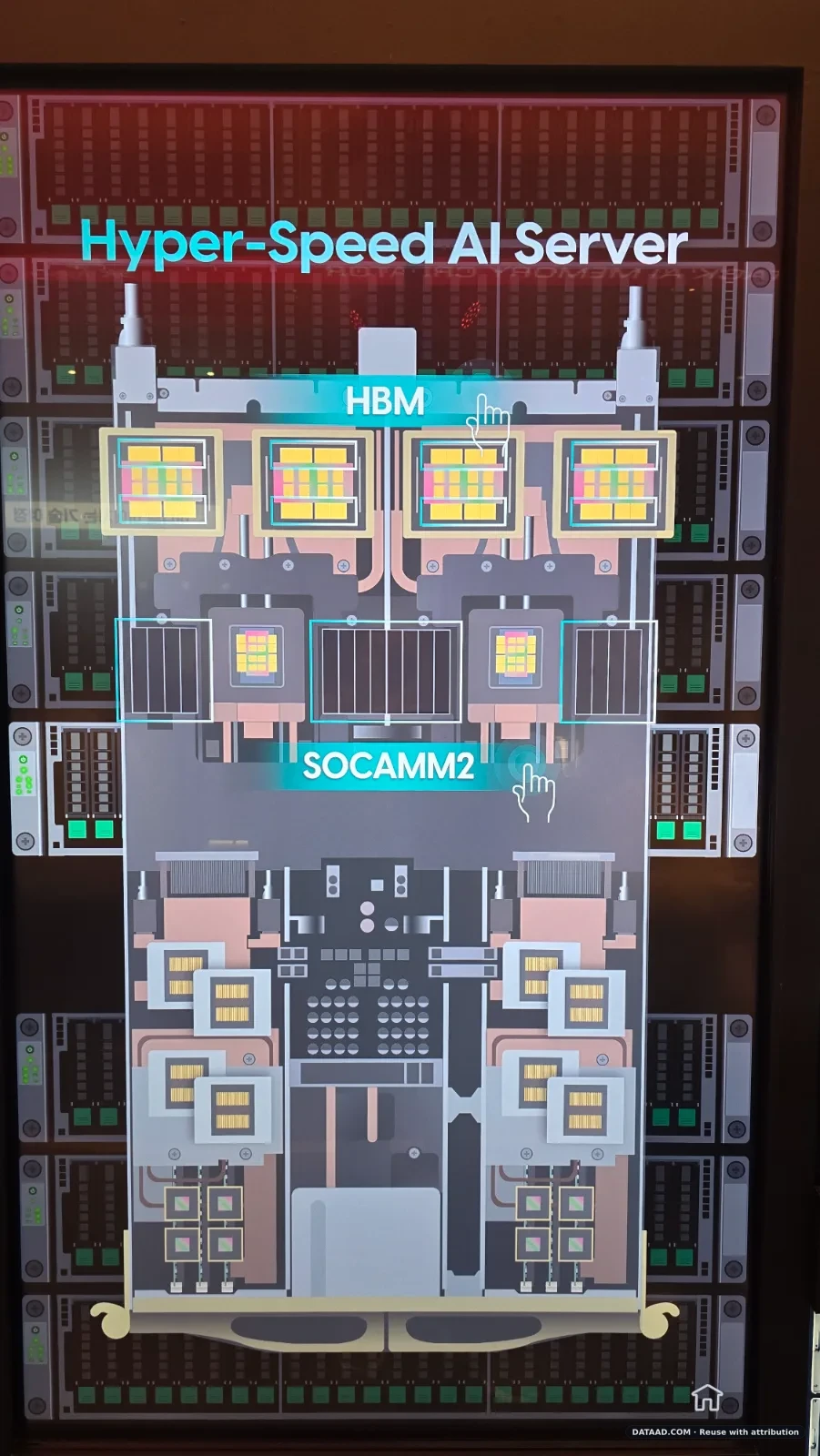
At its semiconductor exhibition, SK hynix presented a vision of a "Hyper-Speed AI Server" integrating High Bandwidth Memory (HBM) and SOCAMM2 memory technologies, alongside enterprise solid-state drives designed for high-performance AI infrastructure.
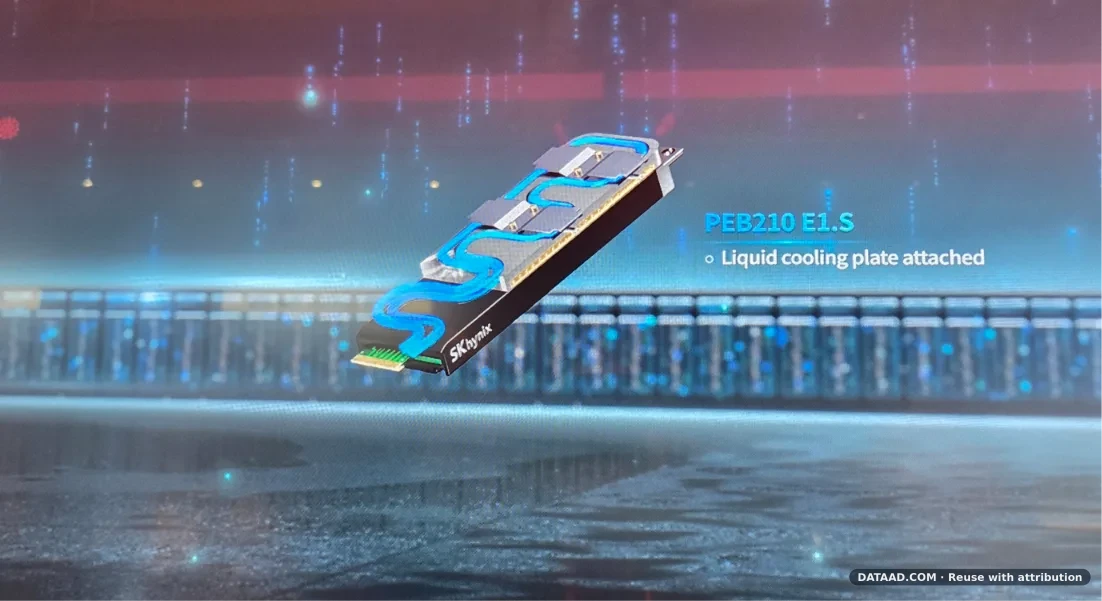
Among the most interesting developments was the PEB210 E1.S enterprise SSD with Direct Liquid Cooling (DLC) support, demonstrating how liquid cooling is expanding beyond CPUs and GPUs into high-performance storage devices.
Together, these technologies illustrate a broader transition toward AI systems in which computing, memory, storage, and cooling must be designed as interconnected elements.
HBM and SOCAMM2: Two Memory Technologies, Different Roles
SK hynix's Hyper-Speed AI Server exhibition model highlights two important memory technologies: HBM and SOCAMM2.
Although both are DRAM-based, they serve different purposes within an AI computing system.
HBM: Delivering Bandwidth for AI Accelerators
High Bandwidth Memory uses vertically stacked DRAM dies connected through advanced packaging and through-silicon via (TSV) technologies.
Its principal advantage is the ability to provide extremely high memory bandwidth within a compact semiconductor package.
Modern AI accelerators rely on HBM to supply data to processing units executing complex machine-learning operations.
As AI models increase in size and computational complexity, HBM bandwidth and capacity have become critical factors influencing accelerator performance.
SK hynix has developed successive generations of HBM, including HBM3E, HBM4, and its roadmap toward HBM4E, addressing the rapidly expanding requirements of advanced AI computing platforms.
SOCAMM2: Expanding Efficient System Memory
SOCAMM2, or Small Outline Compression Attached Memory Module, is a compact memory module form factor optimized for AI server applications.
Unlike HBM, which is closely integrated with accelerator packages, SOCAMM2 is designed to provide system-level memory capacity using low-power DRAM technology.
SK hynix announced mass production of its 192GB SOCAMM2 module based on 1cnm LPDDR5X technology in April 2026.
The company has highlighted improved bandwidth and power efficiency compared with conventional server memory configurations, making SOCAMM2 particularly relevant to AI systems requiring substantial memory capacity within constrained power and space budgets.
In the exhibition model, HBM and SOCAMM2 are presented as complementary technologies rather than direct competitors.
| Feature | HBM | SOCAMM2 |
|---|---|---|
| Memory type | Stacked DRAM | LPDDR5X-based DRAM |
| Primary role | AI accelerator memory | System-level memory |
| Key advantage | Extremely high bandwidth | Capacity and power efficiency |
| Integration | Advanced accelerator packaging | Compact memory module |
| AI applications | Training and inference computation | System memory for AI workloads |
The combination of these technologies reflects a growing need to balance maximum computing performance with practical system-level memory capacity and energy efficiency.
SK hynix PEB210 E1.S: Bringing Liquid Cooling to Enterprise SSDs
One of the most significant technologies demonstrated at the exhibition was SK hynix's PEB210 E1.S enterprise solid-state drive.
While liquid cooling has traditionally been associated with high-power processors and graphics accelerators, growing AI workloads are creating new thermal management requirements for storage devices.
The PEB210 E1.S is designed for enterprise applications requiring high-speed data access, dense storage configurations, and sustained operation under demanding workloads.
SK hynix has also introduced a version supporting Direct Liquid Cooling, allowing heat to be removed through a cooling plate attached to the SSD.

The E1.S form factor is particularly relevant to dense server configurations, where multiple SSDs can be installed within limited physical space.
As storage capacity and performance increase, removing heat from NAND flash devices and SSD controllers becomes increasingly important for maintaining reliable operation.
Excessive operating temperatures can affect electronic component reliability and may trigger thermal throttling, reducing sustained storage performance.
By incorporating a liquid-cooling interface, high-performance SSDs can potentially operate within a more controlled thermal environment.
How Direct Liquid Cooling Works for SSDs
SK hynix's exhibition animation illustrates an array of PEB210 E1.S SSDs equipped with liquid-cooling plates and interconnected coolant pathways.
The concept uses a heat-transfer structure attached directly to the SSD, allowing thermal energy to move from the storage device into a circulating coolant.
The general cooling process involves three stages:
- Heat collection: Heat generated by the SSD controller and memory components transfers through the thermal interface into the cooling plate.
- Heat transport: Coolant circulating through the plate absorbs thermal energy and carries it away from the SSD assembly.
- Heat rejection: The heated coolant is routed to a facility or secondary cooling system through the server's liquid-cooling infrastructure.
The important engineering development is that storage devices are becoming part of the server's broader thermal management architecture.
Rather than relying exclusively on high-speed airflow, future AI storage subsystems may combine liquid cooling with carefully managed airflow for components not connected to the liquid-cooling loop.
However, actual thermal performance depends on the SSD's power consumption, cooling-plate design, coolant temperature, flow rate, thermal resistance, and overall server configuration.
The exhibition visualization demonstrates the architectural concept but does not establish specific cooling performance figures.
Why SSD Cooling Matters for AI Workloads
The increasing importance of enterprise SSDs is closely connected to changes in AI workload characteristics.
Large-scale artificial intelligence systems require enormous volumes of data for training, model deployment, retrieval, and inference operations.
In addition to model parameters, modern AI applications may need to manage vector databases, contextual information, embeddings, checkpoints, and other data-intensive resources.
High-performance SSDs provide the persistent storage capacity needed to support these applications.
As storage systems become denser and access requirements increase, cooling becomes an important component of maintaining predictable performance and reliability.
Direct liquid cooling offers several potential advantages:
- Improved thermal control: More direct heat removal from storage components.
- Reduced dependence on airflow: Potentially lower cooling-air requirements for liquid-cooled components.
- Higher storage density: Greater flexibility in designing dense SSD arrays, subject to thermal and mechanical constraints.
- Stable sustained performance: Reduced risk of temperature-driven performance limitations.
- Integrated rack cooling: Opportunities to incorporate storage into wider liquid-cooling architectures.
These benefits are dependent on implementation and should be validated through system-level testing rather than assumed from the presence of a cooling plate alone.
From CPU and GPU Cooling to Complete AI Server Thermal Management
The development of liquid-cooled SSDs reflects a broader transformation in data center infrastructure.
Historically, direct liquid cooling has primarily targeted processors responsible for the highest thermal loads.
However, as AI rack power density increases, server designers must also consider heat generated by memory, storage, networking, power conversion, and other supporting components.
The thermal architecture of a next-generation AI server may therefore include multiple categories of cooled components.
| Server component | Primary function | Thermal management consideration |
|---|---|---|
| GPU / AI accelerator | AI computation | High heat flux and direct liquid cooling |
| CPU | System processing | Processor cold plates |
| HBM | High-bandwidth accelerator memory | Package-level heat removal |
| SOCAMM2 | System memory | Power-efficient module design and thermal management |
| Enterprise SSD | Persistent high-speed storage | Air cooling or dedicated liquid-cooling plates |
| Networking / power components | Communication and power delivery | Air cooling or targeted liquid cooling |
Cooling-system integration becomes increasingly important as more components are connected to liquid loops.
Engineers must manage coolant distribution, pressure drop, flow balancing, leak prevention, serviceability, and compatibility between cooling hardware and server components.
Quick-disconnect couplings, manifolds, flexible hoses, cold plates, and coolant distribution units can all become important supporting technologies in liquid-cooled infrastructure.
Nevertheless, the SSD cooling demonstration does not establish the type or specification of the quick-disconnect couplings, coolant, or distribution hardware used in any particular commercial deployment.
AI Storage Is Becoming a Strategic Infrastructure Layer
The AI industry's growing emphasis on inference introduces another challenge: managing enormous quantities of contextual and application data economically.
HBM provides the bandwidth required for intensive processing, but using premium accelerator memory for every type of data is not practical.
A hierarchical architecture incorporating HBM, system DRAM, and enterprise SSDs allows data to be placed according to performance, latency, and capacity requirements.
In such a system, SSDs are no longer merely peripheral storage devices.
They form an essential part of the infrastructure supporting large-scale AI applications.
The efficiency of the overall system depends on how effectively data moves between storage, system memory, and accelerator memory.
SK hynix's portfolio demonstrates how memory and storage technologies are evolving together to address these different requirements.
Its combination of advanced HBM, SOCAMM2, and liquid-cooling-ready enterprise SSDs highlights the increasing importance of system-level optimization.
Commercial and Engineering Challenges
Although direct liquid cooling can provide significant thermal-management advantages, implementation presents practical challenges.
Liquid-cooled SSD installations must accommodate the mechanical dimensions of cooling plates, fluid connections, and potentially removable drive assemblies.
Serviceability is particularly important in enterprise data centers, where individual storage devices may require replacement without disrupting adjacent systems.
Designers must also evaluate coolant compatibility, leak containment, pressure requirements, maintenance procedures, and overall cooling-system reliability.
Furthermore, the economic benefits of liquid cooling depend on actual workload conditions and the balance between additional cooling hardware costs and operational improvements.
For lower-power storage environments, conventional air cooling may remain the most practical solution.
Liquid cooling is likely to be most relevant where storage density, sustained performance, or system-level thermal constraints justify the additional engineering complexity.
DATAAD Perspective: Memory, Storage and Cooling Must Evolve Together
SK hynix's AI infrastructure demonstrations illustrate a broader change in semiconductor and server design.
The industry can no longer optimize computing performance independently from memory capacity, storage infrastructure, and thermal management.
HBM supports the extreme bandwidth requirements of AI accelerators. SOCAMM2 provides an alternative approach to efficient system memory. Enterprise SSDs deliver the persistent storage capacity required by data-intensive workloads.
Direct liquid cooling introduces another dimension by addressing the thermal requirements of increasingly dense server environments.
What makes the PEB210 E1.S demonstration particularly interesting is not simply the use of a liquid-cooling plate.
It is the indication that AI infrastructure cooling is expanding from a processor-centric approach toward a more comprehensive server-level design philosophy.
As advanced AI applications scale, the ability to coordinate computation, memory, storage, electrical power, and cooling infrastructure will become an increasingly important factor in system competitiveness.
For SK hynix, these technologies represent an opportunity to contribute to AI infrastructure at multiple architectural levels rather than through individual memory components alone.
The next generation of AI data centers will not be defined by faster chips alone, but by how intelligently computing, memory, storage, and cooling work together.
Technical References
- SK hynix Newsroom — Memory Solutions Grab the AI Wave at COMPUTEX 2026
- SK hynix Newsroom — Mass Production of 192GB SOCAMM2
- SK hynix Newsroom — Next-Generation AI Infrastructure Vision at OCP Global Summit 2026
Editorial note: This article combines SK hynix's publicly disclosed product information, exhibition photographs, and DATAAD's independent technical analysis. The illustrations and demonstrations do not establish final system configurations or independently verified energy savings.