
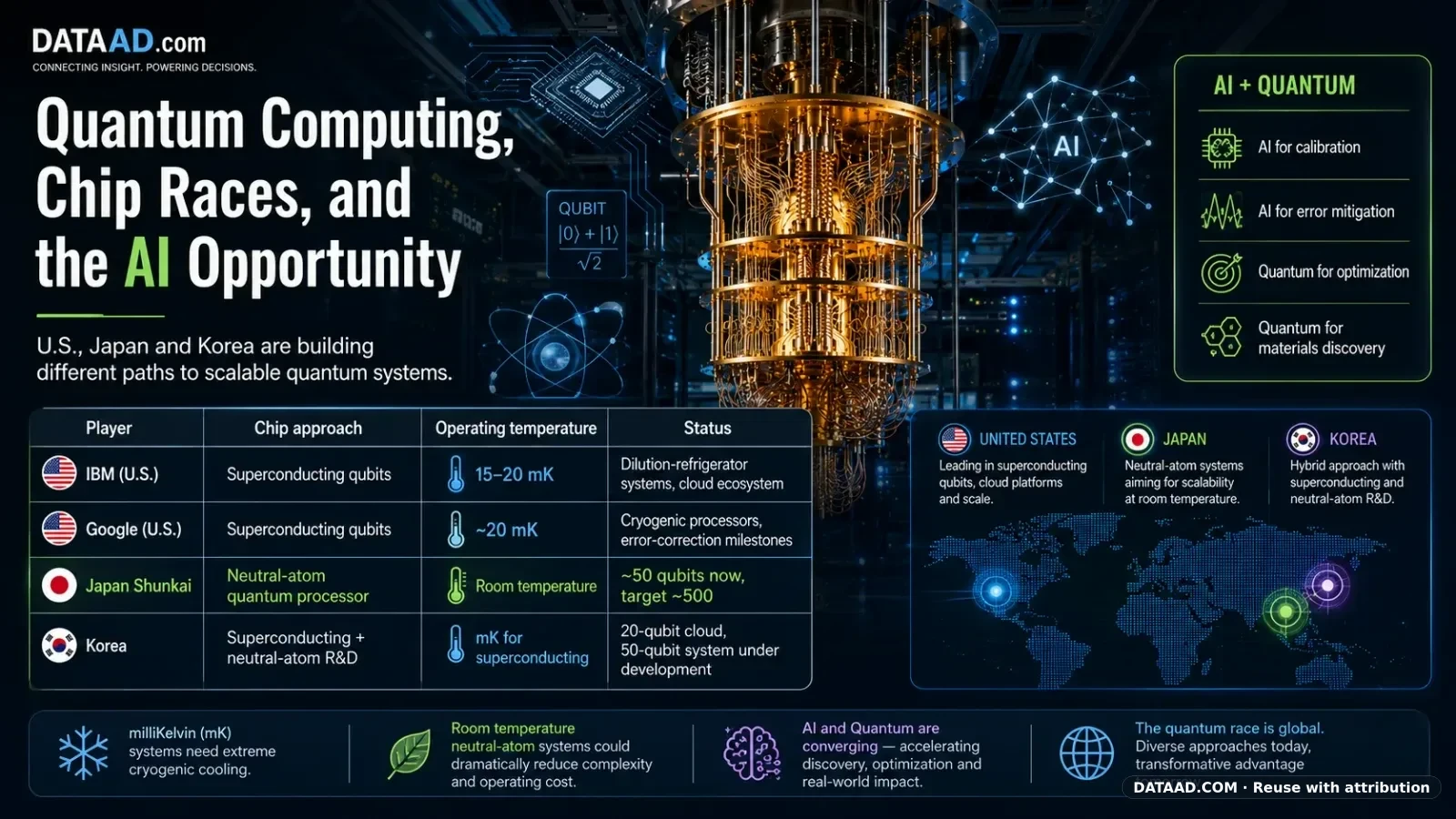
For most of the AI era, the semiconductor race has centered on one question: who can build the fastest GPU?
Quantum computing introduces a completely different question.
Instead of simply putting more transistors onto silicon, quantum computers attempt to manipulate quantum states through qubits. The technologies being pursued are also remarkably diverse: superconducting circuits, neutral atoms, trapped ions, photons and semiconductor spin qubits are all competing to become scalable computing platforms.
By 2026, this competition is beginning to move beyond laboratory demonstrations. The United States remains the strongest commercial ecosystem, Japan is pursuing several very different quantum architectures simultaneously, and South Korea is attempting to build an independent quantum hardware capability around its semiconductor and research infrastructure.
The U.S.: IBM and Google Push Superconducting Quantum Chips
IBM and Google have chosen superconducting qubits as their principal architecture.
In simple terms, superconducting quantum processors look more like semiconductor chips than many competing quantum architectures. Electrical circuits fabricated on a substrate behave as artificial atoms and are controlled through microwave signals.
But there is an enormous engineering requirement: temperature.
IBM's superconducting quantum processors normally operate at approximately 15–20 millikelvin, or only a tiny fraction of a degree above absolute zero. Google's quantum processors are also installed inside cryogenic systems operating in roughly the 10-millikelvin regime.
This is why photographs of IBM and Google quantum computers frequently show the famous gold-colored chandelier-like structure. That structure is not the quantum chip itself. It is largely the cryogenic infrastructure required to keep the processor sufficiently cold.
IBM: Scaling the Entire Quantum Computing System
IBM has moved beyond simply maximizing the number of physical qubits.
Its current portfolio includes Heron processors with 133 or 156 programmable qubits and the newer Nighthawk processor with 120 programmable qubits and higher connectivity.
Nighthawk is particularly important because IBM increasingly measures progress not simply by qubit count, but by how large and complex a reliable quantum circuit can actually be executed.
IBM's 2026 roadmap targets circuits containing approximately 7,500 gates using as many as three 120-qubit Nighthawk modules. Longer term, IBM plans a fault-tolerant system called Starling, targeting 200 logical qubits and 100 million quantum gates.
This represents an important change in the quantum industry: qubit quality, connectivity and error correction are becoming more important than raw qubit count.
Google: Willow and the Error-Correction Race
Google Quantum AI is following a related but somewhat different path.
Its Willow processor contains 105 superconducting qubits and was designed primarily to demonstrate improvements in quantum error correction and system-level performance.
Google has repeatedly emphasized that simply increasing physical qubit numbers is insufficient. As quantum systems grow, errors must decrease rather than accumulate faster than useful computation.
This makes quantum error correction one of the most important technologies in the entire industry.
Japan Is Taking Two Roads at the Same Time
Japan has become particularly interesting because it is not betting on only one quantum architecture.
Fujitsu and RIKEN are developing superconducting quantum processors, while another Japanese national project has now launched a full-stack neutral-atom quantum computer called Shunkai.
Fujitsu and RIKEN: 256 Superconducting Qubits
Fujitsu and RIKEN announced a 256-qubit superconducting quantum computer in 2025, expanding their earlier 64-qubit platform.
The system uses high-density packaging and thermal engineering inside a dilution refrigerator. Fujitsu and RIKEN have also been working toward a system exceeding 1,000 superconducting qubits.
Technically, this places Japan directly in the superconducting quantum-computing race alongside IBM and Google.
Shunkai: A Very Different Quantum Computer
On August 24, 2026, Japan's Institute for Molecular Science announced that its first operational full-stack neutral-atom quantum computer, named Shunkai, had begun operation.
The project is led by Professor Kenji Ohmori under Japan's Moonshot Research and Development Program.
Hitachi has participated in the software stack, while U.S.-based Infleqtion supplied the quantum processing technology.
This detail is strategically important. Shunkai is a Japanese national quantum system, but Japan did not insist that every core component had to be domestically produced. It combined Japanese research and software capabilities with an American quantum hardware partner.
The system begins with approximately 50 physical qubits and is expected to scale toward roughly 500. The longer-term Moonshot goal is a fault-tolerant neutral-atom quantum system with up to 10,000 physical qubits and quantum error detection and correction capabilities by 2031.
The Most Interesting Difference: Temperature
The difference between superconducting and neutral-atom quantum computers becomes especially obvious when we examine their cooling infrastructure.
| System | Country | Qubit Technology | Current / Announced Scale | Operating Environment |
|---|---|---|---|---|
| IBM Heron / Nighthawk | United States | Superconducting circuits | 120–156 programmable qubits per processor | Approximately 15–20 mK using dilution refrigeration |
| Google Willow | United States | Superconducting circuits | 105 qubits | Cryogenic environment around the 10 mK regime |
| Fujitsu–RIKEN | Japan | Superconducting circuits | 256 qubits; larger systems under development | Millikelvin-class dilution refrigeration |
| Shunkai | Japan | Neutral atoms | ~50 initially; ~500 planned | Room-temperature apparatus without a dilution refrigerator; atoms are laser-cooled |
| KRISS | South Korea | Superconducting qubits | 20-qubit cloud demonstration; 50-qubit system under development | Millikelvin-class cryogenic environment |
The term "room-temperature quantum computer" requires some explanation.
Neutral-atom systems do not simply allow atoms to remain thermally at ordinary room temperature. The atoms used as qubits must still be cooled and precisely controlled using lasers, typically inside an ultra-high-vacuum environment.
The important difference is that the entire processor does not need to be placed inside a massive dilution refrigerator at approximately 10–20 millikelvin.
From an infrastructure perspective, that distinction could become extremely important.
Could Neutral Atoms Change Quantum Data-Center Architecture?
A superconducting quantum computer is not simply another server.
It requires dilution refrigeration, microwave control electronics, vibration management, shielding, vacuum technologies and complex thermal engineering.
Scaling from hundreds to thousands or eventually millions of physical qubits therefore creates an infrastructure challenge as much as a semiconductor challenge.
Neutral-atom machines shift this engineering problem.
Individual atoms can be trapped by tightly focused laser beams known as optical tweezers. The atoms can also be rearranged, potentially allowing quantum connections to be configured differently depending on the computation.
The absence of a massive millikelvin refrigerator could make future integration with conventional HPC and AI infrastructure easier.
However, neutral atoms have their own engineering challenges: laser systems, optical precision, vacuum chambers, atom loading, gate fidelity and control complexity all have to scale.
There is therefore no convincing evidence yet that one architecture has definitively won.
South Korea: Quantum Computing Meets Semiconductor Manufacturing
South Korea is still behind the United States in commercial quantum computing, but its position should not be underestimated.
KRISS has already demonstrated a domestically developed 20-qubit superconducting quantum computing system through the cloud and is developing a 50-qubit system targeted for completion by March 2027.
Korea is also researching neutral-atom quantum computing as another pillar of its national quantum program.
The country's possible long-term advantage is its semiconductor ecosystem.
Samsung Electronics and SK hynix already operate some of the world's most advanced semiconductor manufacturing, memory and packaging ecosystems. Quantum processors will not necessarily use exactly the same processes as AI GPUs or memory, but scaling quantum computing will ultimately require advanced fabrication, packaging, control electronics, cryogenic electronics, photonics and extremely precise manufacturing.
Those are areas where Korea already possesses significant industrial capability.
AI and Quantum Computing Are More Likely to Cooperate Than Compete
It is tempting to describe quantum computing as the technology that will eventually replace today's AI GPUs.
DATAAD believes that is probably the wrong way to view the next computing architecture.
The more realistic future is likely to be a CPU + GPU + QPU hybrid computing system.
CPUs will continue to manage general computation. GPUs and other AI accelerators will run large-scale matrix calculations, neural networks and generative AI. Quantum processors could be called only when a particular problem benefits from quantum computation.
This is conceptually similar to today's AI data centers, where different accelerators are already assigned different types of workloads.
AI Can Help Quantum Computers
AI may become an important technology for operating quantum computers themselves.
- Automatic qubit calibration: Machine-learning systems can continuously optimize control parameters.
- Error detection and decoding: AI can analyze complex error patterns generated by large quantum processors.
- Pulse optimization: AI can help optimize microwave or laser control sequences.
- Hardware monitoring: Predictive algorithms can detect system drift and instability.
- Quantum circuit optimization: AI systems can search for more efficient circuit structures.
Quantum Computers Could Help AI
The opposite direction may eventually become equally important.
Quantum computers are being investigated for optimization, sampling, linear-algebra problems and complex probability distributions that appear frequently in machine learning.
There is also considerable interest in whether quantum systems could accelerate the discovery of new AI architectures or help solve optimization problems that become increasingly difficult for classical processors.
But expectations should remain realistic.
Today's quantum computers are not about to replace NVIDIA GPUs running large language models. Classical GPUs remain vastly more practical for modern AI training and inference.
The near-term opportunity is instead hybrid computing: AI determines which portions of a problem should be sent to a quantum processor, the QPU performs a specialized calculation, and classical AI systems process the result.
Materials Discovery May Be the First Major Intersection
One of the most promising areas where AI and quantum computing could meet is materials science.
AI is already capable of searching enormous chemical and material design spaces. But accurately calculating the quantum behavior of complex molecules becomes extremely difficult as systems grow.
A future workflow might therefore operate like this:
AI proposes candidate molecules → quantum computer simulates their quantum behavior → AI evaluates the results → robotics or automated laboratories manufacture and test the best candidates.
This could accelerate research into batteries, semiconductors, catalysts, pharmaceuticals, superconductors and new cooling materials.
The impact could reach directly into AI infrastructure itself. Quantum-assisted materials research may someday help discover better battery chemistries, lower-loss electrical materials, improved semiconductor processes or more efficient thermal-management materials for next-generation AI data centers.
Qubit Count Alone Will Not Decide the Winner
One lesson from the current quantum race is becoming increasingly clear: comparing quantum computers only by qubit count is becoming meaningless.
A 1,000-qubit processor with high error rates may be less useful than a much smaller machine capable of running reliable deep circuits.
The important metrics will increasingly include gate fidelity, coherence time, connectivity, logical qubit performance, error-correction overhead, operating cost and the ability to integrate quantum processors with classical computing infrastructure.
DATAAD Analysis: The Next Data Center May Have Three Brains
Today's AI data center is dominated by the GPU.
The next generation may become heterogeneous.
A conventional CPU could manage the system, thousands of GPUs could perform AI training and inference, and specialized quantum processing units could solve selected optimization, simulation or materials problems that are inefficient for classical computers.
IBM already describes this direction as quantum-centric supercomputing. Japan's neutral-atom strategy points toward another possible route where quantum processors could operate more naturally alongside conventional computing infrastructure without massive millikelvin refrigeration.
Korea, meanwhile, has an opportunity to connect quantum research with one of the world's strongest semiconductor, memory and advanced-manufacturing ecosystems.
The strategic question may therefore no longer be simply:
"Which country will build the most powerful quantum computer?"
The more important question could become:
"Which country can integrate AI, semiconductor manufacturing, HPC and quantum computing into one usable industrial computing ecosystem?"
That race has only just begun.
DATAAD Perspective
Quantum computing should not be viewed as a replacement for artificial intelligence. It is more likely to become another specialized computing layer inside future AI infrastructure. GPUs transformed computing by accelerating parallel mathematics. QPUs may eventually do the same for selected quantum-native problems. The companies and countries that successfully connect CPUs, GPUs and QPUs may define the next generation of computing.
Sources: IBM Quantum, Google Quantum AI, Institute for Molecular Science (Japan), Infleqtion, RIKEN, Fujitsu and Korea Research Institute of Standards and Science (KRISS). Information reflects publicly announced systems and development roadmaps as of August 2026.