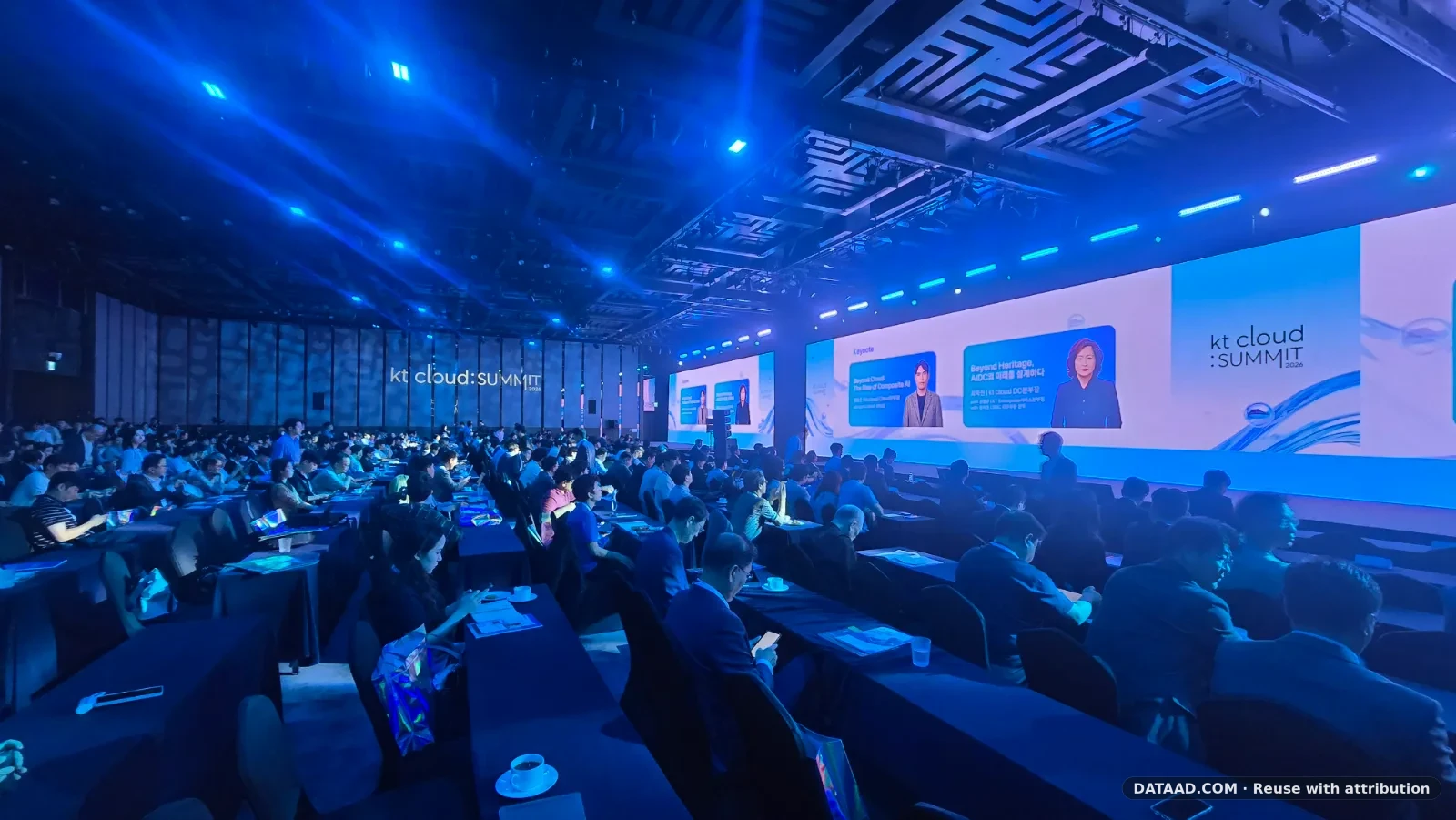
SEOUL — The most interesting message from the morning keynote at KT Cloud Summit 2026 was not about a single AI model, GPU or cloud service.
It was about integration.
KT Cloud framed the next stage of AI transformation around cloud platforms, public-sector AX, AI data centers, connectivity and energy. The morning keynote moved from “Beyond Cloud: The Rise of Composite AI” to the future of AIDC, hyper-connected AX infrastructure and ultimately the relationship between energy and intelligence.
That sequence matters.
For much of the past decade, cloud competition was largely discussed through virtual machines, storage, Kubernetes, databases and software services. AI is changing that architecture. Compute density is increasing, power availability is becoming a strategic constraint, and thermal management is moving closer to the processor.
In other words, the cloud is becoming physical again.
Composite AI Changes the Infrastructure Beneath It
The phrase “Composite AI” is particularly significant.
Rather than imagining enterprise AI as one large model operating in isolation, the emerging architecture is more likely to combine multiple AI models, databases, inference engines, conventional applications and specialized accelerators.
From an infrastructure perspective, this means the winning platform may not simply be the company with the largest model.
It may be the company capable of orchestrating heterogeneous computing resources efficiently while maintaining data governance, networking, security and predictable operating costs.
KT Cloud's keynote therefore pointed toward a broader role for the cloud provider: not merely supplying computing capacity, but becoming an integrator of AI infrastructure.
AIDC Moves to the Center
The second major signal from the morning session was the prominence of the AI data center itself.
As rack power density rises, the boundary between IT equipment and facility infrastructure becomes increasingly difficult to separate.
Servers, accelerators, rack manifolds, cooling distribution, pumps, heat rejection systems and electrical infrastructure increasingly have to be engineered as one system.
For AIDC operators, cooling is therefore no longer simply a facilities issue handled after the server architecture has been selected.
Cooling is becoming part of the computing architecture itself.
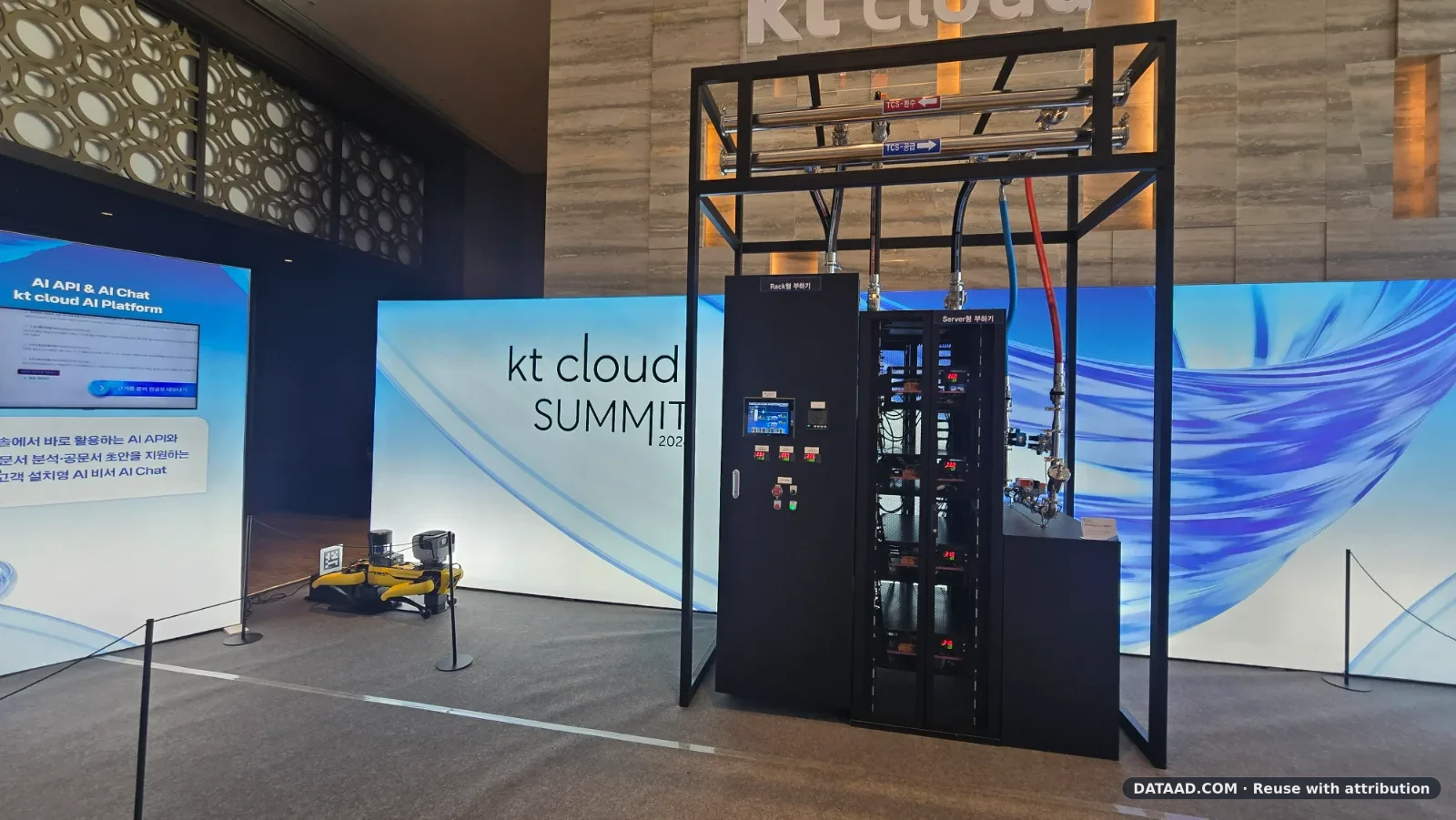
Rack- and server-side liquid distribution demonstration at KT Cloud Summit 2026. Higher-density AI computing is pushing cooling infrastructure closer to the processor. Photo: DATAAD
The Exhibition Floor Made the Message Tangible
The exhibition area provided a physical counterpart to the keynote.
One demonstration showed a rack- and server-side liquid-cooling system with supply and return lines, distribution hardware, controls and instrumentation. The installation illustrates how liquid distribution is moving directly into the rack environment as conventional air cooling reaches practical limits at higher compute densities.
The significance is not any single pipe, hose or cooling component. It is the architectural change occurring around the rack.
Cooling infrastructure that once belonged primarily to the building is gradually moving closer to the server and semiconductor.
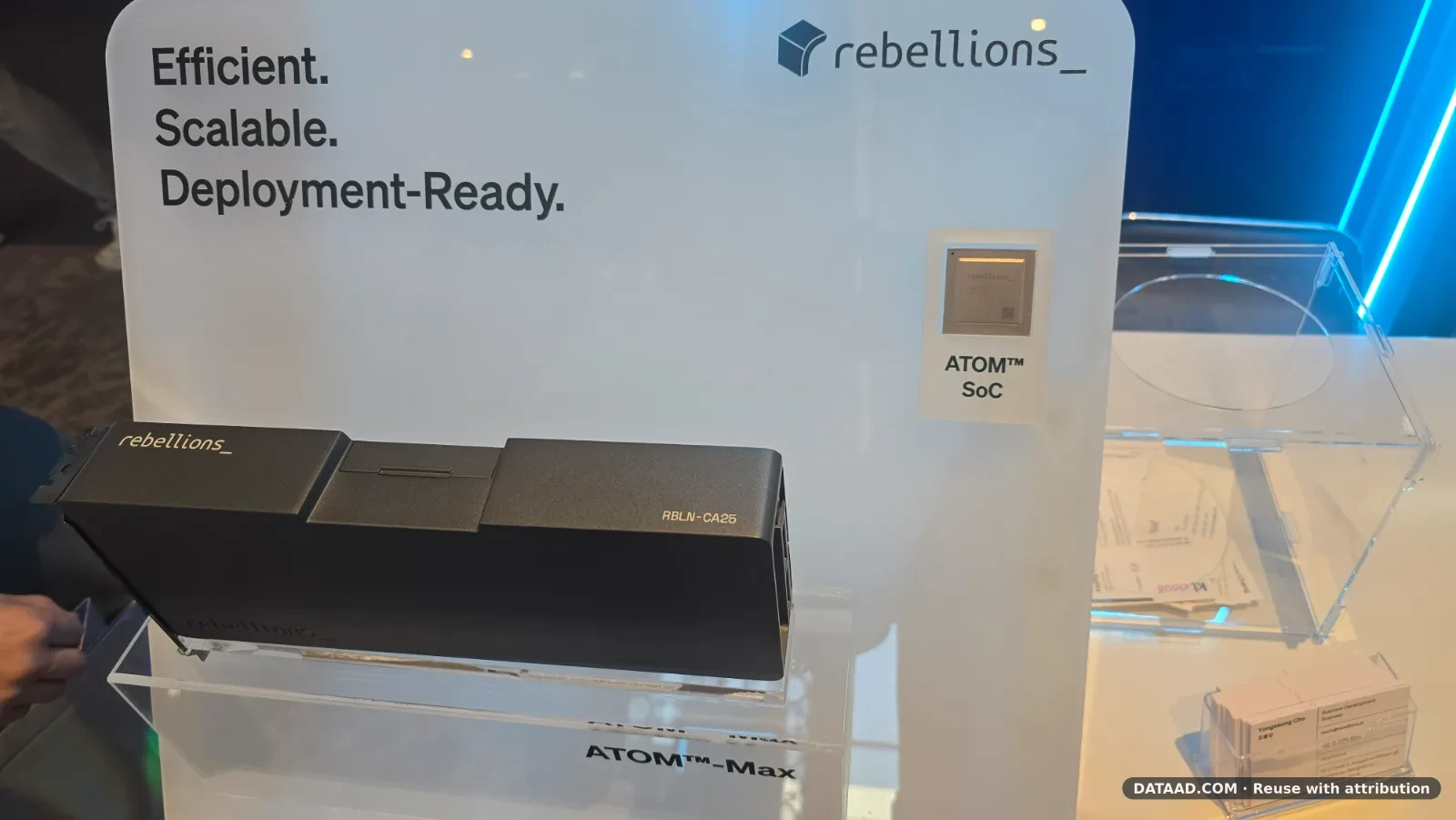
Another display featured Rebellions' ATOM-Max system and ATOM SoC, highlighting another dimension of Korea's AI infrastructure strategy: the development of domestic AI computing hardware alongside cloud and data-center infrastructure.
Rebellions ATOM-Max and ATOM SoC on display at KT Cloud Summit 2026, illustrating the growing role of domestic AI accelerators within Korea's AI infrastructure ecosystem. Photo: DATAAD
Put together, these exhibits tell a more important story than either technology would on its own.
AI infrastructure is becoming a stack:
AI silicon → servers → rack architecture → network → cloud platform → cooling → power
The competitive advantage increasingly comes from how effectively those layers can operate together.
Electricity Becomes Intelligence
One of the most revealing themes in the keynote was the connection between energy and intelligence.
AI ultimately converts electricity into computation.
The ability to secure electrical capacity, deliver it reliably, remove the resulting heat and operate the infrastructure efficiently may therefore become just as strategically important as access to processors.
This is particularly relevant for Korea, where new high-density data-center developments must simultaneously address power availability, grid constraints, urban concentration and cooling requirements.
The future AIDC industry may consequently look increasingly like a combination of the semiconductor, cloud, electrical-power and industrial-engineering industries rather than simply an extension of the traditional hosting business.
Public AX Is Also Becoming Infrastructure
The presence of public-sector AX in the keynote was another noteworthy signal.
Enterprise AI adoption receives much of the global attention, but government and regional AX could eventually become an important source of large and persistent AI workloads.
Local governments deal with transportation, public safety, industrial policy, administration, energy and regional infrastructure. As these functions become increasingly AI-assisted, public-sector transformation could create demand not only for software but also for regional compute and data infrastructure.
That could gradually produce a different AIDC geography from the one created by conventional internet services.
The Physical AI Connection
There is another reason the infrastructure discussion is becoming more important.
The next wave of AI data may increasingly come not only from humans creating text, images and video, but from machines continuously interacting with the physical world.
Robots, autonomous vehicles, industrial equipment, cameras and intelligent infrastructure can generate continuous streams of operational data.
This could significantly increase inference workloads at the edge while simultaneously increasing demand for centralized AI training and data processing.
In that environment, cloud architecture, edge computing, networks and AI data centers become interconnected parts of the same system.
DATAAD View
The strongest impression from the morning session was that KT Cloud is trying to move the conversation beyond “cloud” itself.
The real competition in AI infrastructure is moving downward into the physical stack and upward into AI orchestration at the same time.
At the bottom are electricity, cooling, racks and network architecture.
At the top are models, agents, enterprise applications and AX.
Between them sit cloud platforms and increasingly heterogeneous AI accelerators.
This is why liquid cooling, domestic AI chips, AIDC construction, power infrastructure and cloud platforms can now appear naturally at the same conference.
They are no longer separate industries. They are becoming parts of the same machine.
For Korea, that may also be the central opportunity.
The country already has significant capabilities in semiconductors, telecommunications, electrical equipment, industrial manufacturing and data-center construction.
The next challenge is not merely producing more individual components.
It is learning how to integrate them into a globally competitive AI infrastructure system.
Field Note: This article is based on DATAAD's on-site observations during the morning keynote and exhibition at KT Cloud Summit 2026 in Seoul on September 15, 2026.
Official event information: KT Cloud Summit 2026