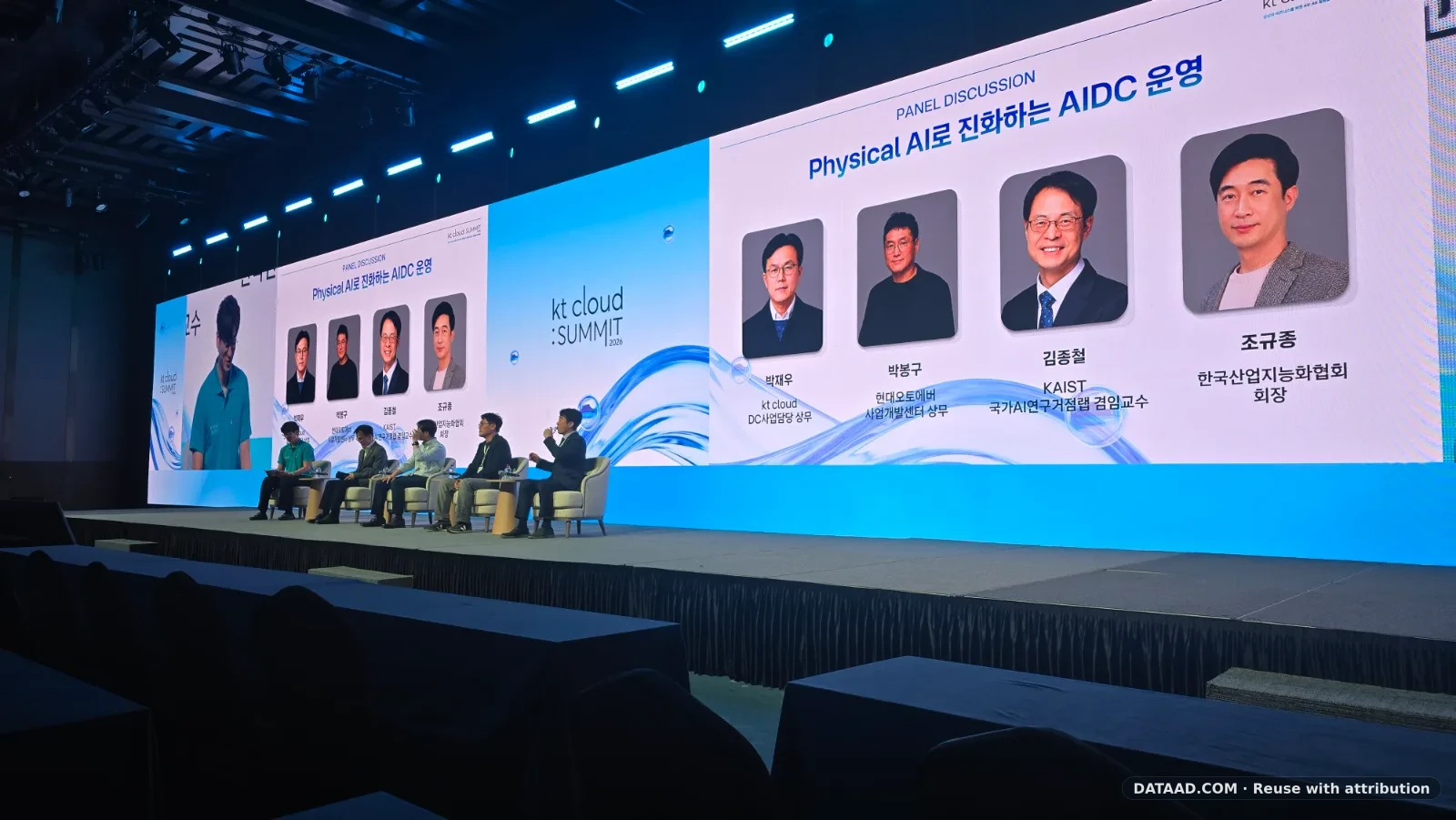
SEOUL — The global AI data-center race is usually described as a competition for GPUs, electricity and megawatts.
But KT Cloud Summit 2026 suggested that Korea may need to compete on a different axis.
The United States has hyperscalers, enormous capital pools and the world’s dominant AI computing and software platforms. China has manufacturing scale, a rapidly expanding domestic AI hardware ecosystem and a vast power system. Southeast Asia is emerging as one of the world’s fastest-growing destinations for new data-center capacity, supported by available land, regional connectivity and major international investment.
Korea cannot easily beat any of them simply by building larger data centers.
Its opportunity may instead come from density.
Korea combines globally important HBM production, advanced semiconductor manufacturing, emerging domestic NPUs, nationwide telecom infrastructure, cloud and data-center operators, automotive and electronics factories, industrial robots, shipyards and increasingly automated logistics systems within an unusually compact geography.
That combination could give Korea a distinctive position in the next phase of AI infrastructure: Physical AI.
KT Cloud Summit Was Really About the Physicalization of AI
The official program at KT Cloud Summit 2026 moved well beyond conventional cloud computing.
The AIDC track covered AI data-center operations, BIM and digital twins, next-generation networking, AI factories, Physical AI, direct-to-chip liquid cooling and chip-to-chiller infrastructure.
This progression matters because AI infrastructure is increasingly becoming a physical engineering system rather than simply an extension of cloud software.
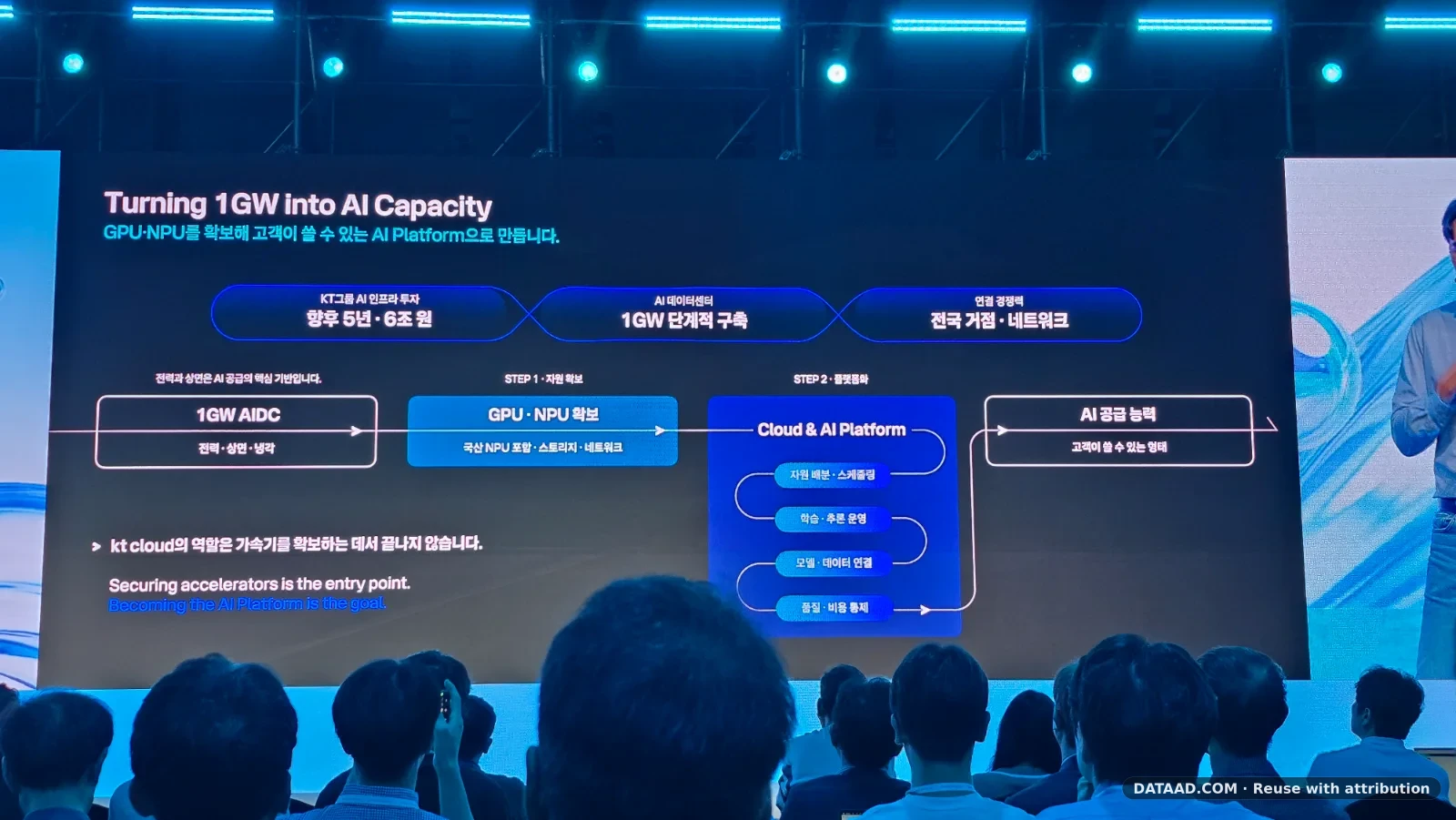
One of the clearest messages from the event was KT Group’s plan to invest KRW 6 trillion in AI infrastructure over five years while progressively developing around 1GW of AI data-center capacity.
But the more important question is not whether Korea can build 1GW.
It is what that 1GW will connect to.
In the United States, much of the AI infrastructure boom is being driven by hyperscale model training, cloud platforms and enormous GPU clusters.
In Korea, an increasingly important share of the future workload could originate in factories, robots, vehicles, semiconductor production equipment, logistics systems and other machines interacting continuously with the physical world.
The Korean AIDC opportunity may therefore be less about building the world’s largest AI factory and more about connecting AI factories to the world’s densest industrial environment.
Physical AI Changes the Geography of AIDC
Generative AI was initially dominated by human-created data: text, images, video, documents and internet content.
Physical AI creates a different data economy.
Robots generate motion data. Autonomous vehicles generate sensor data. Semiconductor tools generate process data. Factories generate vibration, temperature, vision and production data. Shipyards, warehouses and industrial equipment generate continuous operational information.
These systems do not only require centralized model training. They increasingly require distributed inference, low-latency connectivity, edge computing and continuous feedback between machines and central AI infrastructure.
This is where Korea becomes particularly interesting.
According to the International Federation of Robotics, Korea has the highest industrial robot density in the world, reaching 1,220 robots per 10,000 manufacturing employees in 2024.
China operates far more industrial robots in absolute numbers, with roughly two million units in operation, and therefore remains the larger Physical AI market by scale.
But Korea represents something different: an extremely high concentration of automation inside a relatively small industrial geography.
For AI infrastructure, that density could become strategically important.
HBM Is More Than a Semiconductor Export
Korea also occupies an unusual position in the AI semiconductor supply chain.
SK hynix and Samsung Electronics are both deeply involved in the transition from HBM3E to HBM4, the high-bandwidth memory technologies increasingly required by advanced AI accelerators.
SK hynix began mass shipments of HBM4 in 2026, while Samsung also moved HBM4 into commercial production and has already begun advancing toward HBM4E.
This means that one of the most constrained components inside the global AI infrastructure stack is manufactured at large scale in Korea.
That alone does not make Korea computationally sovereign. The country still depends heavily on foreign GPU architectures and the global software ecosystems surrounding them.
But HBM creates an important foundation that most countries seeking to build sovereign AI infrastructure simply do not possess.
The strategic question is whether Korea can connect that memory advantage to more of the AI computing stack.
The Emerging NPU Layer
This is where domestic AI accelerators become important.
Korean companies including Rebellions and FuriosaAI are attempting to build alternatives and complements to GPU-centric inference infrastructure.
The Korean government has also launched a K-Cloud R&D program centered on domestic AI semiconductors, with the explicit goal of developing both hardware and software infrastructure around Korean accelerators.
The significance should not be exaggerated.
NVIDIA’s advantage is not simply the GPU. It includes CUDA, libraries, developer tools, networking, systems integration and a software ecosystem accumulated over many years.
A Korean NPU therefore does not automatically create a Korean AI stack.
But commercial deployment of domestic accelerators inside Korean cloud and data-center infrastructure could gradually create something strategically useful: a second computing path alongside imported GPUs.
That is particularly relevant for inference workloads, where cost, power consumption and workload-specific optimization can matter as much as absolute training performance.
America, China, Southeast Asia — and Korea
| Region | Primary AIDC Advantage | Structural Constraint | Likely Direction |
|---|---|---|---|
| United States | Hyperscalers, GPU/software leadership, capital, frontier AI models | Grid congestion, power availability, permitting and local resistance | Gigawatt-scale AI factories and frontier model infrastructure |
| China | Manufacturing scale, power system, domestic cloud and AI hardware ecosystem | Access to leading-edge foreign semiconductor technology | Large-scale domestic AI plus industrial and Physical AI integration |
| Southeast Asia | Land, expanding power supply, international investment and regional connectivity | Greater dependence on imported high-end silicon and technology platforms | Regional hyperscale and colocation capacity hub |
| South Korea | HBM, advanced manufacturing, telecom networks, high robot density, emerging NPUs | Power and land constraints, GPU dependence, smaller hyperscale ecosystem | Industrial AIDC, edge AI and Physical AI integration |
The comparison reveals why simply copying the American hyperscale strategy may not be the optimal route for Korea.
Malaysia, for example, is already attracting enormous data-center and cloud investment, while Singapore operates more than 1.4GW of data-center capacity and continues to selectively expand capacity under strict energy-efficiency requirements.
Competing with these markets primarily on real estate and megawatts would be difficult.
Korea needs higher-value infrastructure.
From 400G Networks to an AI Nervous System
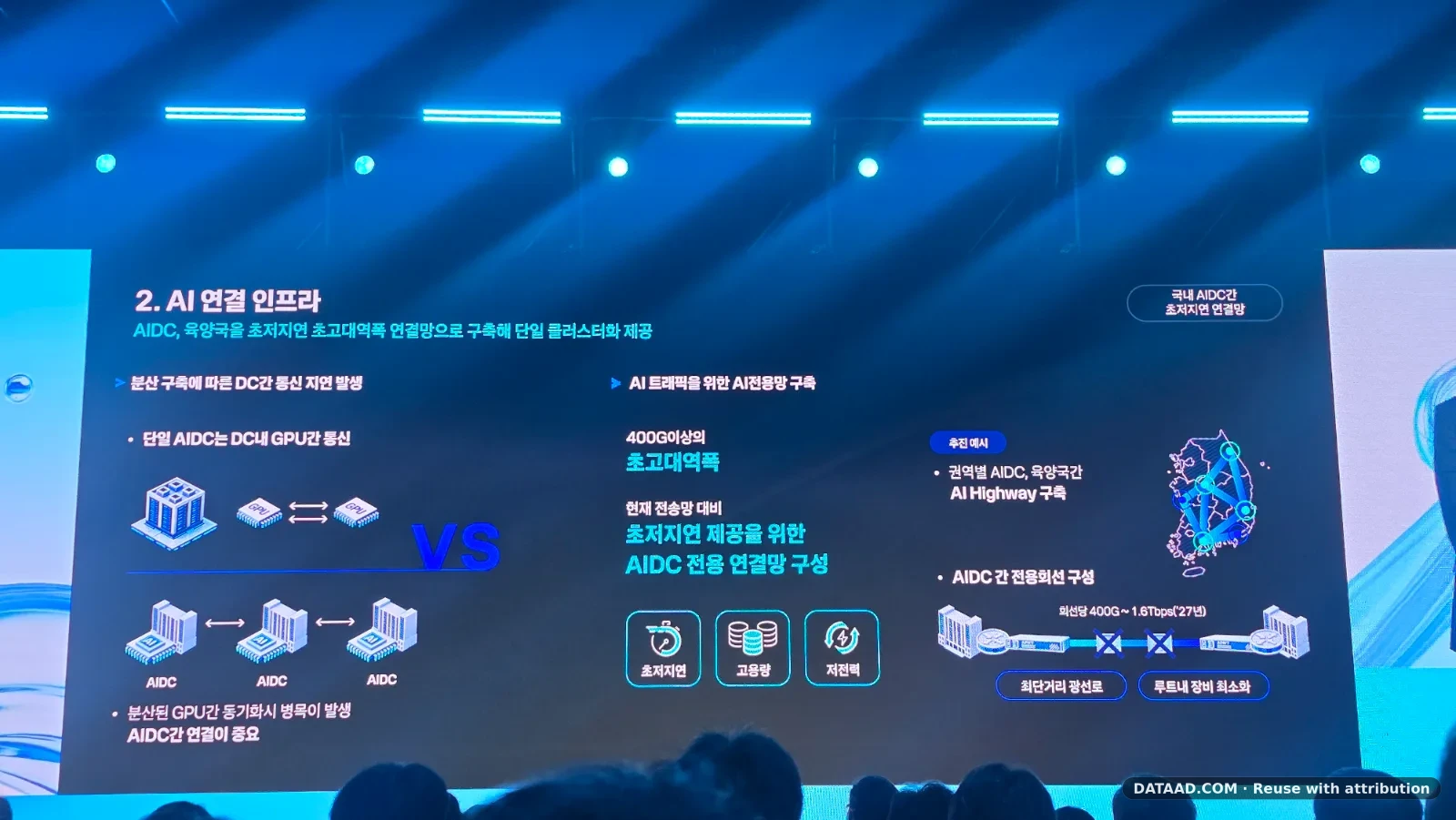
Another notable KT Cloud Summit session focused on connectivity between distributed AI data centers.
The presentation described AI infrastructure increasingly requiring ultra-low-latency, high-capacity interconnection between geographically separated GPU resources and envisioned network capacity progressing beyond today's 400G environment toward much higher bandwidth.
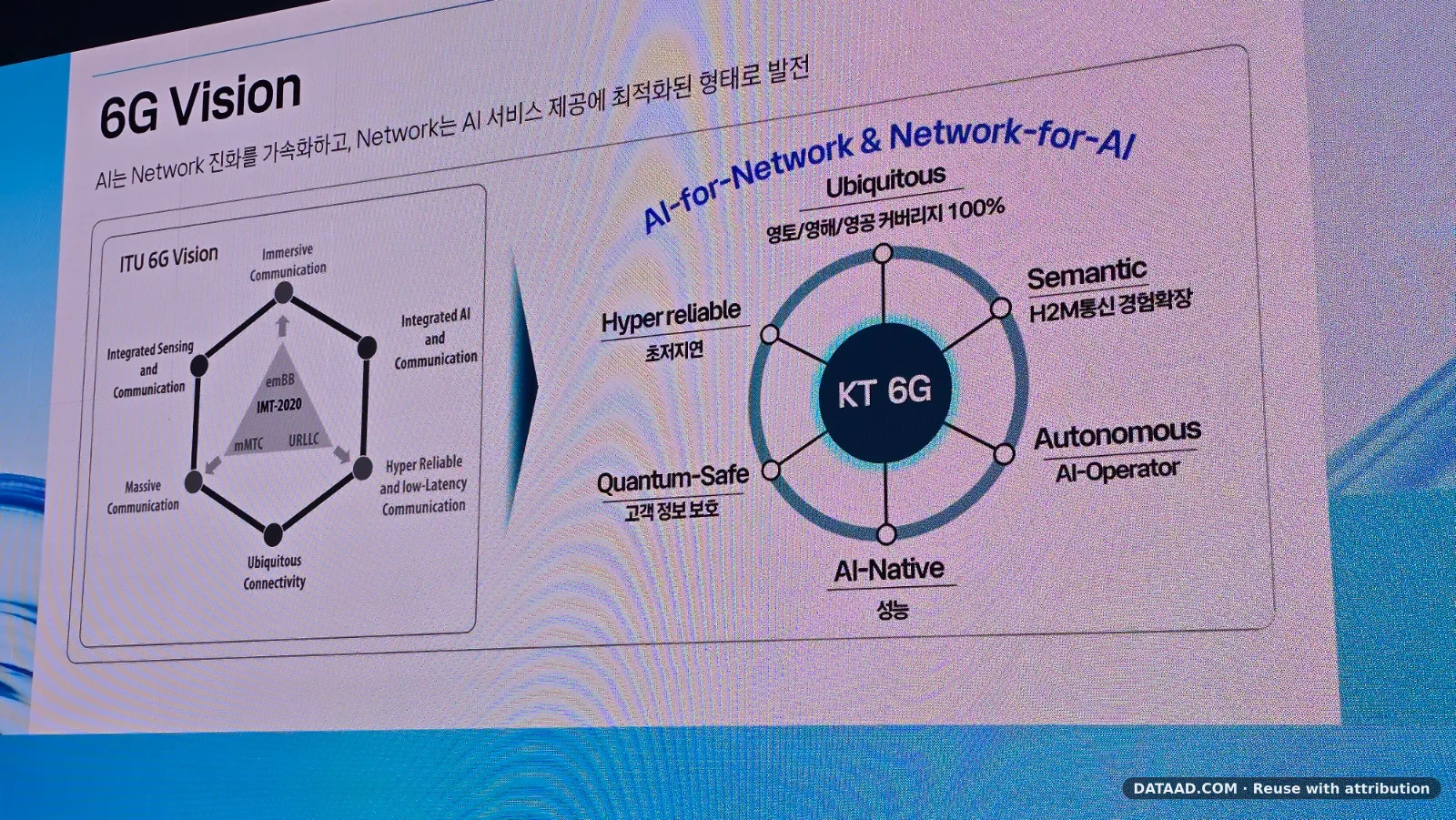
The accompanying 6G vision was equally revealing.
KT described an architecture combining AI-for-Network and Network-for-AI, with characteristics including ubiquitous connectivity, hyper-reliability, autonomous operation, semantic communications, AI-native architecture and quantum-safe security.
This becomes much more relevant under Physical AI than under conventional cloud computing.
A chatbot can tolerate some network delay.
A robot coordinating with machines, cameras, digital twins and remote AI infrastructure often cannot.
Networks therefore move from being pipes carrying AI traffic to becoming part of the AI system itself.
BIM and Digital Twins Show the Same Transition
The afternoon AIDC sessions also demonstrated how this physical-digital convergence begins before a data center even starts operating.
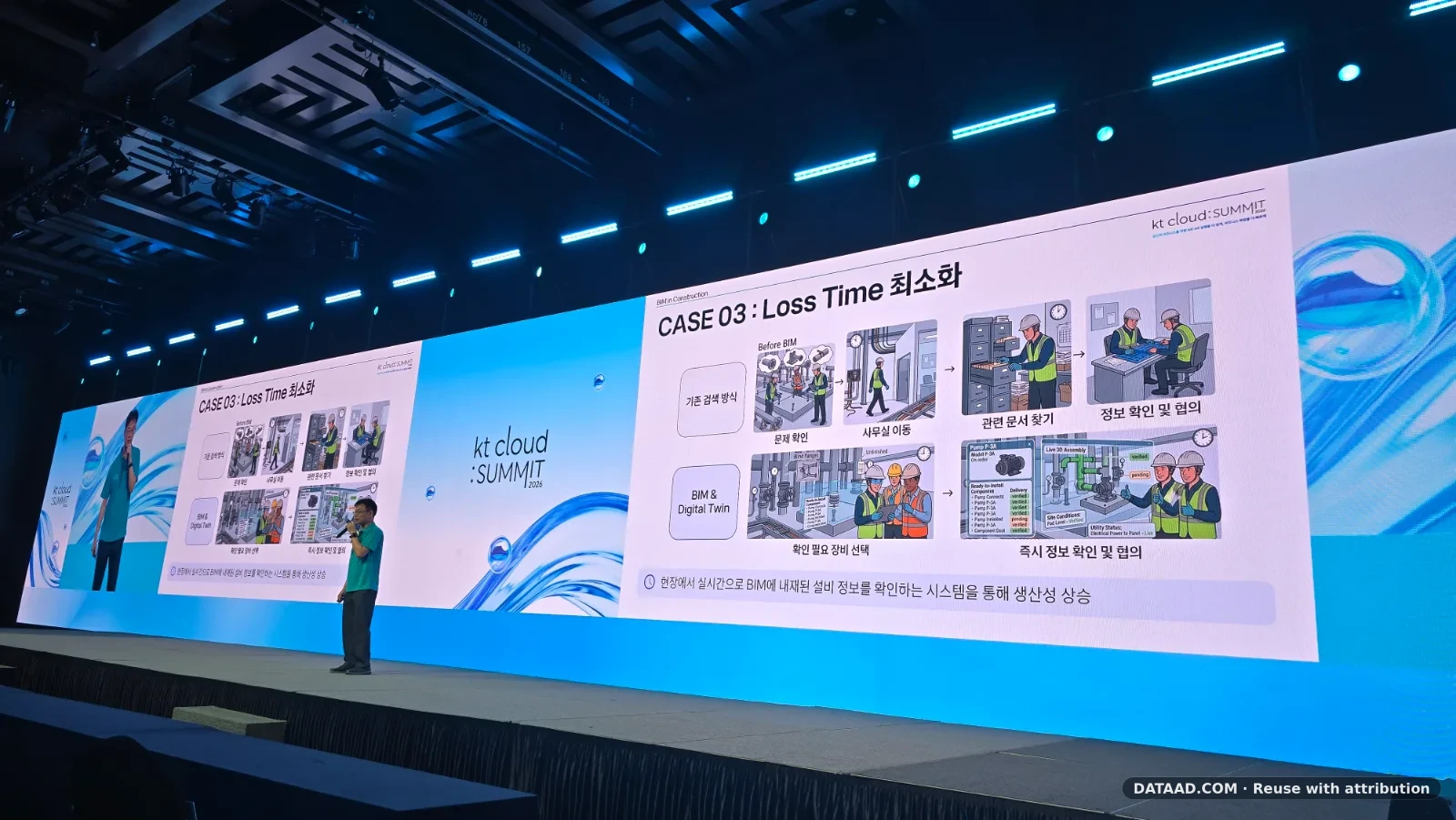
KT Cloud presented BIM and digital-twin approaches designed to bring equipment information directly to construction and operating personnel at the site.
Instead of identifying a problem, returning to an office, searching for drawings and documents and then coordinating a response, engineers can increasingly access equipment information at the point of work.
This is not as visually dramatic as a new GPU.
But it may be equally important.
AI infrastructure is becoming too dense and too complex to operate efficiently using fragmented drawings, spreadsheets and human memory.
The data center itself is becoming a machine-readable industrial asset.
Liquid Cooling Is Part of the Compute Architecture
The Direct-to-Chip cooling session provided another indication of the same change.
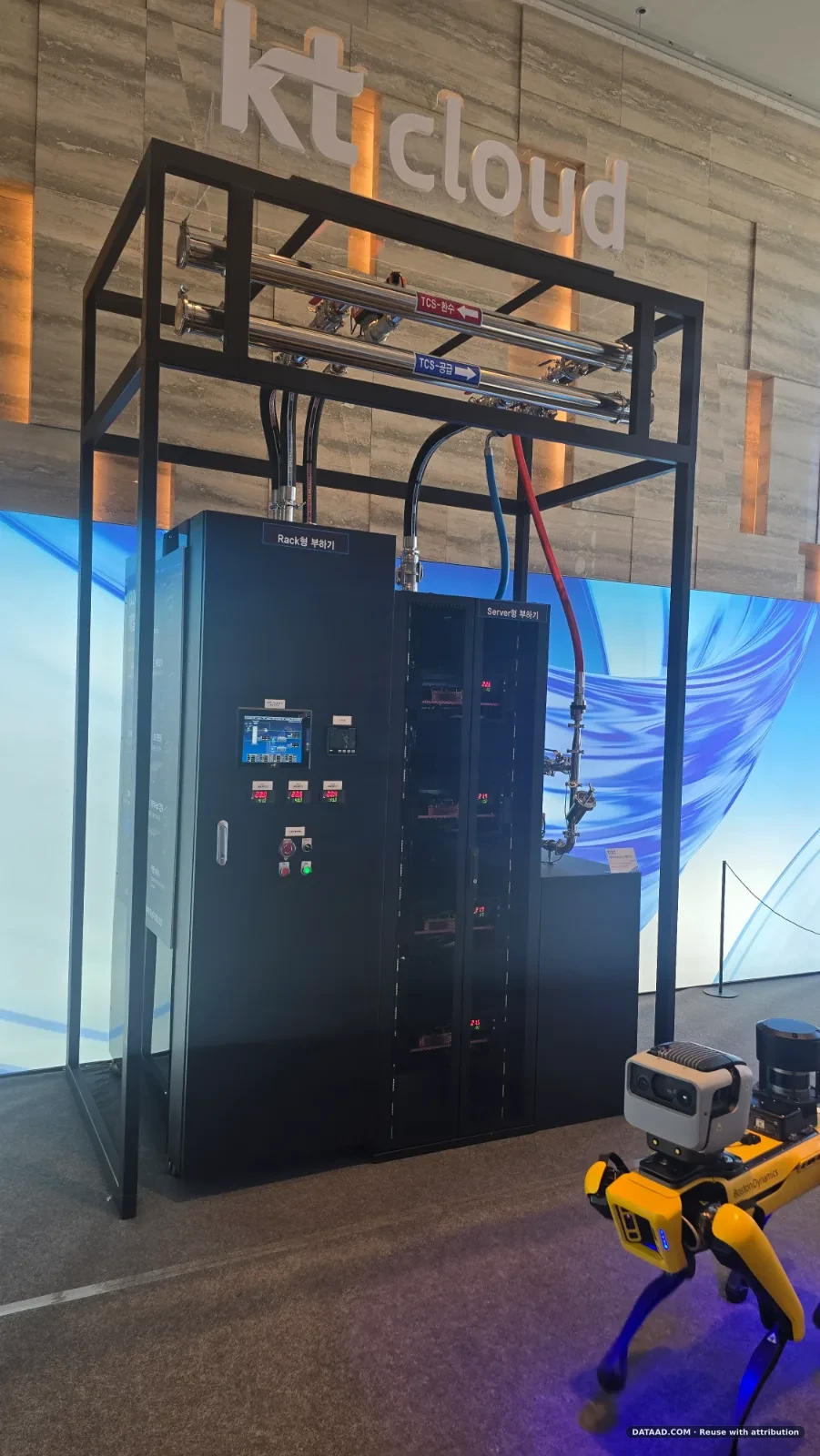
KT Cloud presented ASHRAE Technology Cooling System fluid classes ranging through warmer supply-temperature environments and showed how liquid-to-liquid CDUs, rack manifolds and server cooling loops fit together.
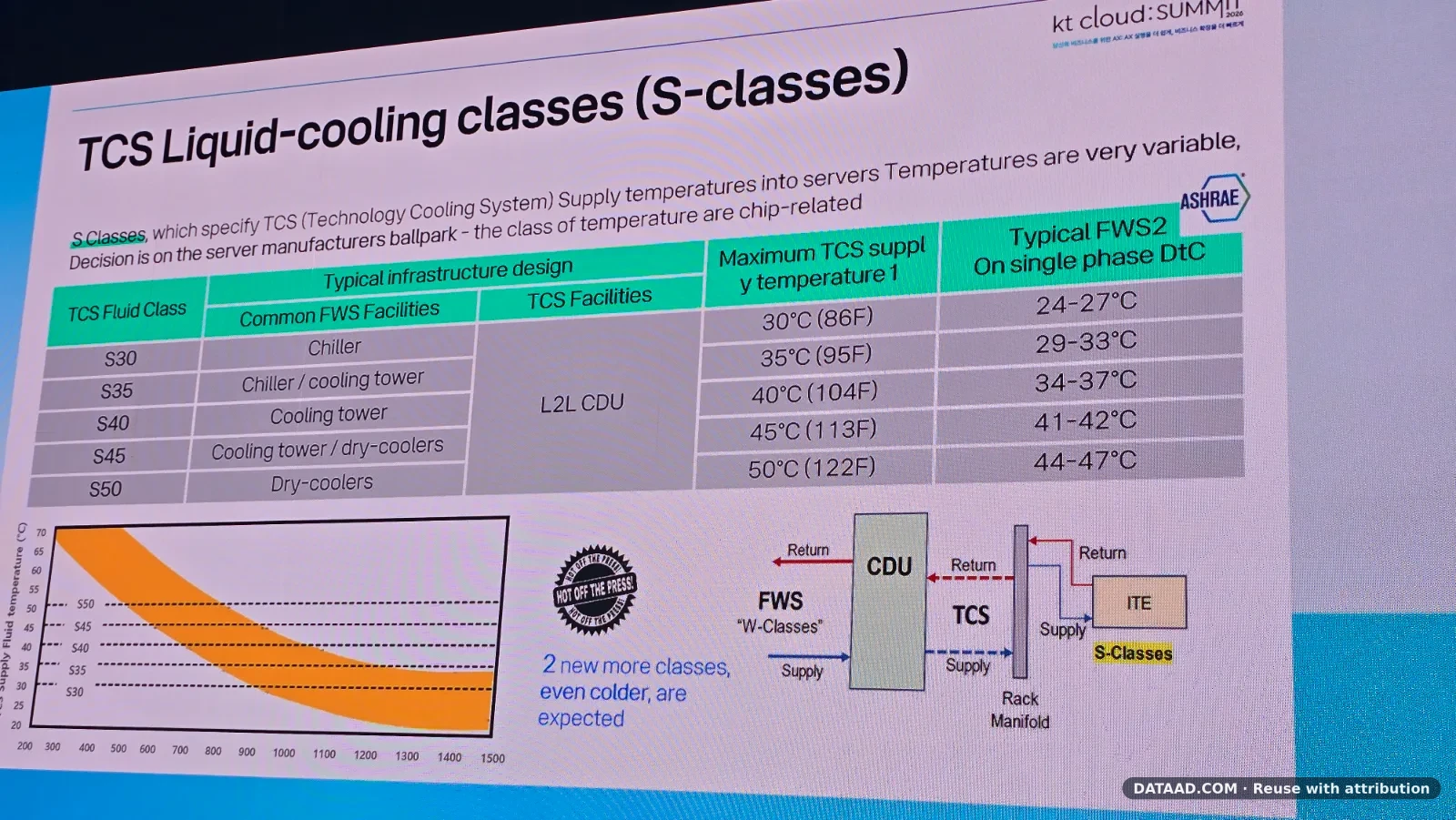
Higher coolant temperatures can expand the operating window for cooling towers and dry coolers and potentially reduce dependence on conventional chilled-water operation.
As AI rack densities rise, however, liquid cooling can no longer be considered a peripheral mechanical system.
Cold plates, hoses, quick disconnects, manifolds, CDUs, pumps, controls and facility heat rejection increasingly have to be engineered around the server architecture.
The boundary between semiconductor, server and building infrastructure is disappearing.
This is particularly important for Korea because the country already has significant capabilities in precision manufacturing, thermal systems, industrial components and semiconductor infrastructure.
AIDC could therefore become a new industrial market, not merely a new category of real estate.
The Limits of the Korean AIDC Model
Korea's advantages should not obscure its constraints.
First is electricity. AI data centers convert enormous amounts of electrical energy into computation, and securing grid capacity may become a larger bottleneck than securing buildings.
Second is global computing scale. Korea does not have a hyperscaler comparable in scale to Amazon, Microsoft or Google, nor does it currently control the dominant GPU and AI software stack.
Third is the software ecosystem. Domestic NPUs become strategically significant only when developers can deploy models easily and when the accelerators can be operated economically at commercial scale.
Fourth is AIDC standardization. Rack architecture, high-voltage power distribution, direct liquid cooling, manifolds, quick disconnects, fluid quality and operating practices are still evolving rapidly as new GPU generations arrive.
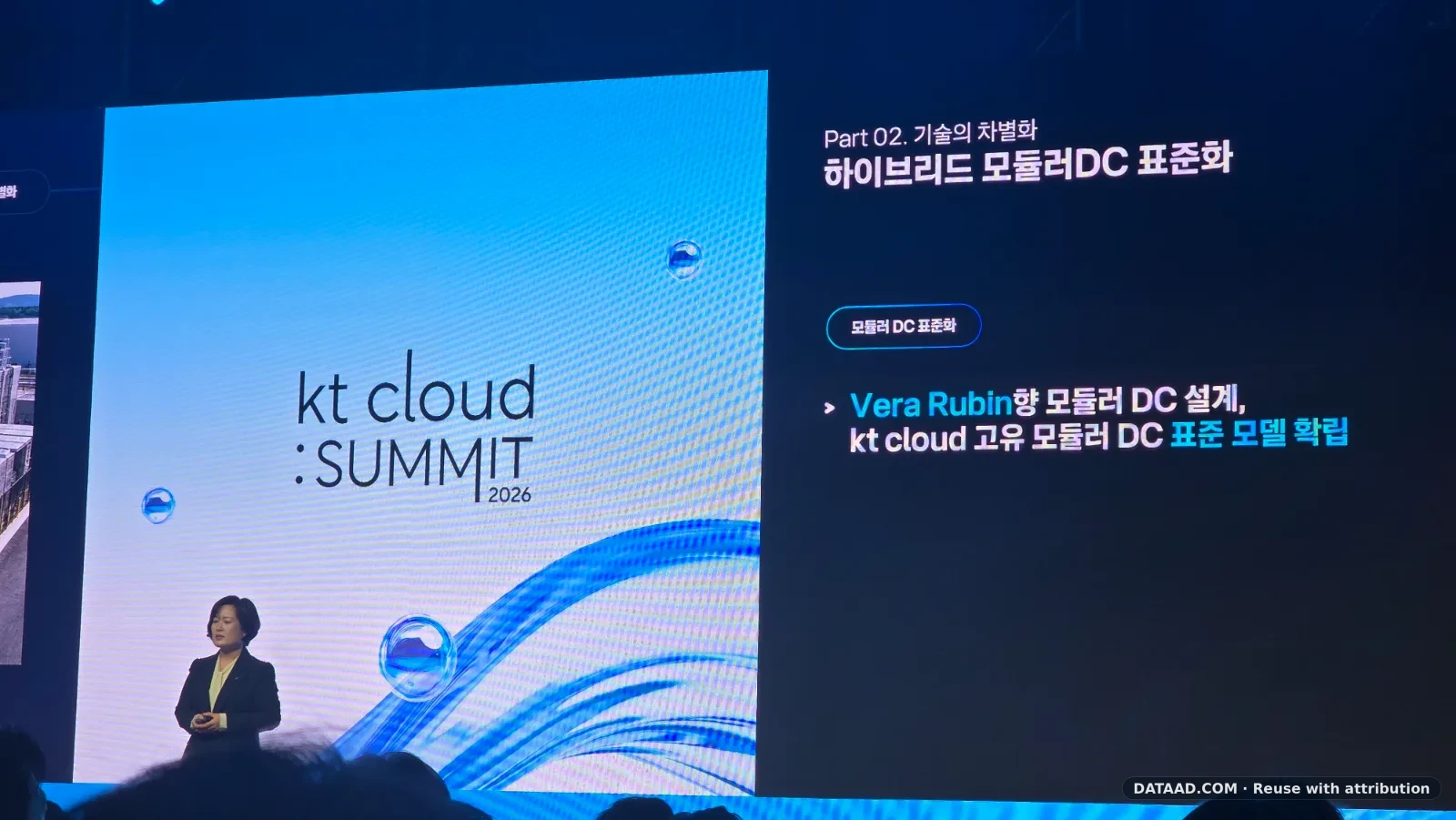
KT Cloud's presentation of a modular data-center standard oriented toward future Vera Rubin-class systems illustrates the problem: the infrastructure has to be designed for computing hardware that is evolving faster than conventional data-center construction cycles.
Finally, Korea must avoid confusing infrastructure investment with AI competitiveness.
A gigawatt of data-center capacity is only valuable if economically productive workloads eventually fill it.
DATAAD View: Korea Should Build the Physical AI Cloud
The most interesting conclusion from KT Cloud Summit 2026 is therefore not that Korea should build more data centers.
It is that Korea should build a different type of AI infrastructure economy.
The United States can pursue enormous centralized AI factories because it controls much of the frontier compute and cloud stack.
China can pursue AI infrastructure at industrial scale because of the size of its manufacturing base, power system and domestic market.
Southeast Asia can absorb large amounts of hyperscale capacity because land, energy infrastructure and regional connectivity make it attractive for international operators.
Korea's strongest proposition is different.
It can connect AI infrastructure directly to an unusually dense physical economy.
HBM can sit beside domestic NPUs.
NPUs and GPUs can connect to Korean cloud platforms.
Cloud platforms can connect through telecom and future 6G networks to factories, vehicles, robots, semiconductor equipment, shipyards and logistics systems.
Those machines can generate the next wave of training and inference data, which in turn creates demand for more distributed AI infrastructure.
That is potentially a self-reinforcing ecosystem.
And it suggests a different definition of sovereign AI.
Sovereignty does not necessarily mean producing every GPU, server or software framework domestically.
It may mean retaining enough strategic layers of the stack — memory, accelerators, networks, data centers, industrial data and operating expertise — that the country can shape how AI is deployed inside its own economy.
Korea is unlikely to win the global AI data-center race by becoming the largest.
It could become important by becoming the most tightly integrated.
That may ultimately be the country's real AIDC advantage.
Field Note: This analysis is based on DATAAD's on-site observations, presentation materials and sessions at KT Cloud Summit 2026, held in Seoul on September 15, 2026. Corporate investment and infrastructure figures cited from the summit represent company plans and should not be interpreted as national capacity commitments.