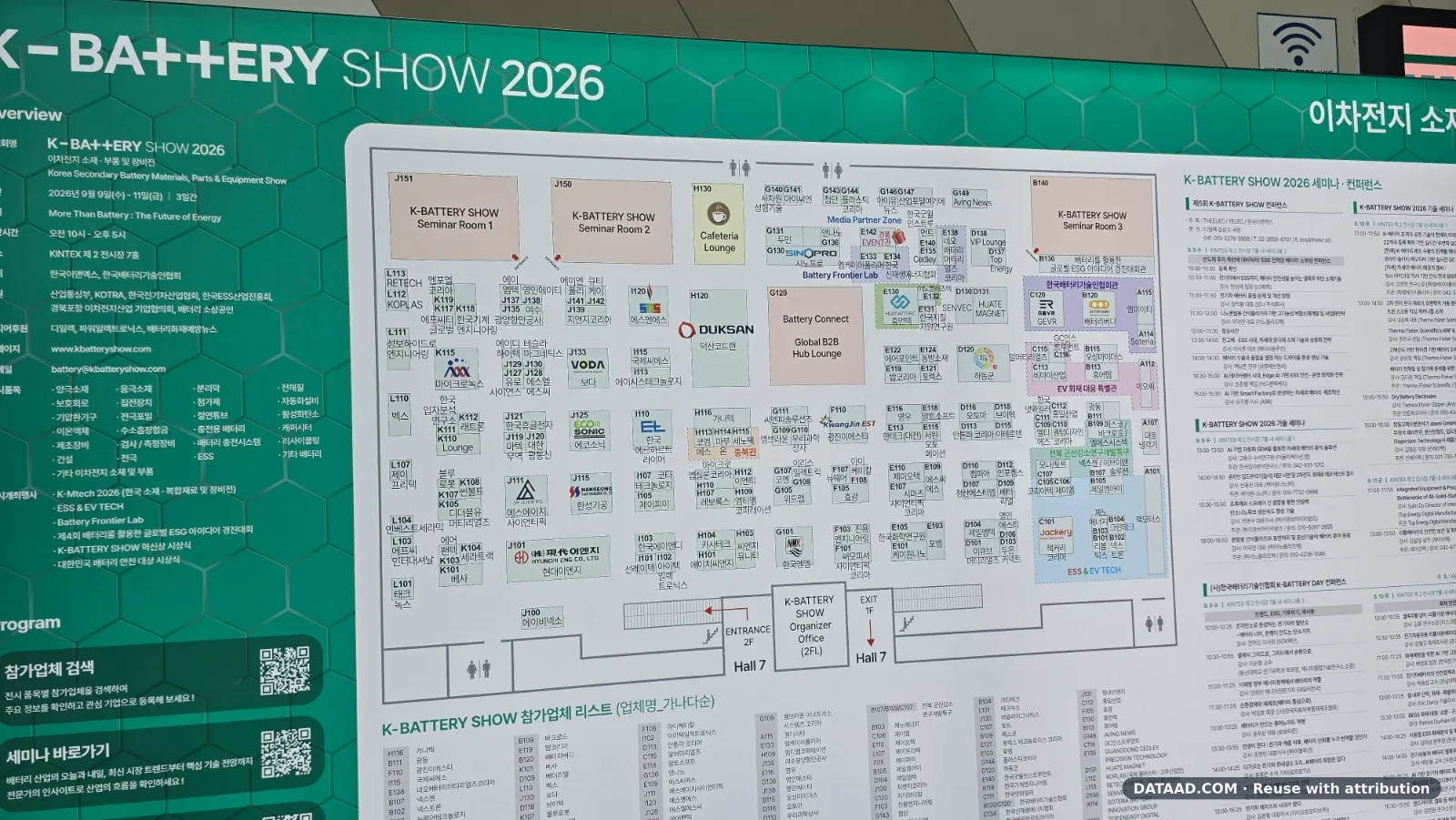
GOYANG, South Korea — September 9, 2026. K-Battery Show 2026 opened at KINTEX with an exhibition floor that said as much about the future of manufacturing as it did about batteries.
The event, held from September 9 to 11 at KINTEX Exhibition Center 2, Hall 7, brings together battery materials, components, manufacturing equipment, testing systems, recycling technologies, energy storage solutions and production engineering.
Its official theme, “More Than Battery: The Future of Energy,” was appropriate. Walking through the exhibition, DATAAD found an industry whose center of gravity is gradually expanding beyond the electric vehicle.
The first era of the modern battery boom was dominated by energy density and electric-car demand. The next phase looks more complicated: manufacturing productivity, process control, fire safety, battery diagnosis, recycling, artificial intelligence and, increasingly, batteries designed for robots and autonomous machines.
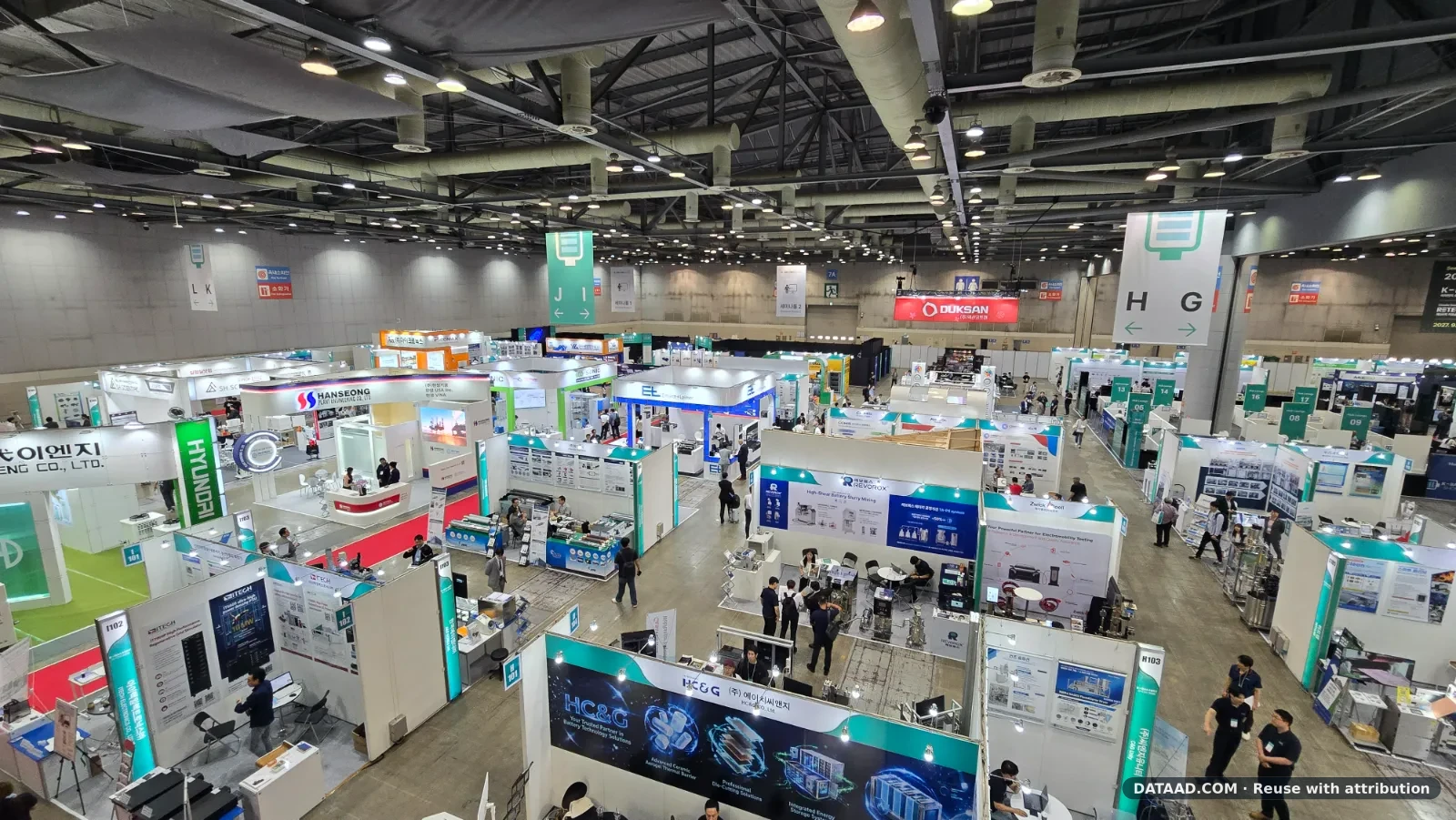
Chinese Equipment Makers Were Highly Visible
One of the strongest impressions from the exhibition floor was the visible participation of Chinese manufacturing-equipment suppliers.
This matters because China's battery advantage is no longer limited to cell production or raw-material processing. Chinese companies are increasingly competing across the machinery and production-engineering layer that sits behind battery manufacturing.
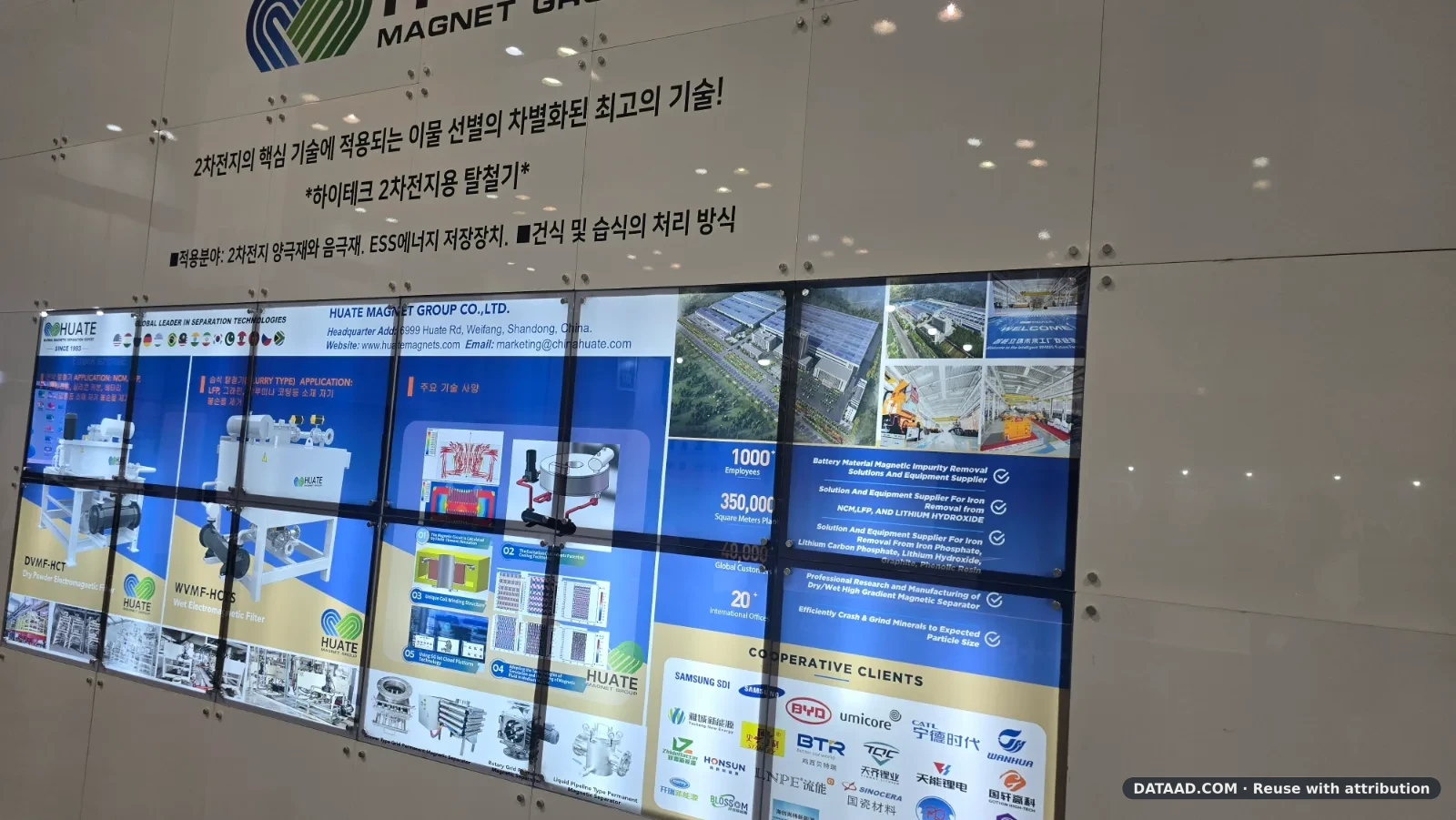
Among the exhibitors observed by DATAAD was Huate Magnet Group from Shandong, China, displaying magnetic separation technologies designed for impurity removal in battery materials. Such equipment may appear far removed from the finished battery cell, but contamination control, material purity and process consistency have a direct impact on yield, reliability and manufacturing economics.
The broader global picture helps explain why this equipment presence deserves attention.
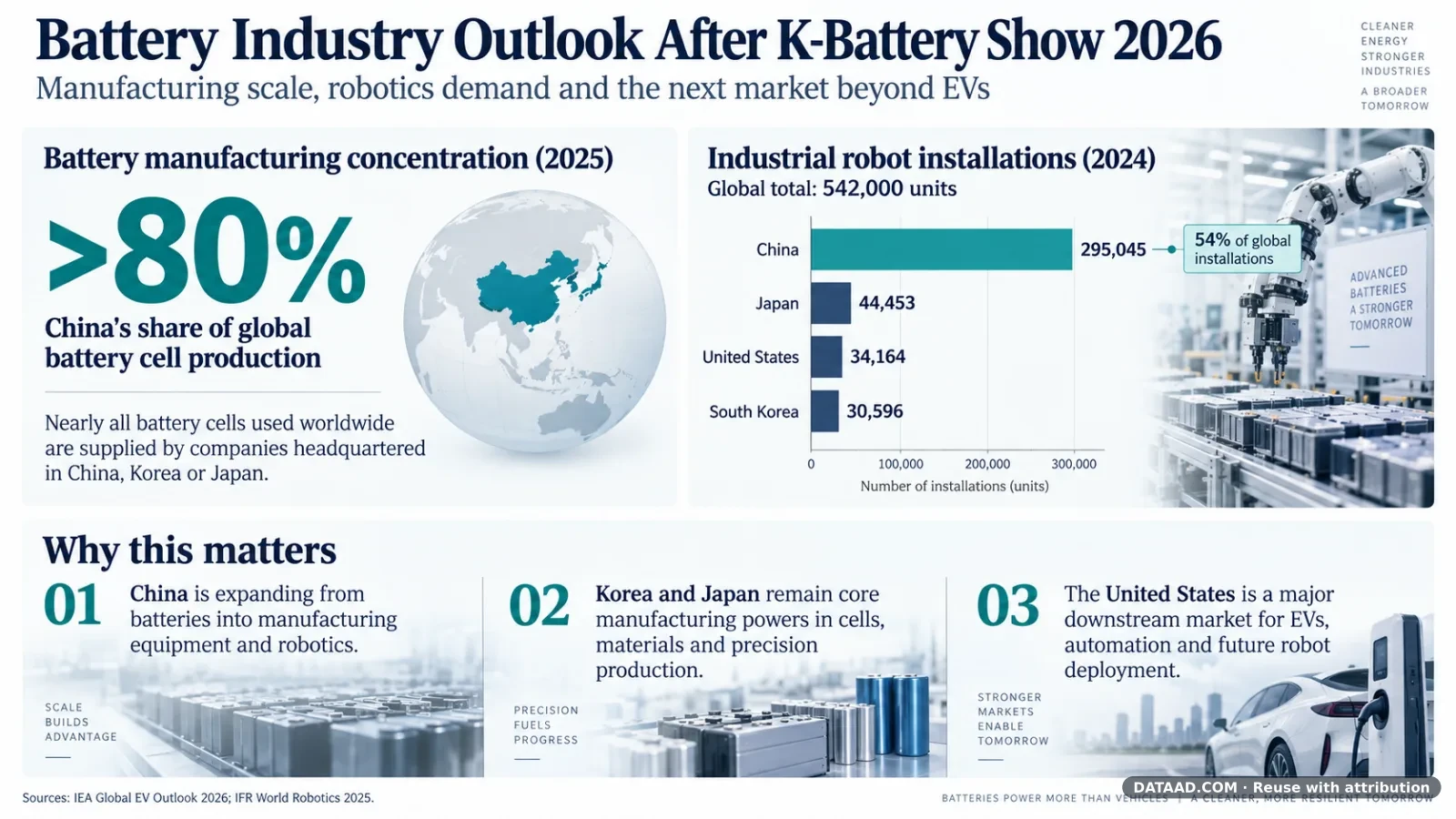
According to the International Energy Agency, China accounted for more than 80% of global battery cell production in 2025. The IEA also notes that lithium-ion battery manufacturing equipment is heavily concentrated in China, Korea and Japan.
This means the next stage of competition is not only about who owns the battery brand. It is also about who supplies the mixers, coating systems, formation equipment, inspection technologies, material-processing machines and automated production systems that allow factories to manufacture cells at high yield and low cost.
In other words, China is increasingly exporting not only batteries, but also parts of the industrial system required to manufacture batteries.
Korea's Opportunity Is the Manufacturing System Around the Cell
Korean exhibitors presented another side of this industrial transition.
Many of the technologies on display focused on process engineering rather than simply finished battery cells. Equipment included slurry-mixing systems, cell assembly technologies, testing machines, thermal equipment, manufacturing automation and production-support systems.
Revorox, for example, presented high-shear battery slurry mixing equipment. The exhibit highlighted mixing, dispersion and process optimization — processes that ultimately influence electrode uniformity and battery performance.

Elsewhere on the exhibition floor, companies demonstrated turnkey cell-production concepts, test equipment and systems covering cylindrical, prismatic and other battery formats.
This is an important area for Korea.
As battery factories become larger and more automated, competitiveness increasingly depends on yield, process repeatability, downtime, contamination control and energy consumption. Even small manufacturing improvements can become significant when multiplied across gigawatt-hours of annual cell production.
Korea therefore does not necessarily need to compete with China only on manufacturing scale. Its longer-term advantage may lie in high-reliability manufacturing, precision process control, advanced materials, factory automation and integration with electronics and semiconductor technologies.
The Seminar Program Shows What the Industry Is Worried About
The K-Battery Day conference program offered another useful indication of where the industry is heading.
The September 9 program covered trends, ESG, climate issues and recycling, but it also included a session on the “humanoid revolution” and the role of batteries in the next generation of machines.
On September 10, the emphasis shifts strongly toward fire safety. Sessions cover thermal-runaway risks, lithium-ion battery fire residues, artificial-intelligence-based battery-management systems, ESS fire response, EV battery impedance characteristics and AI-enabled battery-fire diagnosis and unmanned response.
The September 11 program then moves toward battery diagnosis, repair, reuse and recycling.
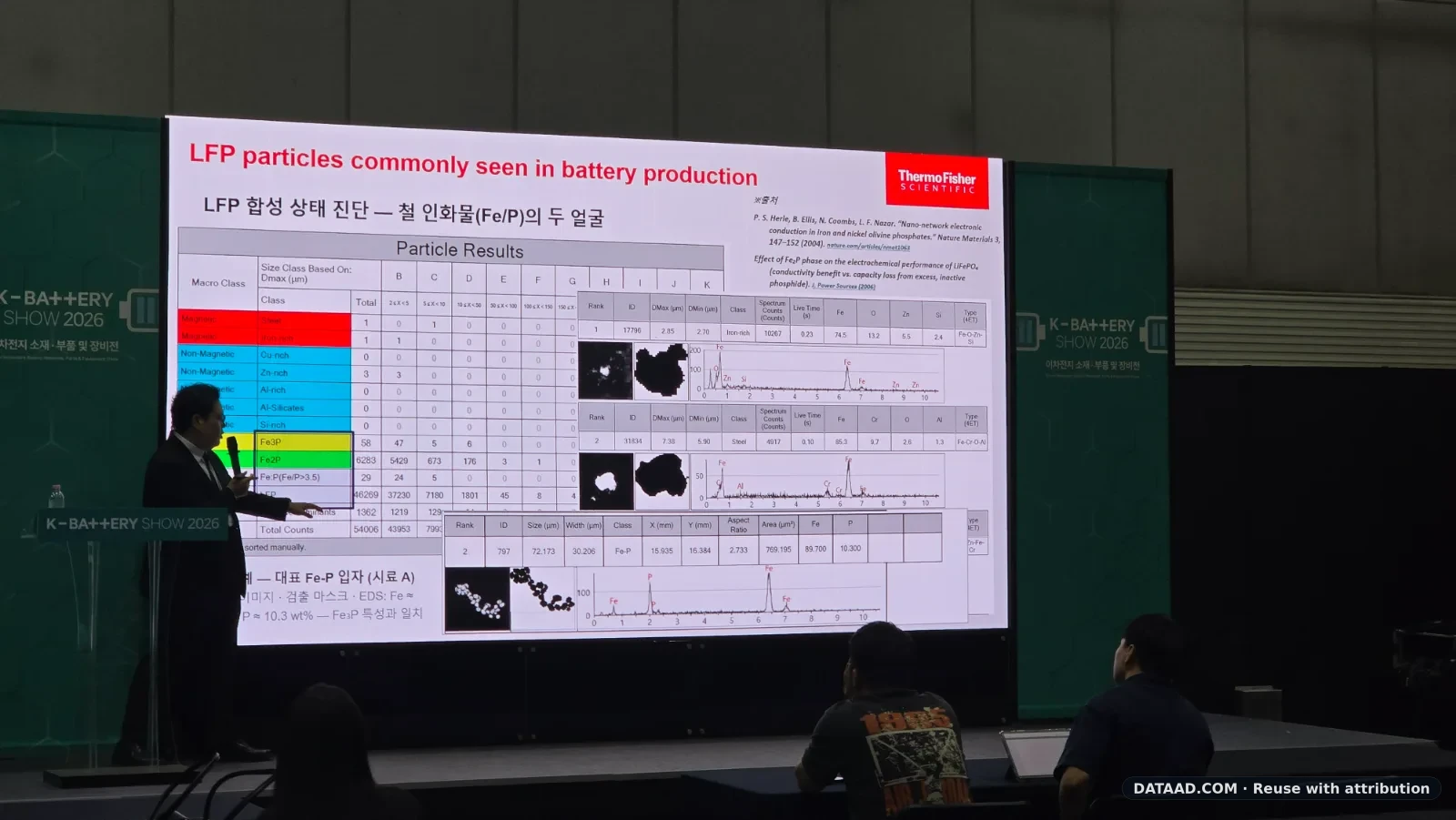
The sequence is revealing.
The battery industry's first major objective was increasing energy density. The second was scaling production. The third may increasingly be about lifecycle intelligence.
A future battery will not simply store electricity. Its temperature, impedance, charging history, deterioration, abnormal behavior and remaining useful life will increasingly become measurable data.
Artificial intelligence can then analyze that data to identify potential failures before they become fires, optimize charging, extend battery life and determine when a battery should be repaired, repurposed or recycled.
Safety Could Become More Valuable Than Another Few Percent of Energy Density
Battery safety was one of the clearest themes surrounding the exhibition and conference.
This reflects a fundamental change in where batteries are being deployed.
A battery inside a passenger vehicle is already a demanding safety application. But batteries are now moving into homes, warehouses, factories, large-scale ESS installations, drones, autonomous equipment and machines that may eventually work directly alongside people.
For these applications, maximizing energy density cannot be the only objective.
A battery capable of detecting abnormal thermal behavior, changes in internal impedance or early signs of degradation could ultimately be more valuable than a battery offering slightly higher capacity without the same level of diagnostic intelligence.
The next battery may be judged not only by how much energy it stores, but by how well it understands its own condition.
After EVs, Robots Could Become a Major New Battery Platform
The most interesting long-term question raised by K-Battery Show 2026 may be what comes after the first great EV battery expansion.
One possible answer is robots.
Industrial robots are already deployed at massive scale, while autonomous mobile robots, warehouse systems, drones, delivery machines, agricultural robots and humanoids could create entirely new categories of battery demand.
The International Federation of Robotics reported that 542,000 industrial robots were installed worldwide in 2024. China represented 54% of those installations, while Japan remained the world's second-largest industrial robot market and South Korea remained one of the world's most highly automated manufacturing economies.
South Korea now records the world's highest manufacturing robot density, according to IFR data, with 1,220 industrial robots per 10,000 manufacturing employees.
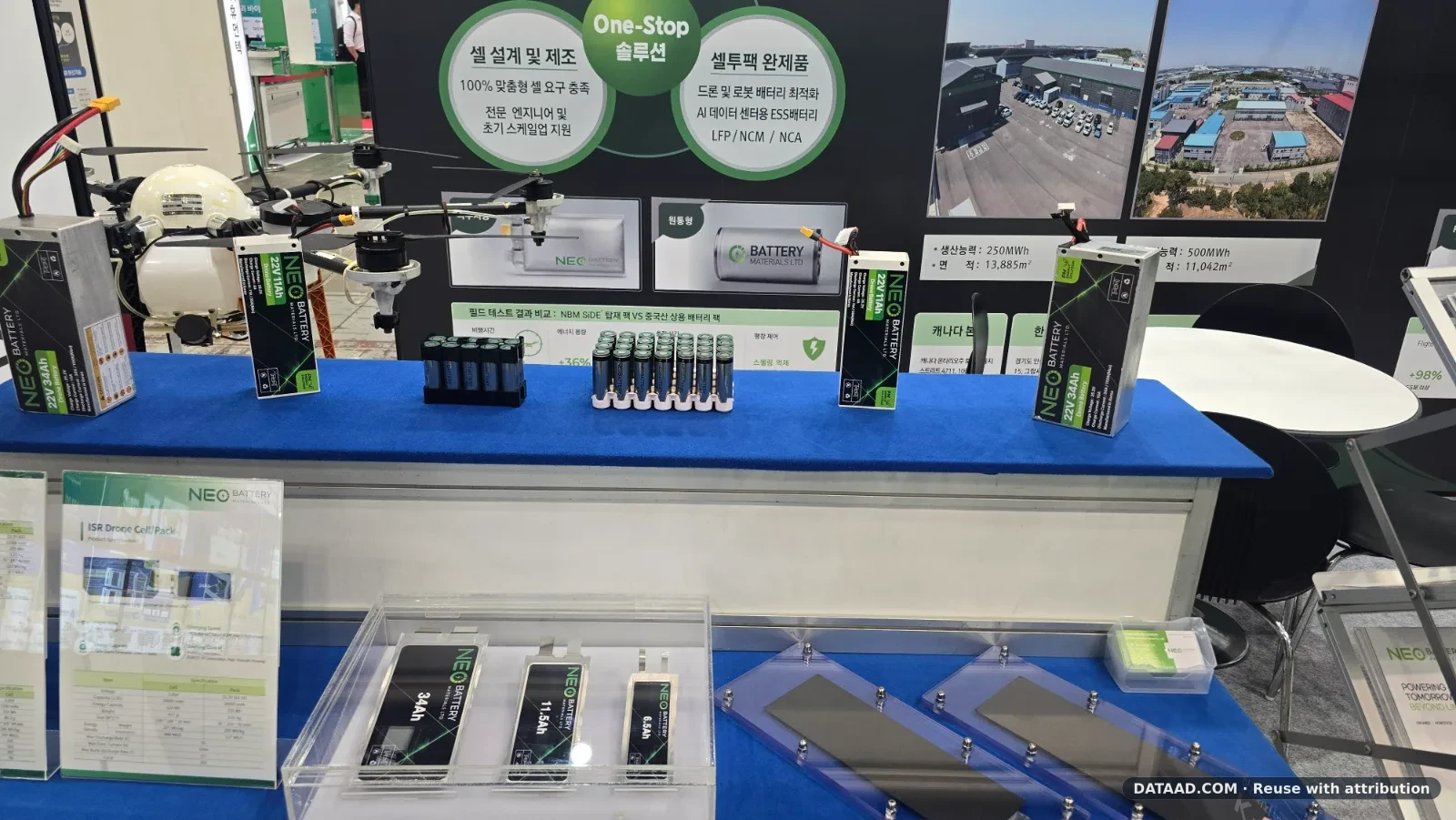
The connection between robotics and batteries deserves more attention.
An EV battery primarily needs to move a vehicle over long distances efficiently and safely. A robot battery can face a different duty cycle.
Humanoid and industrial mobile robots may require frequent acceleration, high instantaneous power for actuators, rapid charging, large numbers of charge-discharge cycles, compact packaging, low weight and extremely reliable thermal management.
Robots operating continuously in factories or logistics centers may also favor modular or rapidly replaceable battery packs rather than simply maximizing total energy capacity.
This suggests that the robot battery market may eventually resemble a combination of the automotive battery, industrial battery, electronics and power-tool industries.
China, Korea and Japan Start From Different Strengths
The emergence of batteries for robotics and physical AI creates an interesting industrial structure because the countries already strong in batteries are also major manufacturing and robotics economies.
| Market | Potential Competitive Strength |
|---|---|
| China | Battery scale, LFP chemistry, raw-material processing, manufacturing equipment, low-cost industrialization and rapidly expanding robotics. |
| South Korea | Advanced battery cells, electronics, precision manufacturing, automated factories, semiconductor integration and global battery-production networks. |
| Japan | Materials science, precision engineering, industrial robotics, manufacturing reliability and long-life system design. |
| United States | Large downstream market, AI software, autonomous systems, warehouse automation, defense applications, capital and technology-platform companies. |
This does not mean that each country will remain confined to one role. All four are attempting to strengthen domestic supply chains and manufacturing capabilities.
But the existing industrial structure is significant.
The IEA estimates that companies headquartered in China, Korea and Japan collectively supply almost all lithium-ion battery cells used worldwide. At the same time, the United States remains one of the world's largest markets for automobiles, computing, automation, logistics and AI technologies.
That combination could create a new industrial relationship:
Asian battery and manufacturing strength combined with rapidly growing global demand for AI-powered physical machines.
The United States May Become More Important as a Deployment Market
The United States should not be described merely as a battery consumer.
Battery manufacturing capacity in the country has expanded significantly, much of it through investments and partnerships involving Korean and Japanese manufacturers. However, America's greatest long-term influence may come from the systems that use batteries.
AI-driven warehouses, autonomous logistics, defense systems, drones, electric aviation, robotic manufacturing and eventually humanoid robots could create large downstream markets for specialized battery systems.
That could change the economics of the battery industry.
The largest future battery customer may not always be an automobile manufacturer. It could be a robotics company, logistics platform, AI infrastructure provider, defense contractor or autonomous-machine operator.
EVs Remain the Core Market — But They May No Longer Define the Entire Industry
Electric vehicles are still by far the largest source of battery demand. According to the IEA, EVs accounted for more than 70% of total global battery deployment in 2025, with EV battery deployment reaching approximately 1.2 TWh.
But that share itself illustrates the broader point: batteries are already expanding into other applications.
ESS, distributed energy systems, drones, industrial equipment, robotics and other mobile machines are creating additional demand with different technical requirements.
The EV era created the gigafactory.
The physical-AI era could create something more distributed: millions — and eventually perhaps billions — of intelligent machines, each requiring its own energy system.
DATAAD View: The Battery Is Becoming Part of the Intelligence Stack
K-Battery Show 2026 demonstrated that the battery industry is gradually becoming more than an energy-storage industry.
It is becoming a manufacturing, data and infrastructure industry.
A modern battery system increasingly combines chemistry, thermal management, sensors, power electronics, communications, software and artificial intelligence.
That convergence will become even more important as physical AI moves intelligence away from screens and data centers and into machines operating in the physical world.
For China, the opportunity lies in extending enormous battery manufacturing scale into equipment and robotics.
For Korea, it lies in connecting batteries with advanced manufacturing, electronics, semiconductors and automation.
For Japan, the opportunity remains closely tied to precision engineering, materials and robotics.
And for the United States, the combination of AI, capital and a large technology-consumption market could make it one of the most important places where these new battery-powered machines are ultimately deployed.
K-Battery Show 2026 suggests that this transition has already started.
Field observations and photographs: K-Battery Show 2026, KINTEX, Goyang, South Korea. Additional market context: International Energy Agency, Global EV Outlook 2026; International Federation of Robotics, World Robotics 2025.