
AI's Next Bottleneck May Be Electricity, Not Computing Power
The global expansion of artificial intelligence is creating an unprecedented challenge for the energy industry. As AI data centers move toward increasingly powerful GPU clusters, securing sufficient electricity is becoming as important as acquiring advanced semiconductors.
Next-generation AI racks are already entering the 100–200 kW power class, while future infrastructure could push individual rack power consumption considerably higher. Large AI data center campuses may require hundreds of megawatts of continuous electricity, in addition to power for cooling, networking and supporting facilities.
Unlike conventional commercial buildings, AI infrastructure requires exceptionally reliable power supplies. Transmission constraints, grid connection delays and carbon-reduction commitments are therefore becoming major obstacles to AI infrastructure development.
This raises an important question: could small modular reactors (SMRs) become a practical source of electricity for the next generation of AI data centers?
Doosan's Strategy: Becoming the Foundry for SMR Developers
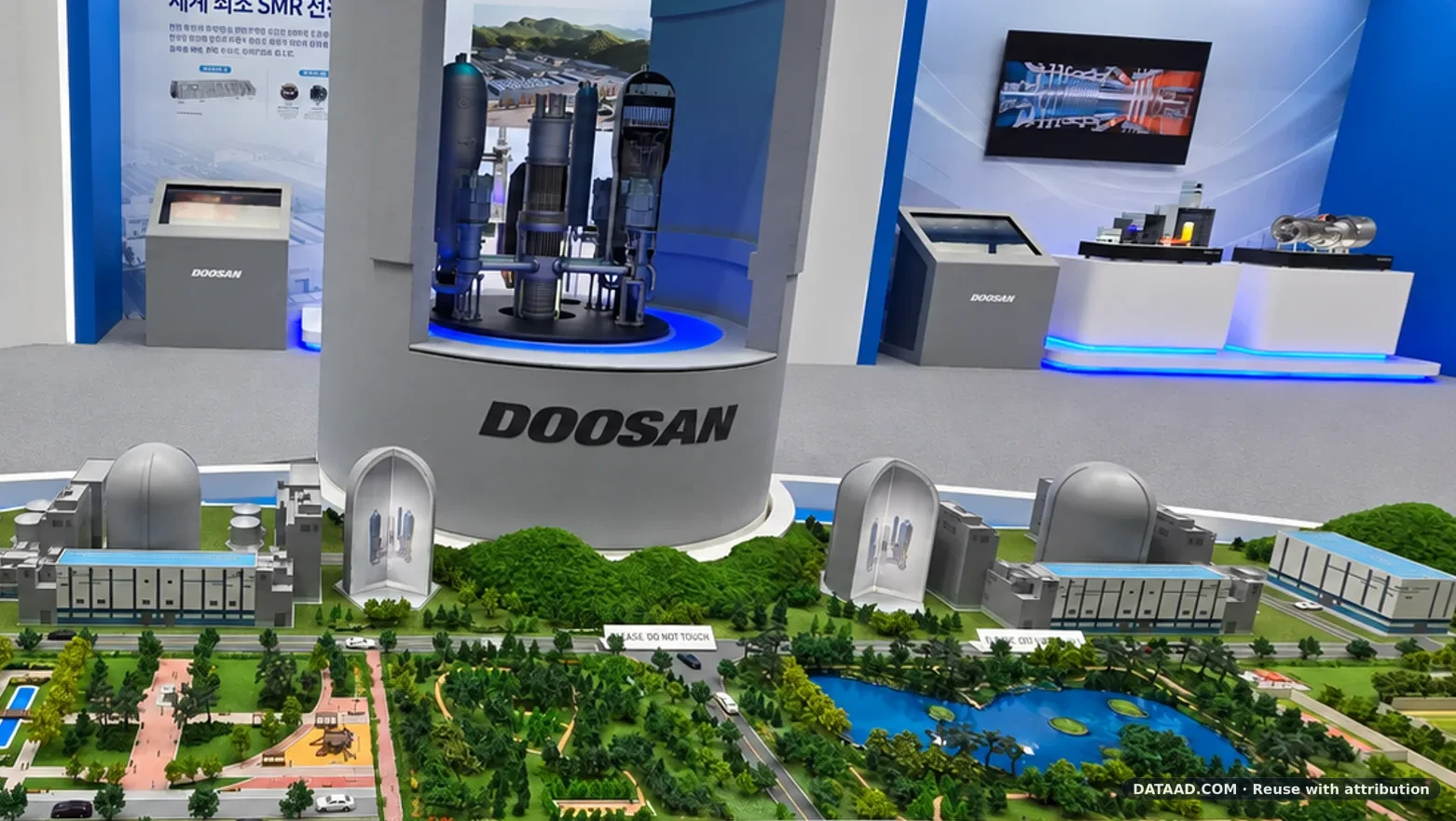
At an industry exhibition in South Korea, Doosan Enerbility presented its vision for the emerging SMR manufacturing market, including reactor models developed by American nuclear technology companies X-energy and NuScale Power.
Rather than concentrating primarily on developing a proprietary reactor design, Doosan is pursuing a different industrial strategy: becoming a global manufacturing partner capable of producing critical nuclear equipment for multiple SMR developers.
Doosan calls this approach its SMR Foundry strategy.
The concept has similarities to the semiconductor foundry industry. Just as semiconductor designers rely on specialized manufacturers to produce complex chips, SMR technology developers require industrial partners capable of manufacturing nuclear-grade reactor vessels, forgings and other critical components.
In this structure, reactor developers focus on technology, engineering, licensing and commercialization, while specialized manufacturers such as Doosan provide the production capabilities needed to transform reactor designs into physical equipment.
Doosan's Changwon manufacturing facilities in South Korea are central to this strategy. The company is expanding its SMR production capabilities and developing advanced manufacturing processes intended to reduce production lead times and support the simultaneous manufacturing of multiple reactor modules.
These technologies include powder metallurgy hot isostatic pressing (PM-HIP), electron beam welding (EBW) and diode laser cladding (DLC).
The company has established strategic relationships with NuScale Power, X-energy and TerraPower. It has also expanded its European market opportunities through cooperation with Rolls-Royce SMR.
For Doosan, the strategic objective is not necessarily to determine which reactor design will dominate the global market. Instead, it is to become a qualified manufacturing partner for multiple technologies as the SMR industry moves toward commercialization.
American Reactor Technologies: X-energy and NuScale
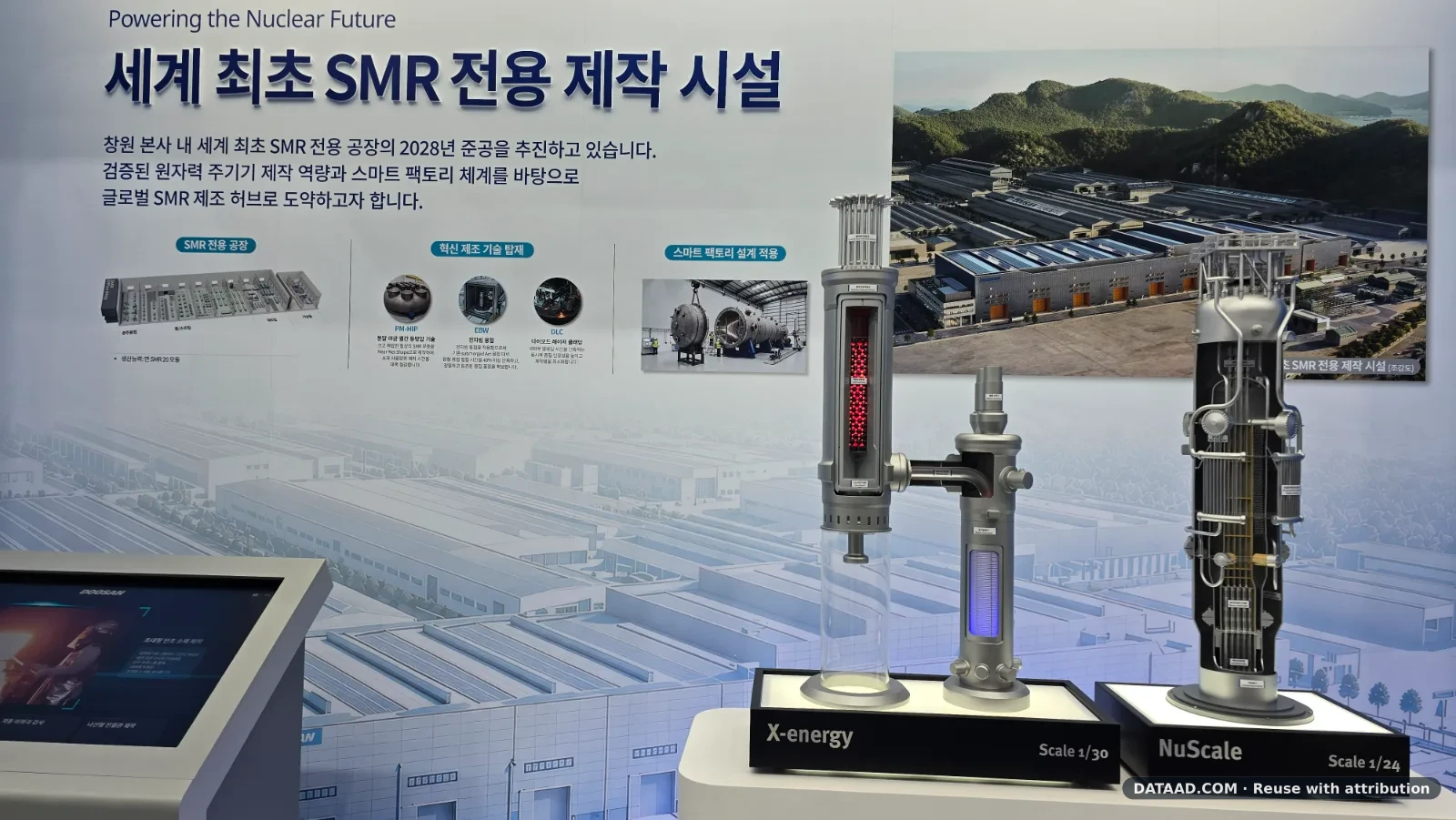
The reactor models displayed at Doosan's exhibition illustrate the technological diversity of the emerging SMR market.
X-energy: High-Temperature Gas-Cooled Reactor
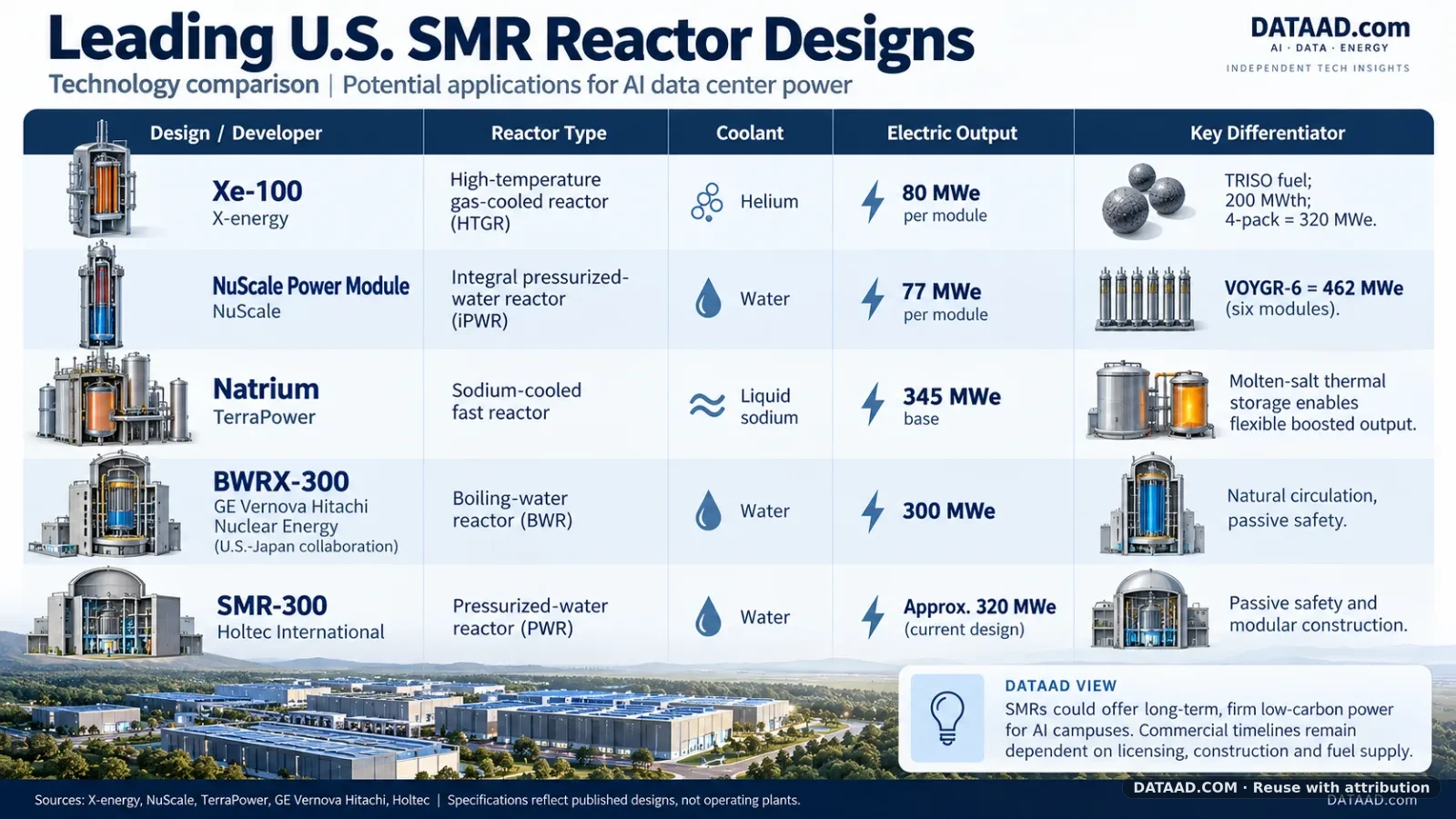
X-energy is developing the Xe-100, an advanced high-temperature gas-cooled reactor designed to produce approximately 80 MW of electricity per module.
The reactor uses helium as its primary coolant and is designed to support both electricity generation and industrial heat applications.
In December 2025, Doosan and X-energy announced a reservation agreement covering critical steel components for 16 Xe-100 reactor units. The agreement is intended to secure manufacturing capacity for X-energy's early commercial projects.
Doosan is also expanding its specialized manufacturing facilities to support future SMR production requirements.
NuScale Power: Modular Water-Cooled Reactor
NuScale Power is developing an integral pressurized-water reactor architecture based on light-water nuclear technology.
Its US460 design incorporates six 77 MWe modules, providing a nominal combined electrical output of approximately 462 MWe.
Doosan has worked with NuScale on the manufacturing of reactor-related components and materials, supporting its ambition to supply equipment for multiple SMR designs.
Although the two technologies employ different cooling architectures and reactor configurations, both depend on specialized nuclear-grade manufacturing capabilities.
This diversity supports Doosan's broader foundry strategy.
Why SMRs Are Attracting Attention from AI Data Center Operators
The attractiveness of SMRs for AI infrastructure lies not simply in their smaller size, but in their potential to provide substantial amounts of reliable electricity over long operating periods.
- Continuous electricity generation: Nuclear reactors can provide high-capacity power independent of daily weather conditions.
- Modular expansion: Multiple reactor units could potentially be deployed as electricity demand increases.
- Lower operational carbon emissions: Nuclear generation can contribute to long-term decarbonization strategies.
- Long-term energy supply: Nuclear power assets can potentially support major industrial infrastructure over several decades.
Consider a hypothetical AI data center campus requiring 400 MW of continuous electrical power.
Five Xe-100 modules rated at 80 MWe each would provide a combined nominal output of 400 MWe. In practice, however, additional capacity planning would be required to account for maintenance, availability, operating reserves and electrical losses.
SMRs should therefore be considered as potential components of a wider energy strategy rather than automatic replacements for grid connections, energy storage or backup generation.
Amazon, X-energy and Doosan: Connecting Nuclear Power to AI Infrastructure
The relationship between SMRs and artificial intelligence is moving beyond theoretical discussions.
In August 2025, X-energy, Amazon, Korea Hydro & Nuclear Power (KHNP) and Doosan Enerbility announced a strategic collaboration intended to accelerate the deployment of advanced nuclear energy in the United States.
The collaboration supports plans for more than 5 GW of new nuclear generating capacity by 2039, addressing rising electricity requirements from AI data centers, advanced manufacturing and other energy-intensive industries.
This partnership illustrates how an emerging nuclear energy supply chain could operate.
- AI infrastructure operators: Create long-term demand for reliable electricity.
- SMR technology developers: Provide reactor designs, nuclear technology and licensing expertise.
- Utilities and project developers: Develop, construct and operate generating facilities.
- Industrial manufacturers: Supply critical reactor equipment and nuclear-grade components.
Doosan's participation demonstrates how South Korean industrial manufacturing capabilities could contribute directly to the expansion of American AI infrastructure.
The 2030 Challenge: Can SMRs Arrive in Time?
The period around 2030 is emerging as an important commercialization target for the first generation of advanced SMR projects.
However, development targets should not be confused with guaranteed commercial operating dates.
Before an SMR can supply power to an AI data center, several requirements must be satisfied, including regulatory approval, project financing, site development, nuclear fuel availability, manufacturing, construction and commissioning.
Some advanced reactor technologies also depend on specialized fuel supply chains that remain under development.
Even if initial commercial projects begin operation around 2030, large-scale deployment across multiple data center campuses is likely to require additional years.
This creates a significant timing challenge.
AI electricity demand is increasing today, while SMRs represent a medium- to long-term energy solution.
Grid expansion, gas-fired generation, renewable electricity, storage technologies and improvements in data center energy efficiency will therefore remain essential during the transition.
For Doosan, however, manufacturing opportunities may arise well before the reactors begin generating electricity.
Large reactor components require specialized materials, production facilities and long manufacturing lead times. Developers may need to reserve manufacturing capacity years before their planned operating dates.
Consequently, manufacturing agreements and capacity reservations represent important indicators of the SMR industry's transition toward actual commercial deployment.
SMR Foundry: A New Industrial Opportunity for South Korea
Doosan's SMR strategy could also have wider implications for South Korea's industrial supply chain.
Commercial SMR deployment will require more than reactor vessels alone. Nuclear projects depend on extensive networks of qualified suppliers providing valves, pumps, heat exchangers, piping systems, instrumentation, electrical equipment and other engineered components.
Although nuclear power plants and AI data centers employ different technical and safety standards, both industries increasingly depend on sophisticated engineering, manufacturing quality and long-term infrastructure reliability.
If SMR manufacturing volumes increase, South Korean companies with established experience in precision engineering, nuclear equipment, materials and industrial manufacturing could find new opportunities within the global supply chain.
However, nuclear qualification requirements remain demanding, and participation in conventional industrial markets does not automatically qualify suppliers for nuclear applications.
The commercial success of an SMR foundry model will ultimately depend on whether developers can transition from first-of-a-kind projects to repeatable manufacturing orders.
DATAAD VIEW | The SMR Foundry May Become as Important as the Reactor Design
The most compelling aspect of Doosan's strategy is its decision to build manufacturing capabilities that can serve multiple reactor technologies.
The semiconductor industry offers an instructive comparison.
Companies such as NVIDIA concentrate on advanced processor architectures, while semiconductor foundries manufacture the physical chips that bring those designs into commercial production.
A comparable division of responsibilities could gradually emerge within the SMR industry.
Reactor developers may compete on efficiency, safety, fuel technology and system design, while qualified manufacturers compete on production capacity, manufacturing precision, quality assurance and delivery performance.
The comparison is not exact. Nuclear power remains subject to extensive national regulation, project-specific engineering and much longer construction cycles than semiconductor manufacturing.
Nevertheless, the underlying industrial principle is similar: specialized manufacturing capability can become a strategic asset independently of the underlying product design.
For the AI industry, SMRs offer a potential response to one of its most difficult infrastructure challenges: securing large amounts of dependable, lower-carbon electricity over the coming decades.
For Doosan, the opportunity is different but equally significant.
The company does not need to design the world's dominant SMR. It needs to become one of the manufacturers capable of building whichever reactor designs succeed.
If SMRs become a meaningful source of electricity for AI data centers during the 2030s, the ability to manufacture nuclear reactors at scale could become one of South Korea's most important contributions to the global AI energy infrastructure ecosystem.
References & Further Reading
- Doosan Enerbility — Reservation Agreement with X-energy for 16 SMR Units, December 2025
- X-energy — Amazon, KHNP and Doosan Partnership for AI Infrastructure, August 2025
- Doosan Enerbility — 2025 Integrated Report, SMR Foundry Strategy
- Doosan — Rolls-Royce SMR Manufacturing Partnership, May 2026
Editorial note: This article is an independent technology and industry analysis by DATAAD. Commercial reactor schedules, generating capacities and manufacturing plans are subject to regulatory approval, project development and future revisions. Exhibition photographs were taken by DATAAD.