
BERLIN — The global railway industry is gathering in Berlin this week with a clear message: the next generation of rail transport will be cleaner, increasingly digital and more autonomous.
InnoTrans 2026, held from September 22 to 25 at Messe Berlin, is the largest edition in the exhibition's 30-year history. The event brings together 3,170 exhibitors from 59 countries across all 42 exhibition halls, with 180 world premieres covering rolling stock, infrastructure, electrification, artificial intelligence, robotics and public transportation.
More than 100 railway vehicles are also being displayed on approximately 3.5 kilometers of outdoor track, making Berlin a temporary showcase of the technologies now competing to define the future of global rail transportation.
Hyundai Rotem brings Korea's future rail technologies to Berlin
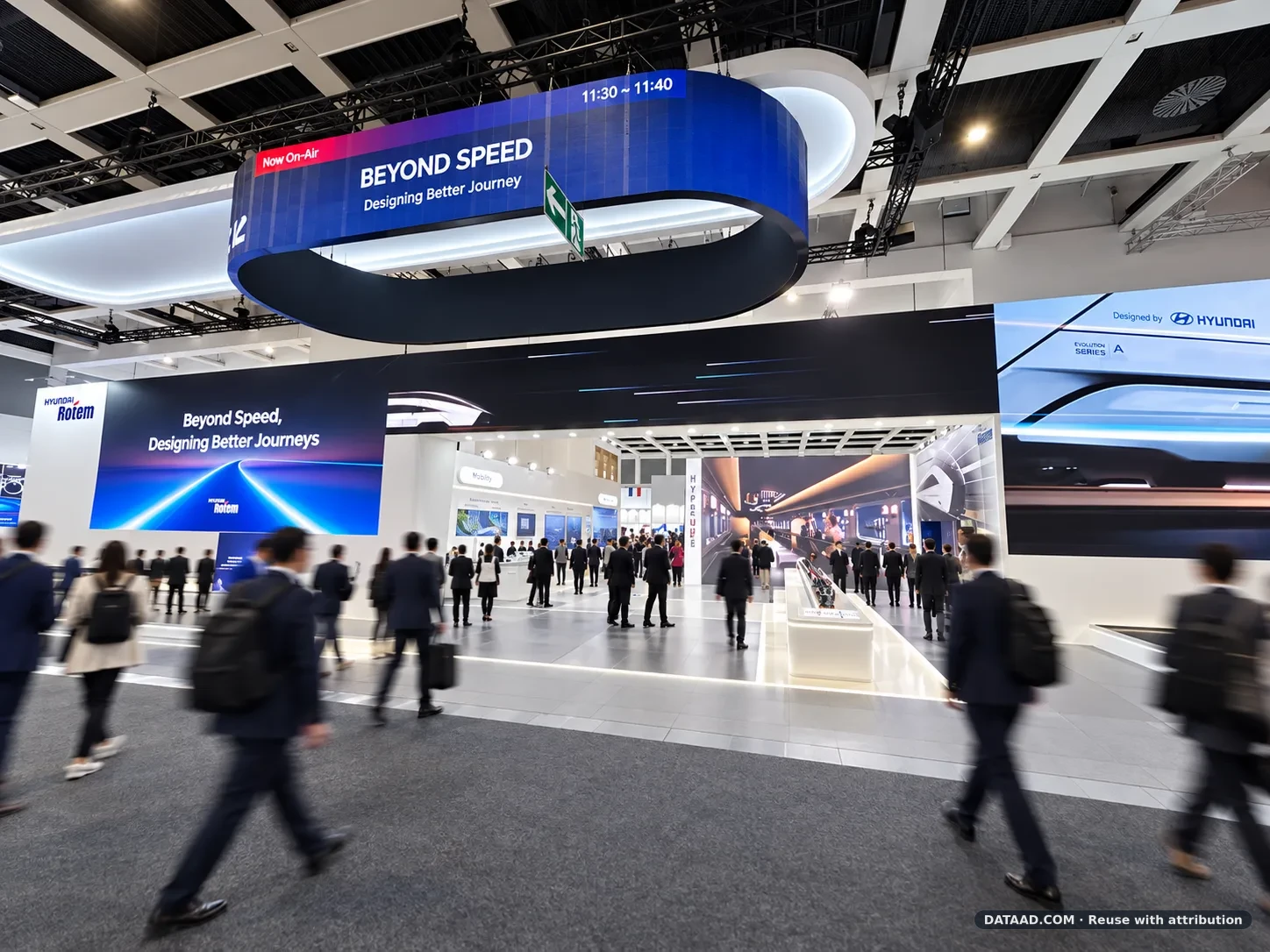
Among the major Asian manufacturers participating this year is South Korea's Hyundai Rotem, which is presenting technologies spanning high-speed rail, hydrogen mobility and artificial intelligence.
The company has unveiled a next-generation high-speed train concept developed in cooperation with Hyundai Motor Group's design organization. The exterior applies aerodynamic design principles inspired by biomimicry, while the passenger cabin focuses on improved interior space, ergonomics and passenger movement.
Hyundai Rotem is also displaying an actual EMU-320 in the outdoor exhibition area. The distributed-power high-speed train, which has a maximum operating speed of 320 km/h, forms the technological basis of Korea's KTX-Cheongryong high-speed train.
Hyundai Rotem's exhibition booth at InnoTrans 2026 in Berlin. The Korean rolling-stock manufacturer is presenting high-speed rail, hydrogen mobility and AI-based railway technologies.
Hydrogen moves from concept vehicle to complete rail system
One of the most notable elements of Hyundai Rotem's exhibition is its hydrogen mobility portfolio.
The company is displaying an actual hydrogen fuel-cell module together with concepts for hydrogen-electric locomotives, hydrogen power cars and low-floor hydrogen-electric multiple units. Rather than presenting hydrogen only as an individual vehicle concept, the display highlights the fuel cell, power system and rolling stock as parts of a broader propulsion architecture.
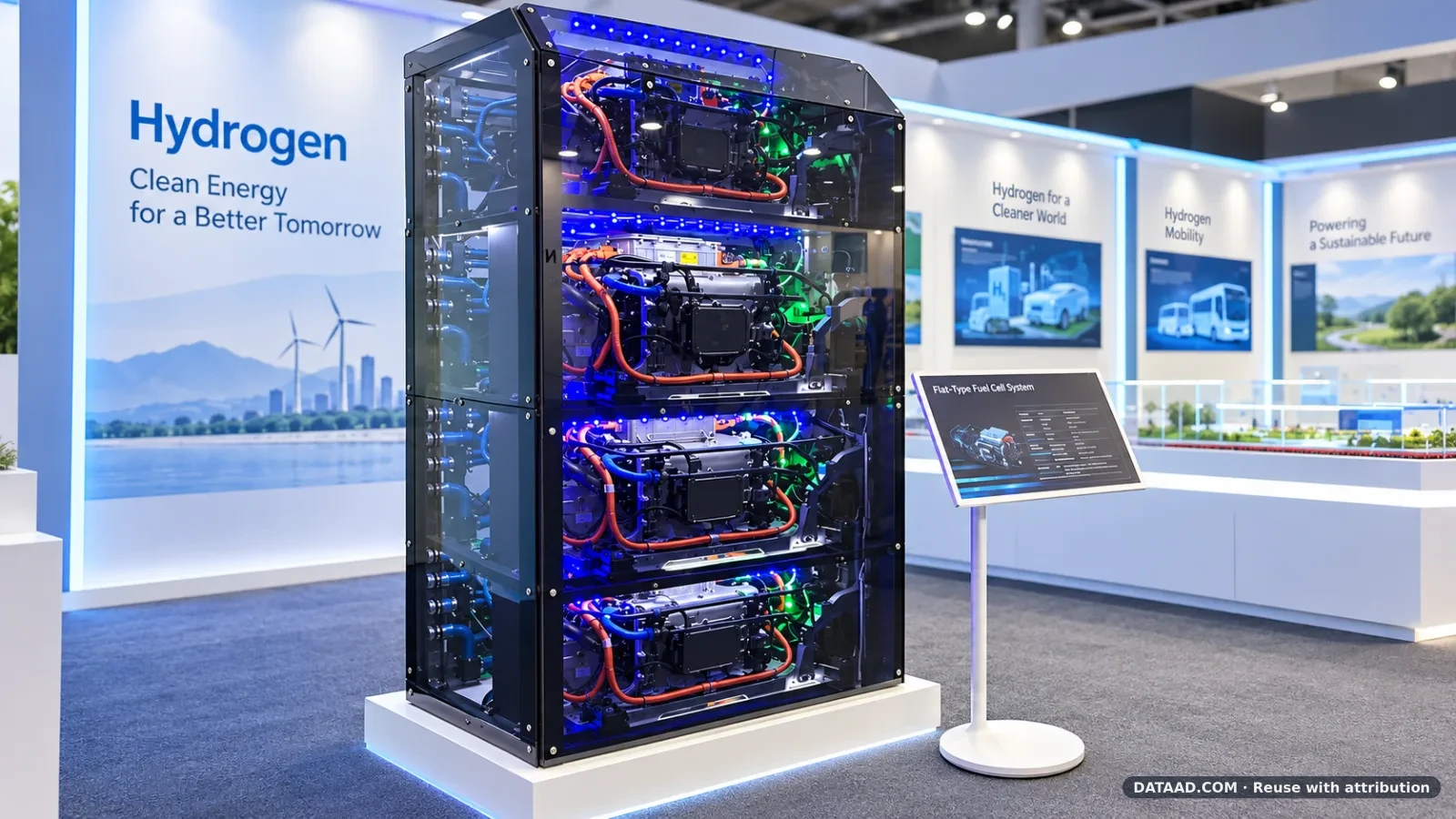
Hyundai Rotem describes its hydrogen mobility architecture as a hybrid propulsion system combining hydrogen fuel cells with electric batteries. Such systems are being explored particularly for routes where continuous overhead electrification is difficult or economically challenging.
The company is also showing a hydrogen-electric tram concept incorporating Physical AI-based autonomous operation.
The system combines artificial intelligence, onboard sensing and an Advanced Driver Assistance System designed specifically for railway vehicles. Hyundai Rotem says the technology can recognize people, structures and potential hazards along the route and support functions ranging from pre-operation inspection to driving and maintenance.
This is particularly relevant for trams, which frequently operate in environments shared with pedestrians, bicycles and road vehicles.
Hydrogen and batteries emerge side by side
Hyundai Rotem is not alone in exploring alternatives to conventional diesel traction.
Across the InnoTrans outdoor display, manufacturers are showing several different approaches to reducing emissions on non-electrified or partially electrified railway networks.
Stadler is presenting a hydrogen-powered narrow-gauge train as well as battery-powered rolling stock, while China's CRRC is showing a hydrogen fuel-cell hybrid locomotive. CAF is presenting its Civity battery electric multiple unit.
The diversity of these platforms illustrates an important shift in railway decarbonization: there may not be one propulsion technology suitable for every route.
Overhead electric power remains highly efficient on heavily used electrified networks, while battery systems can bridge shorter non-electrified sections. Hydrogen fuel cells are being evaluated for applications requiring longer autonomous operation, fast refueling or operation where installing continuous catenary infrastructure is difficult.
ABB focuses on the electrical backbone of rail
While rolling-stock manufacturers attract much of the attention at InnoTrans, another important part of the transformation is taking place behind the vehicles themselves.
ABB is presenting railway technologies covering power distribution, traction, switching, cable protection, building control and digital energy management.
The company's presence illustrates how the transition toward electric, battery and hybrid rail increases the importance of power electronics and energy-management systems throughout the railway value chain.
Future rail systems will require not only new propulsion technologies but also reliable power conversion, distribution, onboard energy storage, protection systems and digital monitoring across trains, stations and infrastructure.
Siemens pushes the software-defined railway
Germany's Siemens Mobility is taking another direction at InnoTrans 2026, placing data and artificial intelligence at the center of its rail strategy.
The company is premiering Vectron X, its latest locomotive platform, which extends the Siemens Xcelerator digital ecosystem directly into rolling stock.
Vectron X combines conventional locomotive technology with standardized data interfaces, connected applications and software-based functionality. Siemens is positioning the platform as part of a broader software-defined railway architecture connecting vehicles, signaling, maintenance systems and infrastructure.
AI-based traffic management, predictive maintenance, infrastructure diagnostics and passenger information are among the applications being demonstrated by Siemens at the exhibition.
From mechanical engineering to an integrated energy and data platform
The technologies visible in Berlin suggest that railway engineering is moving beyond the traditional boundaries of rolling-stock manufacturing.
A modern train increasingly combines mechanical engineering with high-power electrical systems, batteries or fuel cells, thermal management, sensors, communications infrastructure, cybersecurity and artificial intelligence.
For manufacturers such as Hyundai Rotem, the challenge is therefore expanding. Global competition is no longer based only on speed, reliability and manufacturing capability. Future railway platforms are increasingly being evaluated as integrated mobility systems.
Hydrogen propulsion, battery systems and conventional electrification will continue to compete and coexist depending on route characteristics and infrastructure. At the same time, AI and digital technologies are becoming common layers connecting all of those propulsion architectures.
Berlin provides a glimpse of the next railway technology cycle
InnoTrans 2026 brings these trends together in one place.
Hyundai Rotem's combination of high-speed rail, hydrogen fuel cells and Physical AI represents one approach. Siemens is emphasizing software-defined railways, ABB the electrical and energy infrastructure behind them, while Stadler, CRRC, CAF and other manufacturers are developing different combinations of hydrogen, batteries and conventional electrification.
The result is a railway industry moving toward a more diverse technology landscape — one in which propulsion, energy, data and autonomous operation are increasingly designed as a single system.
For Korea, Hyundai Rotem's presence in Berlin is also significant. The company is no longer presenting only rolling stock manufactured for individual projects. Its InnoTrans 2026 exhibition shows an effort to position Korean rail technology within the emerging global competition for high-speed, hydrogen-powered and intelligent transportation systems.
In Berlin, the future of rail is no longer defined simply by how fast a train can travel. Increasingly, it is being defined by how efficiently it uses energy, how intelligently it operates and how seamlessly the vehicle connects with the infrastructure around it.