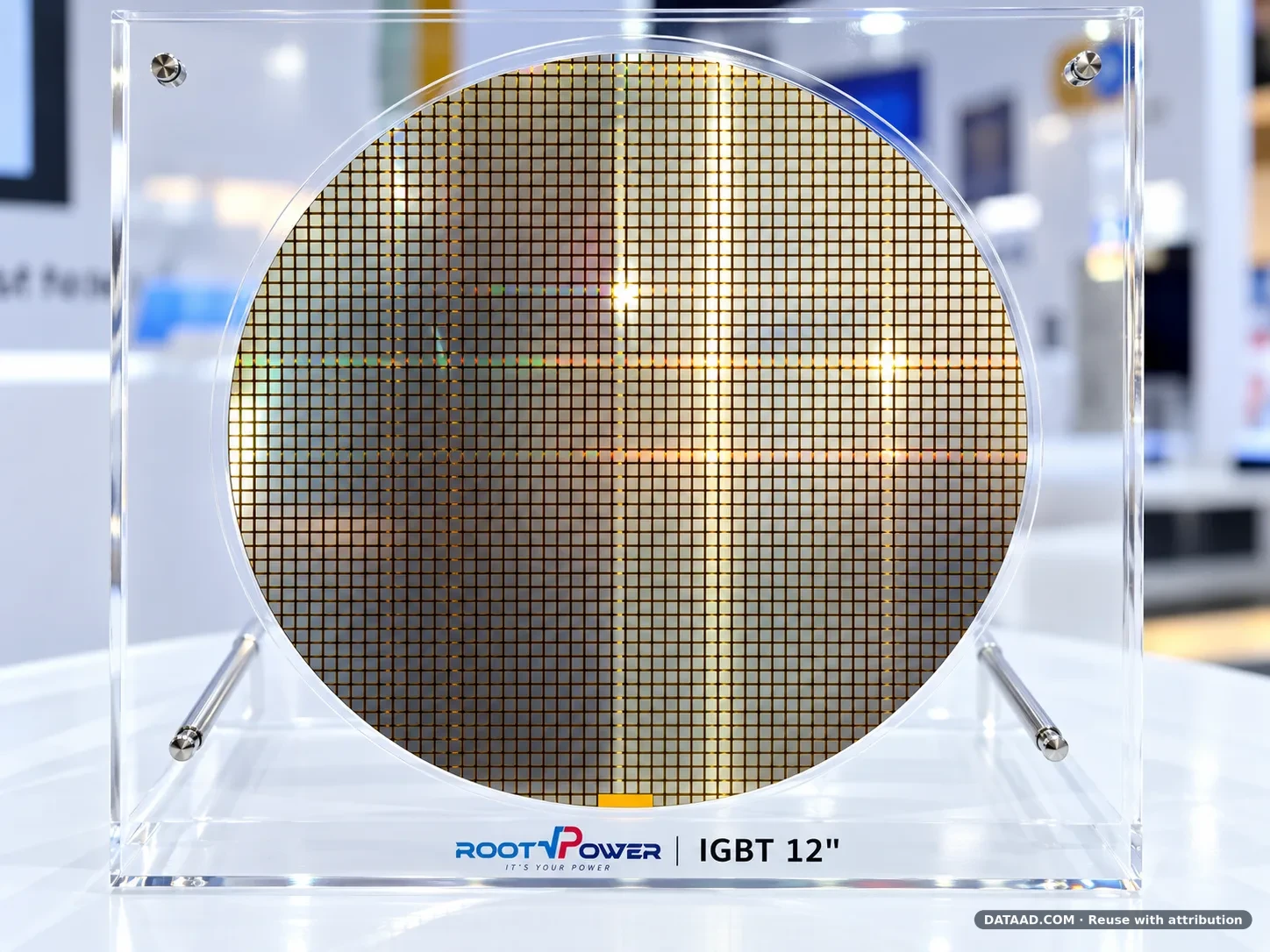
The semiconductor industry is often discussed through the lens of CPUs, GPUs and memory. But the rapid expansion of artificial intelligence, electric vehicles, renewable energy and high-density data centers is bringing another semiconductor category into the spotlight: power semiconductors.
Among them, the IGBT (Insulated Gate Bipolar Transistor) has played a particularly important role in controlling large amounts of electrical power. While CPUs and GPUs process information, IGBTs perform a very different task: they switch and control the electrical energy that allows machines, power converters and industrial infrastructure to operate.
Semiconductors Do Different Jobs
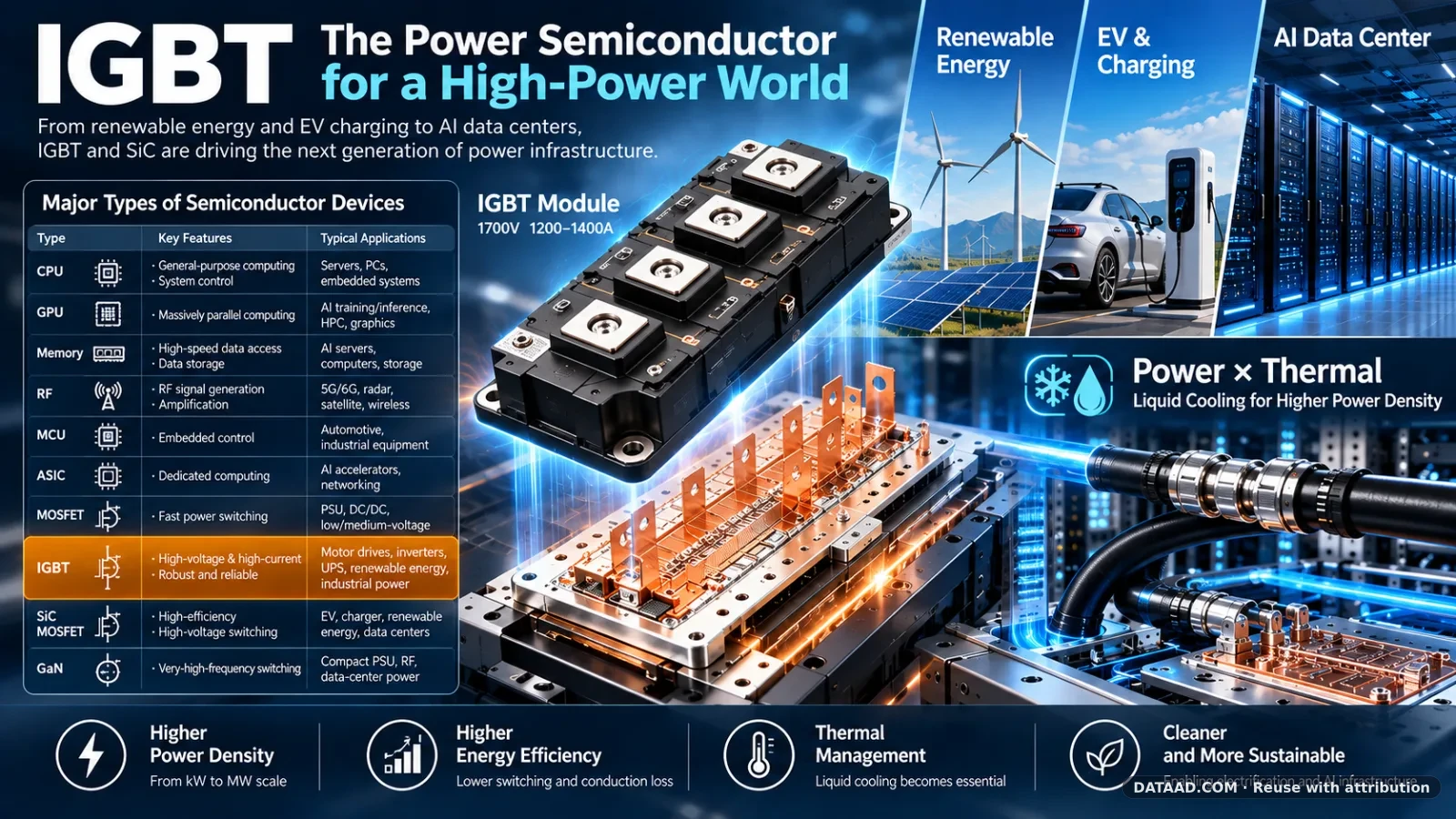
The word “semiconductor” covers a broad family of devices. Some calculate, some store data, some communicate, and others control electrical power. Understanding these differences is increasingly important as computing infrastructure becomes both more powerful and more energy-intensive.
| Semiconductor | Full Name / Type | Primary Role | Typical Applications |
|---|---|---|---|
| CPU | Central Processing Unit | General-purpose computation and system control | Servers, PCs, embedded computing |
| GPU | Graphics Processing Unit | Massively parallel computation | AI training, inference, HPC, graphics |
| Memory | DRAM / HBM / NAND | High-speed data access and storage | AI accelerators, servers, computers, storage |
| RF | Radio Frequency Semiconductor | Generation, amplification and processing of RF signals | 5G/6G, radar, satellite, wireless communication |
| MCU | Microcontroller Unit | Embedded control | Automotive, industrial equipment, IoT |
| ASIC | Application-Specific Integrated Circuit | Optimized computation for dedicated workloads | AI accelerators, networking, specialized computing |
| MOSFET | Metal-Oxide-Semiconductor Field-Effect Transistor | Fast electrical switching | Power supplies, DC/DC converters, industrial electronics |
| IGBT | Insulated Gate Bipolar Transistor | High-voltage and high-current switching | Motor drives, inverters, UPS, renewable energy and industrial power |
| SiC MOSFET | Silicon Carbide MOSFET | High-efficiency, high-voltage switching | EVs, fast chargers, renewable energy, high-efficiency power conversion |
| GaN | Gallium Nitride Device | High-frequency, high-efficiency switching and RF amplification | Compact power supplies, RF systems and high-frequency converters |
CPU and GPU process information. Memory stores it. RF semiconductors transmit signals. Power semiconductors such as IGBTs, MOSFETs and SiC devices control the electrical energy that makes the entire system possible.
IGBT: The High-Power Switch
An IGBT combines characteristics associated with MOS-gate control and bipolar conduction. This makes it particularly useful where substantial voltage and current must be switched reliably and efficiently.
Instead of performing calculations like a CPU or GPU, an IGBT essentially operates as an extremely fast electronic power switch. By switching electrical current on and off under electronic control, it becomes a fundamental building block in power conversion systems.
IGBT modules can therefore be found in industrial motor drives, traction systems, renewable-energy converters, UPS systems, power converters and other high-power equipment. Large modules can handle voltages and currents far beyond those normally associated with logic semiconductor devices.

Why Is There So Much Copper?
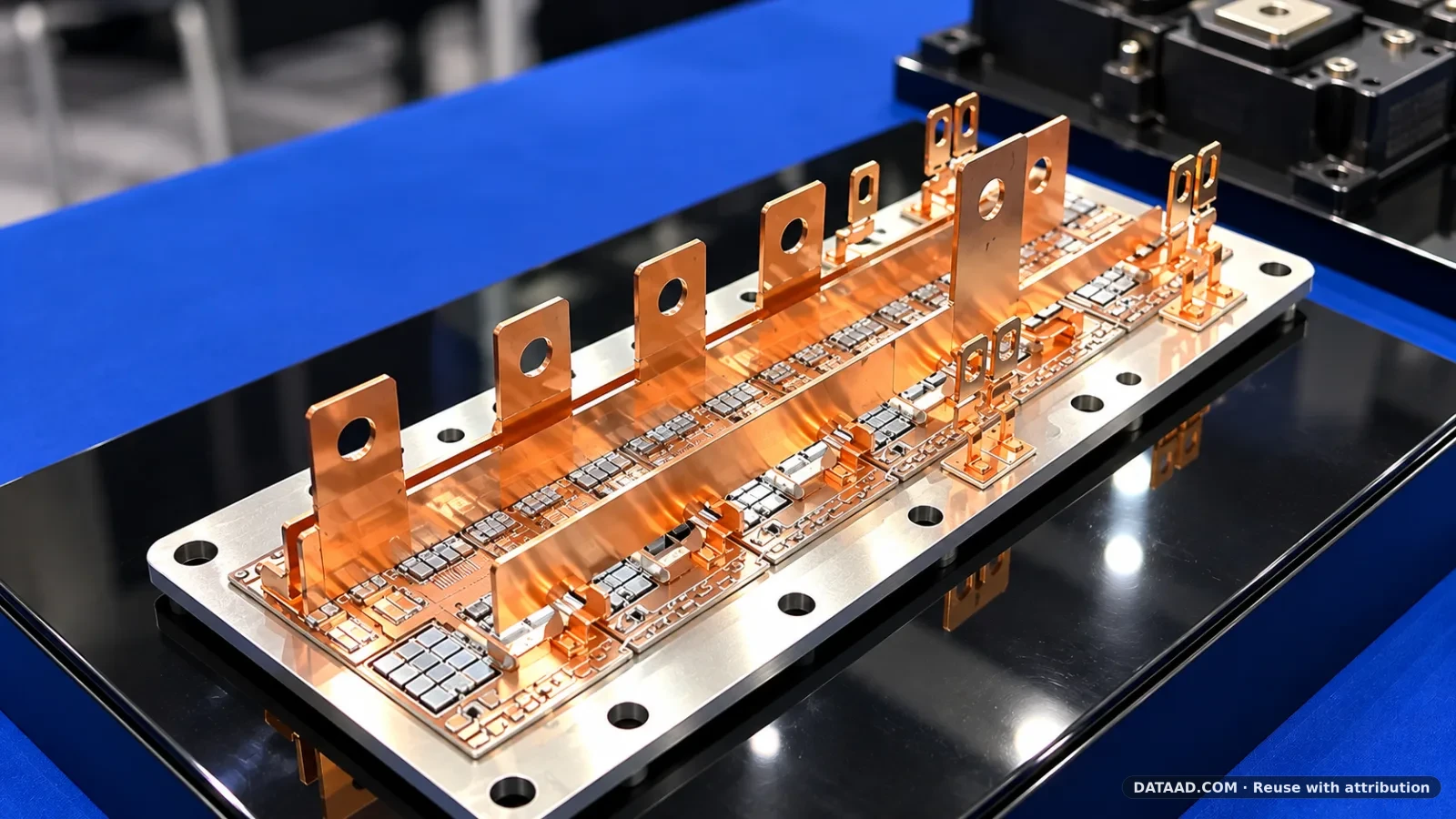
The physical appearance of a high-power semiconductor module immediately reveals how different it is from a CPU or memory chip.
The large copper conductors visible inside the module are part of the electrical current path. At hundreds or thousands of amperes, current distribution, electrical resistance, inductance, mechanical integrity and heat dissipation all become important engineering considerations.
The semiconductor dies themselves may be relatively small compared with the complete assembly. Around them is an engineered structure of conductors, insulation, substrates, terminals, baseplates and thermal interfaces designed to move both electricity and heat.
IGBT vs. MOSFET vs. SiC
There is no single power semiconductor that is ideal for every application. Device selection depends on voltage, current, switching frequency, efficiency, thermal requirements, reliability and cost.
Traditional silicon MOSFETs are widely used where fast switching is required, particularly at lower and medium power levels. IGBTs became highly successful in higher-voltage, high-current applications where ruggedness and established industrial performance are important.
Silicon carbide, or SiC, is increasingly changing this landscape. SiC power devices can operate at high voltage while switching faster and reducing certain switching losses compared with conventional silicon IGBTs. This can allow smaller passive components, higher switching frequencies and increased power density.
Gallium nitride, or GaN, pushes switching frequency even further in suitable applications and is becoming important in compact high-frequency power conversion.
The result is not simply a replacement of one technology by another. IGBT, silicon MOSFET, SiC and GaN increasingly occupy different regions of the power-electronics landscape.
AI Is Also a Power Infrastructure Story
Artificial intelligence has dramatically increased attention on GPUs and high-bandwidth memory. But the growth of AI computing is simultaneously creating another challenge: how to deliver enormous amounts of electricity efficiently to increasingly dense computing systems.
Electricity entering a data center passes through multiple stages of transformation, distribution and regulation before reaching processors. UPS systems, power distribution, AC/DC conversion, DC buses, power supply units and point-of-load converters all contribute to the overall efficiency of the infrastructure.
As AI clusters expand from kilowatts toward megawatt-scale infrastructure, even relatively small conversion losses can translate into significant heat generation and operating cost. Power electronics therefore become increasingly important alongside computing silicon.
From Electricity to Heat
No semiconductor is perfectly efficient. Electrical resistance, conduction losses and switching losses ultimately generate heat.
This applies to both sides of modern digital infrastructure. GPUs, CPUs and memory generate heat while performing computation and moving data. Power semiconductors generate heat while converting and controlling the electricity required to operate those computing devices.
Electricity → Power Conversion → Power Semiconductor → GPU / CPU / Memory → Computation → Heat → Cooling
Power Meets Thermal Management
This is where semiconductor engineering increasingly meets thermal engineering. Historically, many electronic systems could remove heat with conventional air cooling and heat sinks. Increasing power density is making that approach more difficult in a growing number of high-performance applications.
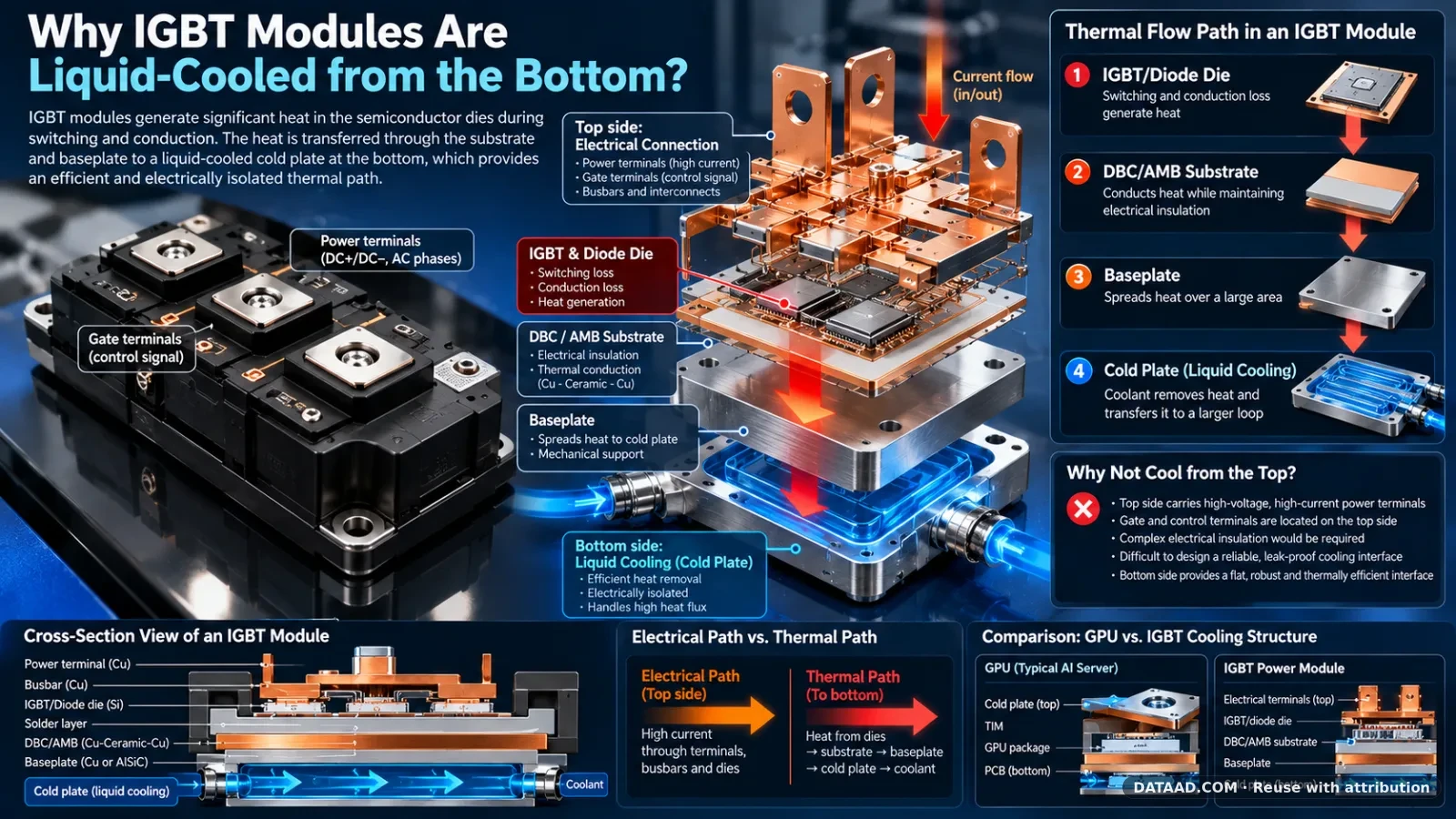
For AI servers, cold plates can be mounted directly on GPUs, CPUs and other high-heat-flux components. Coolant circulating through the cold plate absorbs heat and transfers it to a broader liquid-cooling loop.
High-power electronics can follow a similar thermal principle. Power semiconductor modules may transfer heat through a baseplate to a heat sink or liquid-cooled cold plate. As electrical power density increases, the design of the semiconductor package, thermal interface and cooling system becomes increasingly interconnected.
Liquid Cooling Is Moving Closer to the Semiconductor
Liquid cooling is therefore more than a data-center infrastructure technology. It is becoming part of the broader semiconductor thermal-management ecosystem.
The engineering challenge is gradually moving from simply cooling a room to removing heat as close as possible to where it is generated.
For AI computing, that point may be a GPU or CPU package. For power electronics, it may be an IGBT or SiC module mounted directly to a liquid-cooled baseplate.
This creates a convergence between industries that were once treated separately: semiconductors, electrical power, mechanical engineering and fluid technology.
The Semiconductor Industry Is Becoming a System Industry
The next generation of semiconductor competition will not be defined by transistor performance alone.
A faster GPU requires more memory bandwidth. More computing requires more electrical power. More power requires higher-efficiency conversion. Higher power density generates more heat. And more heat requires increasingly sophisticated thermal management.
That means the future semiconductor ecosystem can increasingly be understood through four interconnected layers:
COMPUTE — CPU, GPU and ASIC
MEMORY & COMMUNICATION — HBM, DRAM, NAND and RF
POWER — IGBT, MOSFET, SiC and GaN
THERMAL — Heat sinks, cold plates and liquid cooling
IGBTs may not receive the same public attention as GPUs, but they illustrate an important reality of the AI and electrification era: digital infrastructure cannot scale without physical power infrastructure.
As renewable energy, EV charging, industrial electrification and AI data centers continue to increase their electrical power requirements, the technologies that compute, store, communicate, switch power and remove heat are becoming parts of the same engineering story.
For the semiconductor industry, the next frontier is therefore not only smaller transistors or faster processors. It is the integration of computing, power and thermal management into increasingly dense and efficient systems.