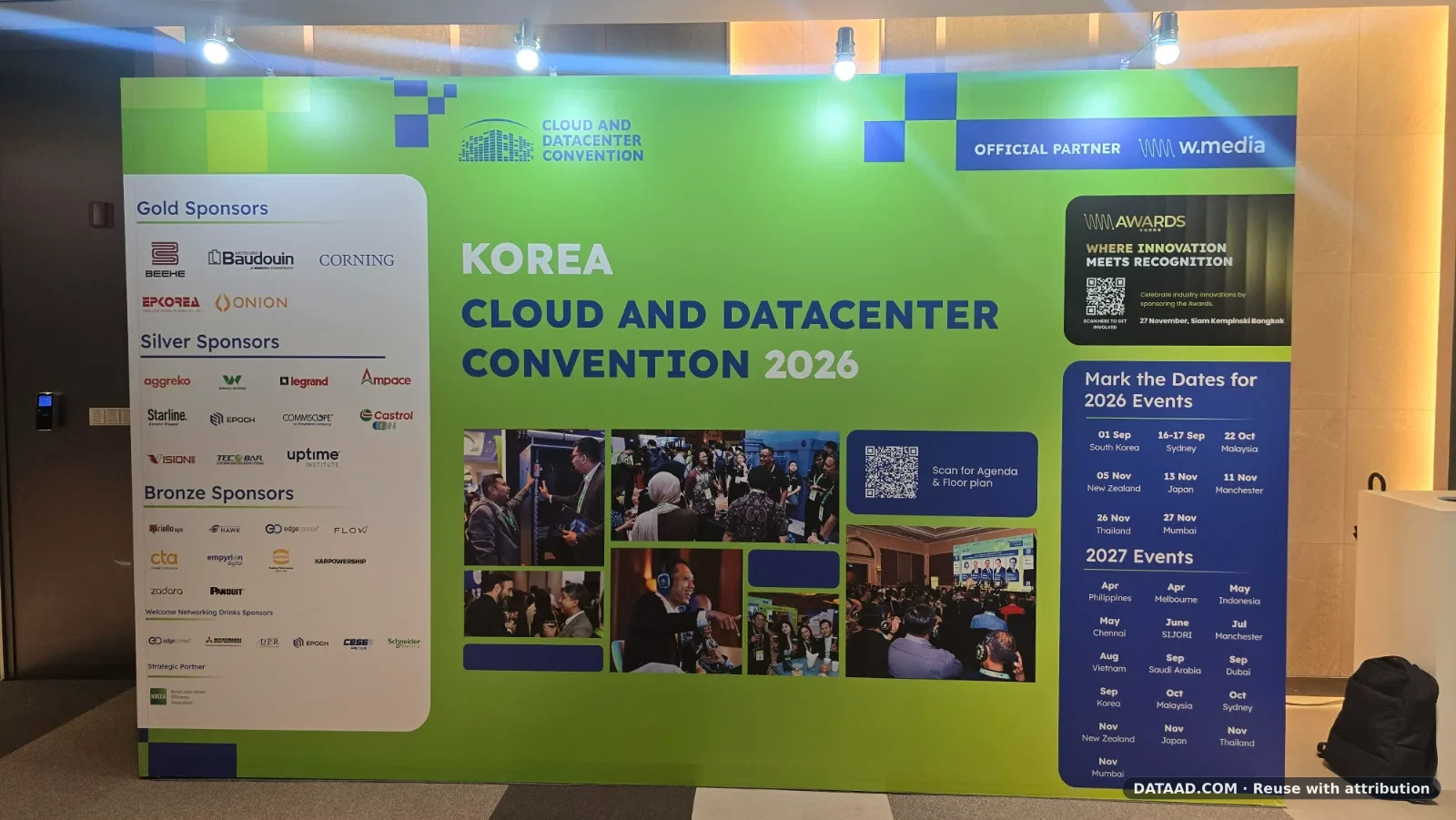
SEOUL — September 1, 2026. Walking through the Korea Cloud & Datacenter Convention 2026, one conclusion became increasingly difficult to miss: the AI data center is rapidly becoming an industrial infrastructure business rather than simply an IT infrastructure business.
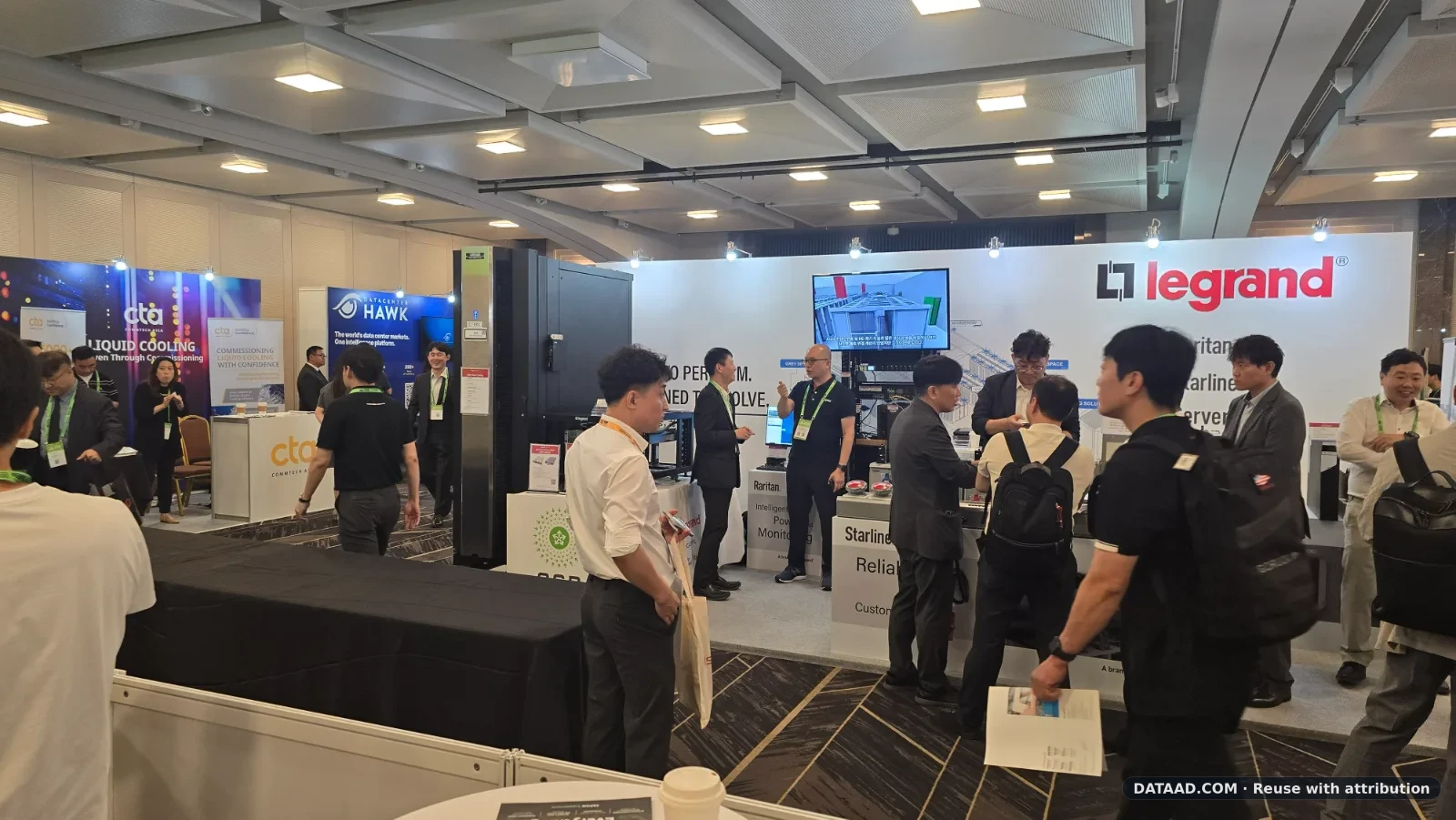
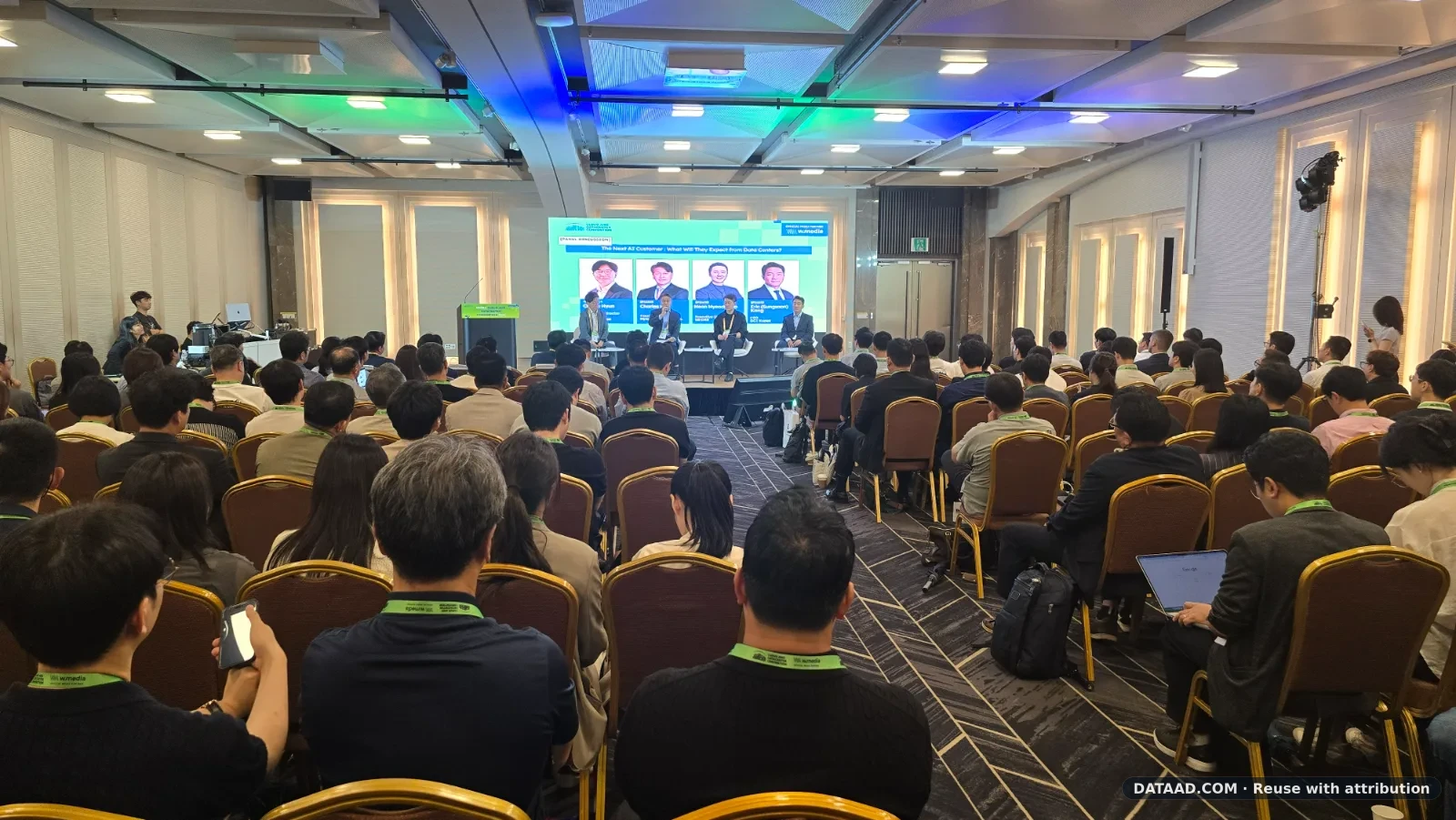
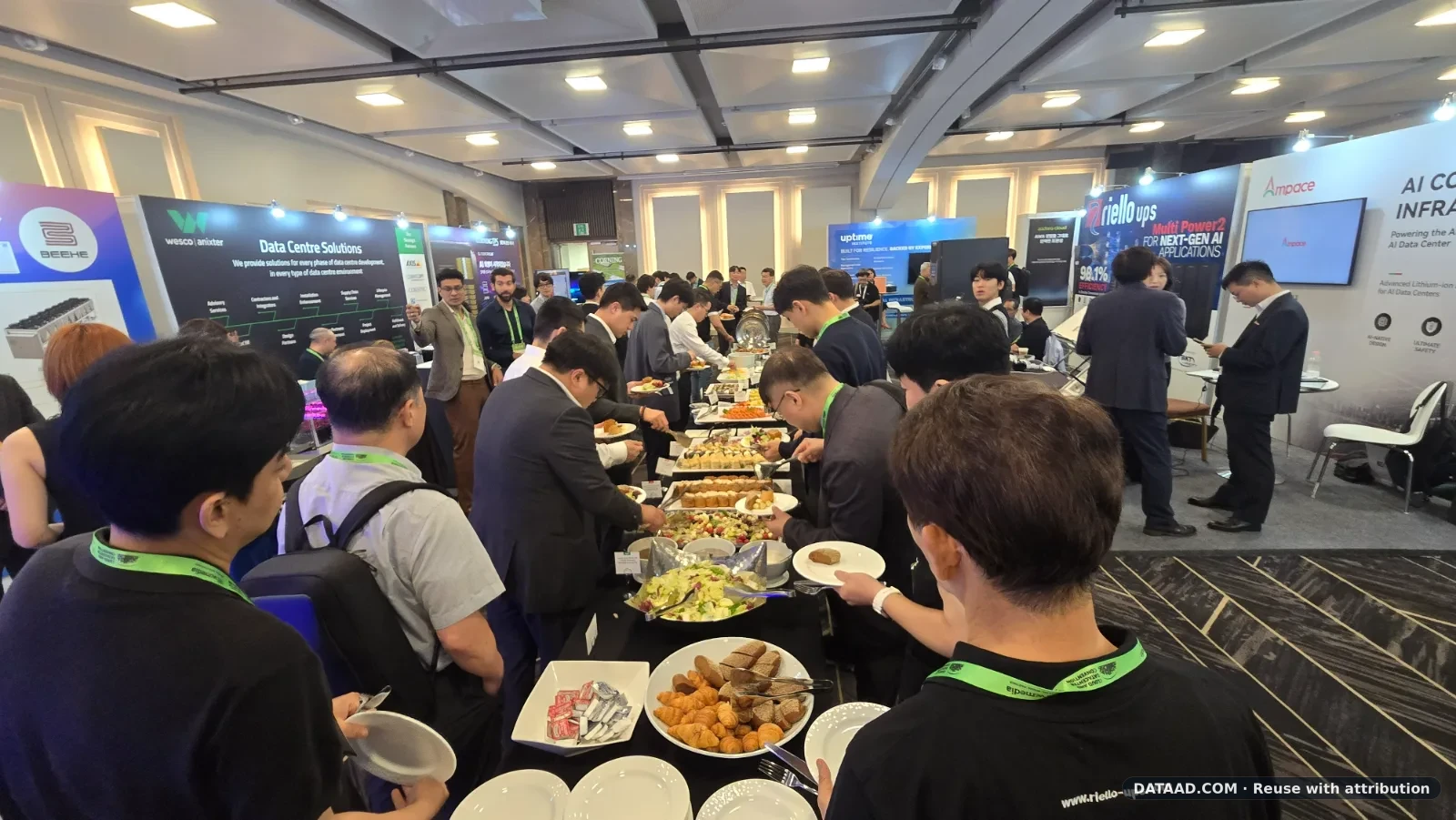
The exhibition floor at KRCDC 2026 brought together liquid-cooling systems, racks, power-distribution equipment, UPS solutions, batteries, monitoring technology and even large engine-generator systems. Panel sessions were packed throughout the day, while engineers, data-center operators, equipment suppliers and infrastructure developers moved between technical discussions and product demonstrations.
For DATAAD, the most important observation from the event was not one individual product. It was the growing integration of compute, electricity, cooling and physical infrastructure.
AI Changes the Entire Data Center Architecture
Conventional data centers were largely designed around servers whose heat could be removed through airflow. AI computing is changing that basic engineering assumption.
As more GPUs are concentrated into each rack, electricity entering the rack ultimately becomes heat that must be removed continuously and reliably. The problem therefore extends far beyond the GPU itself.
A modern AI data center increasingly has to be engineered as one continuous chain:
Grid or local generation → UPS and power distribution → AI rack → GPU → cold plate → hose and quick disconnect → rack manifold → CDU → secondary piping → heat exchanger → chiller or cooling tower.
Failure or inefficiency at any point in this chain can restrict the computing capacity of the entire facility.
Liquid Cooling Is Moving From the Server to the Facility
One of the clearest trends visible at KRCDC 2026 was the expansion of liquid cooling beyond individual cold plates.
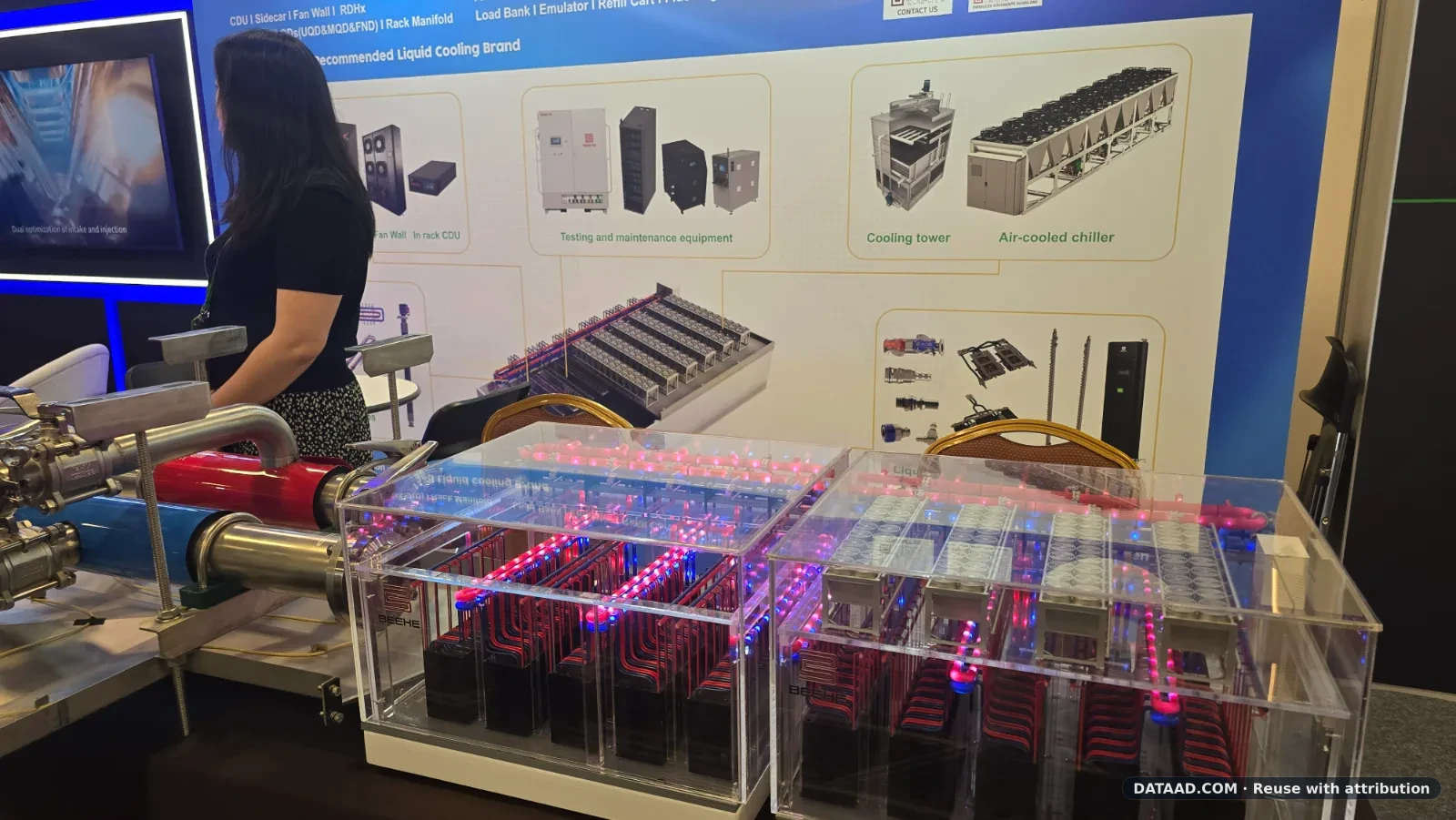
Exhibition systems demonstrated complete cooling architectures incorporating rack manifolds, coolant distribution units, pumps, piping, monitoring equipment, chillers and heat-rejection systems. A transparent demonstration rack showed red and blue coolant lines running directly through multiple server positions, making the thermal architecture visible to visitors.
This is an important transition.
The early liquid-cooling market often focused on the cold plate attached to a CPU or GPU. But the commercial opportunity is becoming much larger. Every liquid-cooled rack requires fluid distribution, connection technology, flow control, leak prevention, serviceability and heat transfer between the IT loop and the facility loop.
As a result, the AI cooling ecosystem increasingly includes:
- Cold plates
- CDUs
- Rack manifolds
- Hose kits
- Quick disconnect couplings
- Pumps and valves
- Coolant monitoring
- Heat exchangers
- Secondary piping
- Cooling towers and chillers
This also explains why mechanical engineering companies that previously had little direct connection with the server industry are now entering the AI infrastructure market.
The 100kW Rack Is Becoming a New Design Reference
Another recurring theme during the conference was the move toward extremely high rack power density.
Once rack density moves toward 100kW and beyond, adding more conventional air-conditioning capacity becomes increasingly difficult. Air still has an important role for memory, power supplies and other components, but the highest heat-flux devices increasingly require heat to be removed much closer to the silicon.
This makes Direct-to-Chip Liquid Cooling one of the most practical transition technologies for the current generation of AI infrastructure.
It also changes the building itself.
Higher rack density affects electrical distribution, floor loading, piping routes, redundancy design, leak detection, maintenance procedures and commissioning. A data-center developer can therefore no longer design the building first and decide how to cool the servers later.
The IT equipment and the building mechanical system are beginning to merge into one engineering problem.
Power Is Becoming as Important as Cooling
The exhibition floor also showed why cooling alone cannot solve the AI infrastructure challenge.
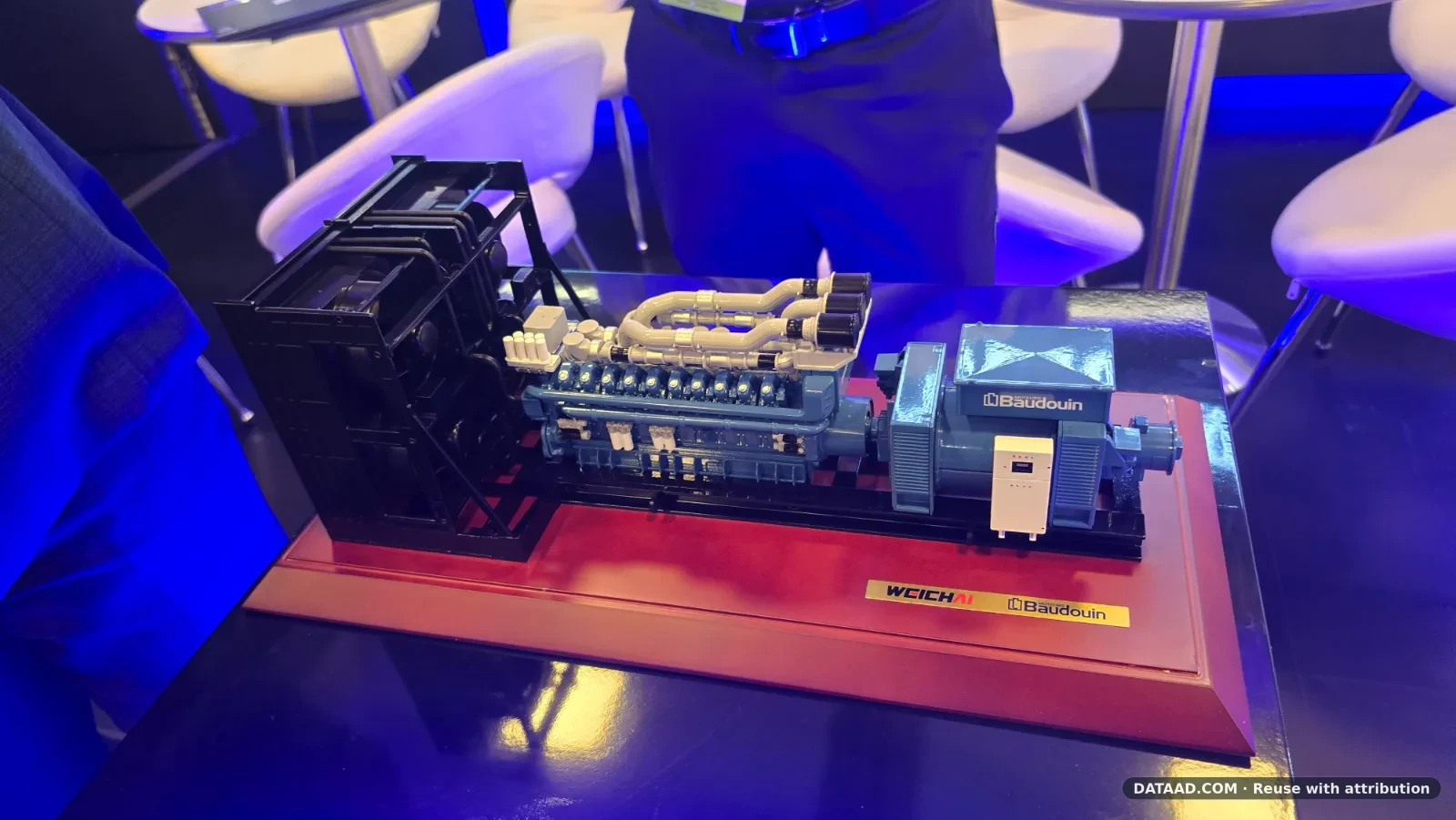
UPS suppliers, battery systems, busway and power-distribution specialists occupied a significant portion of the exhibition, while a scale model of a large engine-generator system illustrated another increasingly important question: where will the electricity for the next generation of AI computing actually come from?
In the traditional data-center model, emergency generators were primarily regarded as backup systems.
The AI era may gradually broaden that role.
Where grid connections cannot be delivered quickly enough, developers are increasingly examining distributed generation, gas engines, fuel cells, energy storage and other behind-the-meter power architectures as potential complements to the electrical grid.
This does not mean that every AI data center will operate its own power plant. But it does suggest that energy strategy is moving much earlier into the data-center development process.
Power Distribution Inside the Building Is Changing Too
Companies exhibiting rack, busway, PDU and monitoring systems also reflected another consequence of high-density computing.
Supplying several kilowatts to a traditional rack and supplying 100kW or more to an AI rack are fundamentally different engineering tasks.
Electrical conductors, connectors, busways, monitoring systems and redundancy architectures all need to accommodate much larger continuous loads.
At the same time, operators need increasingly granular information about where electricity is being consumed. In an AI facility, electrical monitoring and thermal monitoring will therefore become increasingly interconnected.
| AI Data Center Layer | What Is Changing |
|---|---|
| Compute | Higher GPU density and rapidly increasing rack power |
| Cooling | Air cooling shifting toward hybrid and direct liquid cooling |
| Power Distribution | Higher-capacity busway, PDU and rack-level monitoring |
| Facility Cooling | CDU, secondary piping, heat exchangers and chillers become integrated |
| Power Supply | Grid capacity increasingly supplemented by storage or distributed generation |
| Operations | IT, electrical and mechanical engineering become more tightly connected |
The Next AI Customer Will Buy Infrastructure Differently
Another important theme raised during the conference was the changing profile of the data-center customer.
A conventional colocation customer could largely purchase floor space, electrical capacity and network connectivity.
An AI customer is different.
The customer may arrive with GPU clusters whose power density, cooling requirements and deployment schedule have already been determined by the computing architecture. The data-center operator must then demonstrate that the physical facility can support those requirements.
This shifts the commercial conversation from simply asking, “How many megawatts are available?” toward much more detailed questions:
- How much power can be delivered per rack?
- Can liquid cooling be supported?
- What coolant temperatures and flow rates are available?
- How quickly can additional capacity be deployed?
- Can the electrical grid support the expansion?
- What happens if the cooling or power system fails?
The value of a data center may therefore increasingly depend not only on total megawatts, but also on how efficiently those megawatts can be converted into usable AI computing capacity.
Korea Has an Unusual Industrial Opportunity
KRCDC 2026 also highlighted an opportunity that may be particularly important for South Korea.
Korea already possesses globally competitive industries in semiconductors, memory, batteries, electrical equipment, precision manufacturing, pumps, heat exchangers, piping, shipbuilding and industrial automation.
AI data centers require almost all of these capabilities.
The industry should therefore not be viewed only as a real-estate or cloud-service opportunity. It could develop into a much broader manufacturing ecosystem connecting Korean semiconductor technology with electrical and mechanical infrastructure.
Cold plates, CDUs, manifolds, hoses, couplings, pumps, valves, power modules, energy-storage systems and monitoring technologies may ultimately become an important secondary market created by the expansion of AI computing itself.
DATAAD View: The Data Center Is Becoming a Machine
The strongest impression from KRCDC 2026 was that the distinction between a server and the building surrounding it is beginning to disappear.
A traditional data center could be thought of as a building that supplied electricity and cool air to computers.
An AI data center increasingly resembles a giant machine.
Electricity enters the facility, moves through increasingly sophisticated power-distribution systems and reaches thousands of accelerators. Heat generated by those accelerators is captured by liquid, transported through manifolds and CDUs, and ultimately rejected outside the building.
Power, coolant and data are therefore becoming three continuous flows running through the same infrastructure.
That may be the real significance of the AI data-center transition.
The competition will not be determined only by who produces the fastest GPU. It will also depend on who can build the most efficient physical system around that GPU — and who can deliver the electricity, cooling and infrastructure required to keep it operating continuously.
KRCDC 2026 showed that Korea's AI infrastructure race has already moved from discussion to engineering.