The next bottleneck for artificial intelligence may not be GPUs.
It may be electricity.
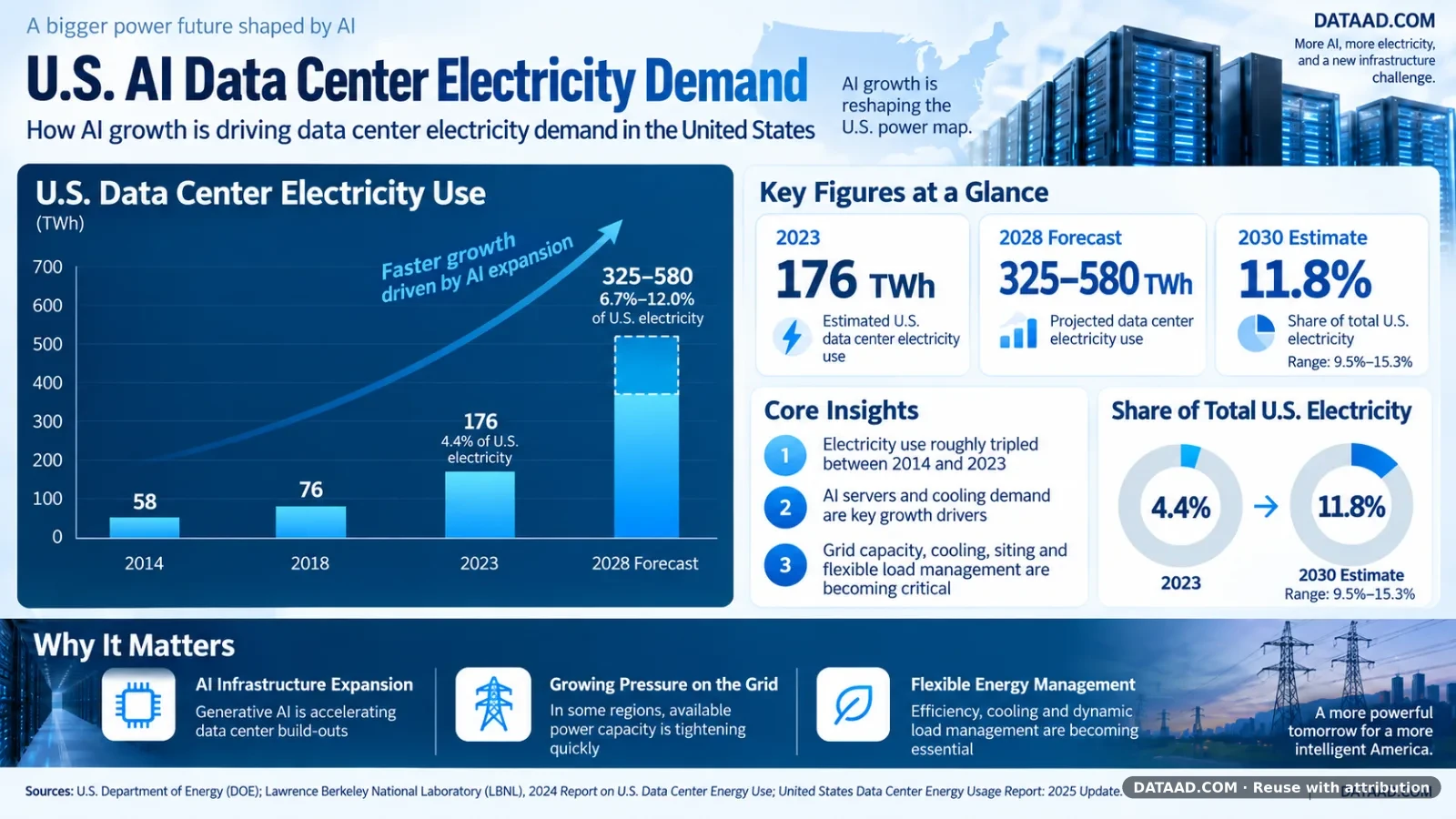
As AI data centers grow from megawatt-scale facilities toward increasingly large power campuses, developers are confronting a constraint that cannot be solved simply by ordering more servers: the electric grid has limited capacity, and new transmission and generation projects can take years to build.
A new industry initiative is proposing a different approach.
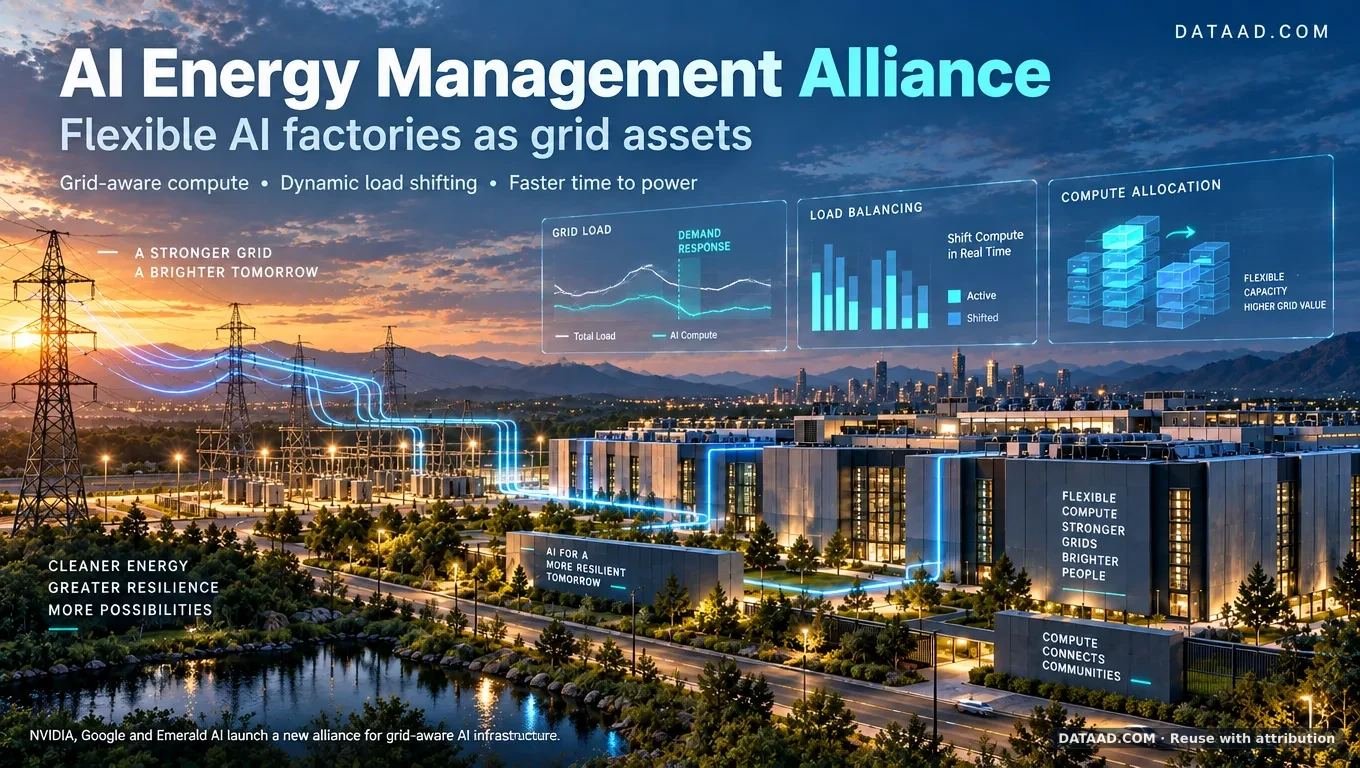
On September 16, 2026, Emerald AI, Google and NVIDIA launched the AI Energy Management Alliance (AEMA), bringing together technology companies, AI developers, utilities and energy producers around the idea of making AI data centers more flexible in how they consume electricity.
Instead of treating an AI data center as a fixed load that demands its maximum power continuously, the alliance wants future AI facilities to dynamically adjust electricity consumption in response to grid conditions.
From constant load to flexible AI factory
Traditional data centers have generally been designed around one principle: computing must remain available regardless of what is happening outside the facility.
That assumption becomes increasingly difficult when individual AI campuses require hundreds of megawatts — and future developments are moving toward gigawatt scale.
AEMA's alternative is to separate AI workloads by how urgently they need to run.
Critical inference services may need immediate computing capacity. But some model training, batch processing, synthetic-data generation or other non-time-critical workloads could potentially be shifted by minutes or hours when the electricity grid is under stress.
When additional power becomes available, the compute could increase again.
In effect, the data center begins behaving more like an intelligent industrial load rather than a fixed consumer.
Compute becomes part of demand response
Demand response itself is not a new concept.
Utilities have long worked with factories, commercial buildings and other large electricity users to reduce or shift demand during periods when the grid is approaching peak capacity.
What is new is the possibility of applying the same principle to massive AI computing infrastructure.
AI workloads have a particularly interesting characteristic: some computing jobs can be moved in time, moved between clusters, or potentially moved geographically without physically moving the underlying facility.
Software therefore becomes part of the electrical infrastructure.
A scheduler deciding when and where GPUs perform a workload could eventually interact with information about electricity availability, grid congestion, energy price and on-site generation or storage.
The boundary between data-center management software and energy-management software begins to disappear.
Why NVIDIA is interested
For NVIDIA, the idea extends the concept of the AI factory.
The company increasingly describes advanced data centers as factories that consume energy and produce AI tokens, models and intelligence.
Earlier in 2026, NVIDIA and Emerald AI announced work with major energy companies including AES, Constellation, Invenergy, NextEra Energy, Nscale Energy & Power and Vistra on flexible AI factories that could interact with the power grid.
The architecture includes NVIDIA's Vera Rubin DSX AI Factory reference design and DSX Flex software intended to connect AI infrastructure with grid services.
The basic proposition is straightforward: if an AI factory can reliably reduce its electricity consumption for limited periods of grid stress, a utility may be able to connect more computing capacity without designing the entire system around every facility simultaneously operating at maximum demand.
Could flexibility unlock more grid capacity?
NVIDIA and its partners have suggested that power-flexible AI factories, combined with better utilization of existing infrastructure and additional generation where required, could potentially unlock as much as 100 GW of capacity across the U.S. power system.
That number should not be interpreted as 100 GW of electricity suddenly becoming available.
It is an industry estimate of how much additional capacity might potentially be accommodated through a combination of flexible loads, optimized infrastructure and new energy resources.
Whether that scale can actually be achieved will depend on utilities, transmission constraints, local grid conditions, regulation and — most importantly — whether data centers can demonstrate that promised load reductions are technically reliable when the grid needs them.
Why AI workloads may be different
Not every digital workload can be interrupted.
Financial transactions, cloud services and real-time AI inference may require extremely high availability.
But AI infrastructure also contains large amounts of computing whose timing may be more flexible.
A multi-day training run, for example, does not necessarily have the same power requirement every second of every day. Some jobs can be checkpointed, delayed or rescheduled. Other workloads may be redirected to another cluster with available compute and electricity capacity.
That creates a possibility that conventional data centers did not have at the same scale: computational flexibility can become electrical flexibility.
The value of a megawatt is changing
This also changes how AI data-center efficiency may eventually be measured.
For years, operators focused heavily on metrics such as PUE — Power Usage Effectiveness — which measures how much of a facility's electricity reaches computing equipment rather than cooling and other supporting systems.
PUE will remain important.
But AI factories introduce another question: How much useful AI computation can be produced from each available megawatt — and how flexibly can that computation be scheduled?
That shifts optimization from simply reducing cooling losses toward coordinating GPUs, networking, liquid cooling, energy storage, generation and grid conditions as one system.
Cooling becomes part of the energy equation
For high-density AI infrastructure, power management cannot be separated from thermal management.
Reducing GPU load changes heat generation almost immediately. Increasing compute density does the opposite.
As liquid-cooled racks move beyond 100 kW and future platforms push density higher, the CDU, pumps, facility water system and heat-rejection equipment increasingly become part of a dynamic energy system.
A future grid-aware AI facility may therefore coordinate not only compute workloads but also cooling equipment, batteries and on-site generation.
The data center starts to look less like a building full of servers and more like an integrated industrial process plant.
Power availability may determine where AI grows
The implications extend beyond individual facilities.
Until recently, data-center location decisions were dominated by connectivity, land, tax incentives and proximity to customers.
Power availability is rapidly becoming one of the defining constraints.
If flexible AI infrastructure can obtain grid connections faster than conventional fixed-load facilities, the ability to manage electricity demand could become a competitive advantage for both data-center operators and regions seeking AI investment.
It could also change negotiations between utilities and hyperscalers.
Instead of asking only, "How many megawatts can you provide us?"
The conversation may increasingly become: "How many megawatts can we use — and how much can we give back when the grid needs flexibility?"
A data center that participates in the grid
The AI Energy Management Alliance is still at an early stage.
Technical standards, utility rules, measurement methods and commercial incentives will all have to develop before power-flexible AI factories become commonplace.
But the direction is significant.
The first generation of large AI data centers was built to secure as much electricity as possible.
The next generation may have to prove that it can also use that electricity intelligently.
If that model works, the data center will no longer be viewed simply as one of the grid's fastest-growing loads.
It could become an active participant in balancing the grid itself.
AI infrastructure is beginning to optimize not only how electricity becomes computation, but when that transformation should happen.