SEOUL — KRCDC 2026. For decades, the boundary inside a data center was relatively easy to understand. Optical fiber carried enormous volumes of information between buildings, network switches and servers, while copper electrical connections handled much of the shorter-distance communication inside equipment.
AI is beginning to change that boundary.
As GPU clusters grow larger and bandwidth between accelerators increases, the distance that data must travel is no longer the only problem. Power consumption, signal integrity, connector density and the physical space required to move enormous amounts of data are becoming equally important engineering constraints.
The result is a gradual movement from copper toward optical connectivity deeper inside the AI rack — and eventually toward the silicon itself.
AI Is Turning Data Movement Into an Infrastructure Problem
A modern AI system does not depend on a single GPU.
Thousands or even hundreds of thousands of accelerators may need to exchange data continuously while training models or running large-scale inference workloads. As compute performance rises, the network connecting those processors must increase capacity at almost the same pace.
This creates a new bottleneck: moving the data.
Traditional copper links remain highly effective over very short distances. They are inexpensive, mature and deeply integrated into electronic systems. But as data rates rise, copper connections increasingly face challenges involving signal attenuation, equalization, retimers, power consumption and heat.
Optical communication changes the equation because information is transmitted as light rather than as an electrical signal moving through copper conductors.
Fiber Is Moving Inside the Rack
Fiber has already dominated long-distance telecommunications and much of data-center scale-out networking. The next transition is happening at much shorter distances.
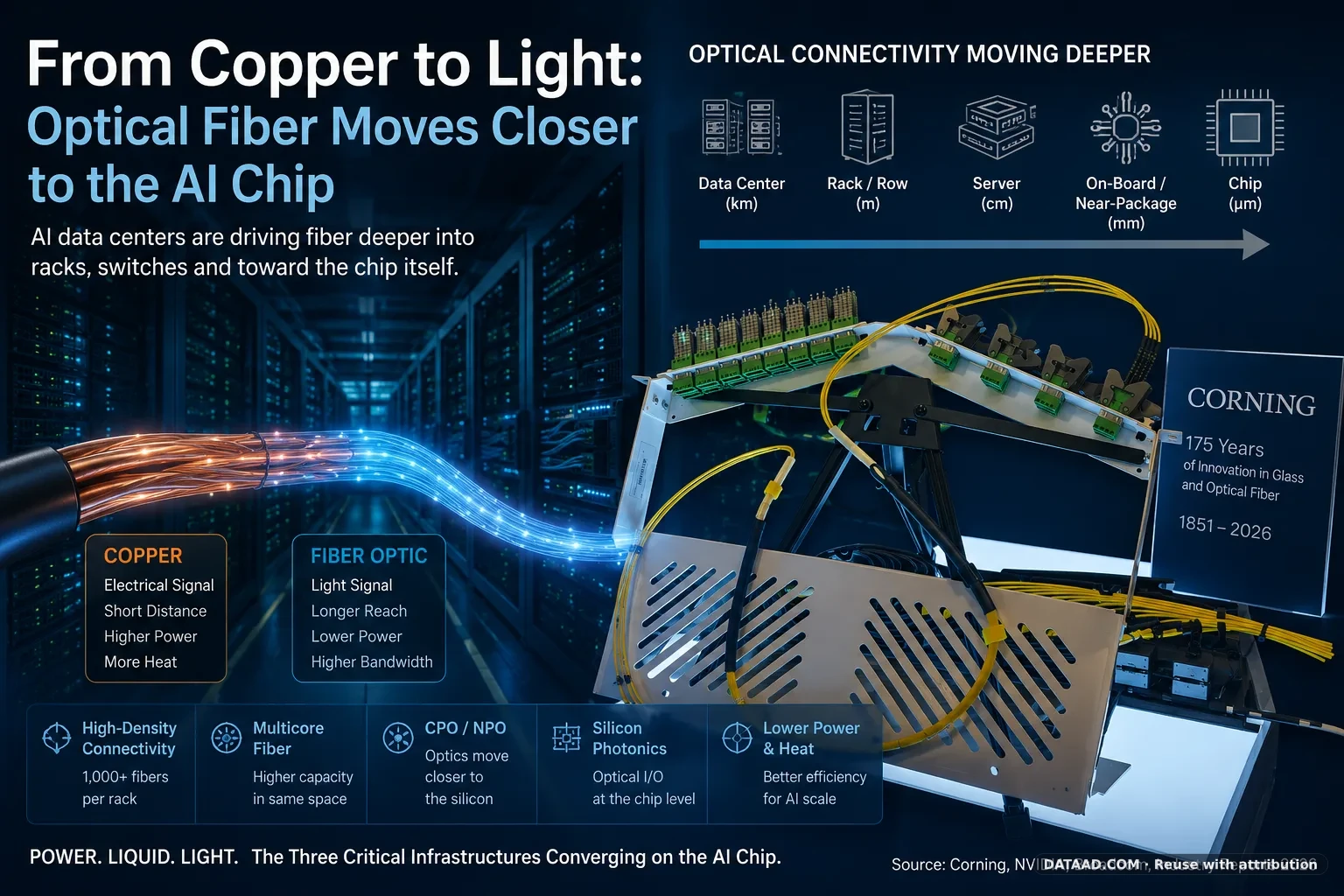
Corning expects fiber density in next-generation AI racks to rise beyond 1,000 fibers per rack, with future architectures potentially moving toward several thousand fiber connections as GPU density increases.
This is an important architectural change.
Instead of fiber terminating at the front of a server or network switch and handing the signal over to copper for the final electrical journey, optical technology is moving farther inside the equipment.
The industry describes this transition through technologies including:
- High-density optical connectors
- Multicore fiber
- Near-Package Optics (NPO)
- Co-Packaged Optics (CPO)
- Silicon photonics
- Fiber-to-chip connectivity
From Box-to-Box to Chip-to-Chip
Co-Packaged Optics may represent one of the most important stages of this evolution.
In a conventional architecture, optical signals arrive at pluggable transceiver modules located near the front panel of a switch. The signal is converted into an electrical signal and then travels through the board toward the switching ASIC or processor.
CPO shortens that electrical distance dramatically by bringing the optical engine much closer to the processing silicon.
Corning describes the change simply: optical networks that once operated primarily box-to-box are beginning to move toward chip-to-chip communication.
Broadcom and NVIDIA are also developing CPO and silicon-photonics architectures for very large AI clusters, reflecting a broader industry movement rather than a development limited to a single optical-fiber supplier.
Why Copper Is Being Pushed Toward Its Limits
| Factor | Copper Interconnect | Optical Interconnect |
|---|---|---|
| Very short distance | Highly competitive | Increasingly attractive at high bandwidth |
| Longer reach | Signal loss increases | Strong advantage |
| Bandwidth density | Increasingly challenging | Very high potential |
| Electrical power | Equalization and retiming can add power | Potentially lower energy per transmitted bit |
| Heat generation | Becomes more significant at very high speeds | Can reduce electrical-path losses |
| Connector density | Physical limits emerge | High fiber-count connectors are expanding rapidly |
| Role in future AI systems | Remains important for shortest electrical paths | Moves progressively closer to the processor |
KRCDC 2026: A 175-Year-Old Materials Company Meets the AI Era
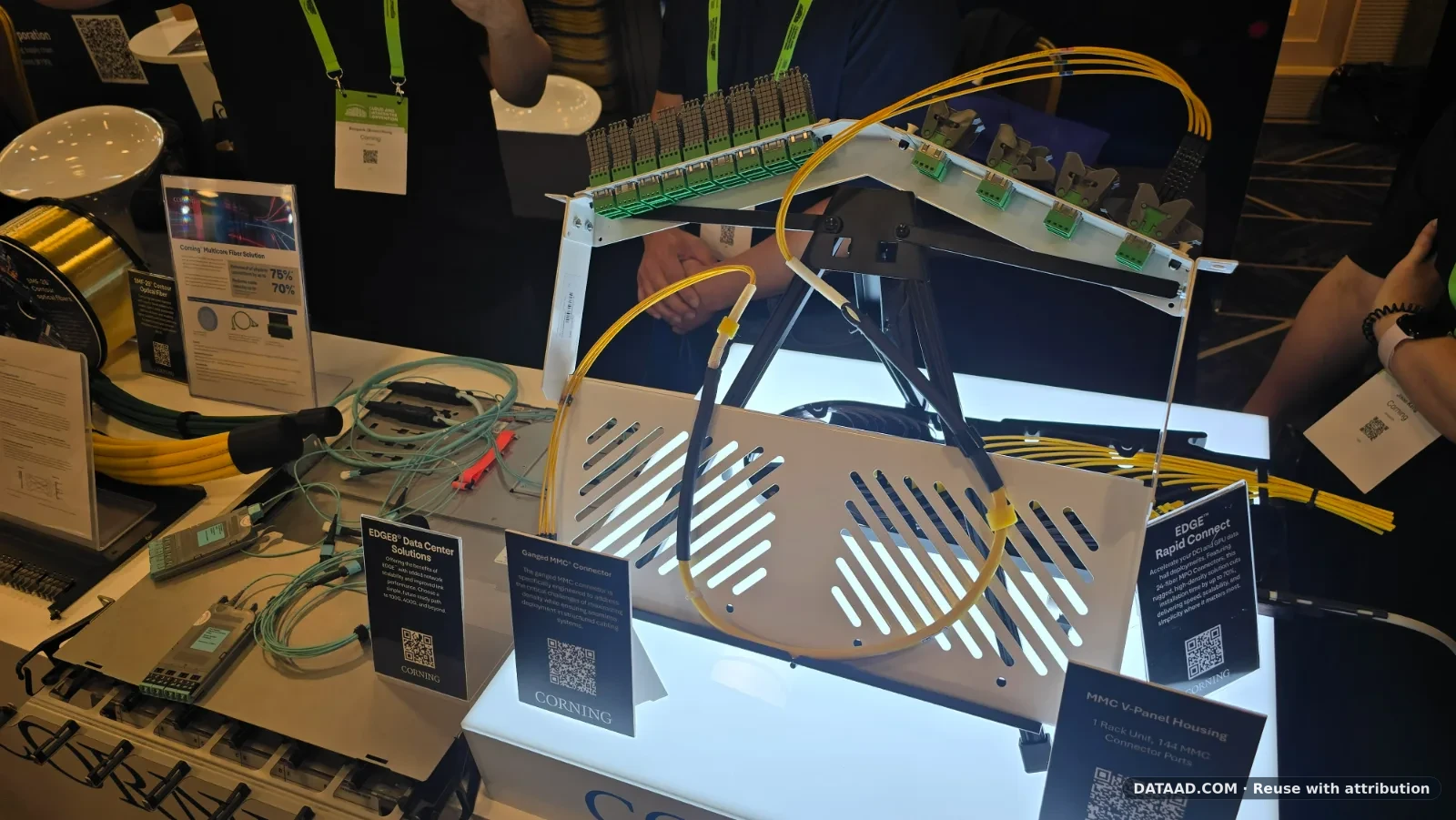
The accompanying photograph was taken at the Corning display during the Korea Cloud & Datacenter Convention 2026 in Seoul.
The exhibition showed multicore-fiber technology, high-density EDGE connectivity, MMC connectors and rapid-connect solutions designed for increasingly dense data-center installations.
The historical contrast is notable.
Corning was founded in 1851 and marks its 175th anniversary in 2026. The company that became known for glass science and later helped provide the optical-fiber infrastructure of the internet is now positioning fiber as a fundamental component of AI infrastructure.
In March 2026, Corning also introduced an expanded portfolio for AI networking that included multicore fiber, high-density connectivity and complete co-packaged-optics solutions designed to take fiber deeper into the data center and toward the chip.
The Network, Power and Cooling Problems Are Converging
This transition should not be viewed independently from the other changes taking place inside AI data centers.
DATAAD observed at KRCDC 2026 that AI infrastructure is increasingly being designed around three continuous flows:
- Electricity — delivering enormous power to GPUs and accelerators
- Coolant — removing concentrated heat from high-density processors
- Data — moving information between accelerators at extremely high speed
All three are now moving deeper into the rack.
High-current electrical distribution approaches the processor. Liquid-cooling manifolds and cold plates approach the processor. Optical communication is now following the same physical direction.
This means tomorrow's AI server may increasingly be understood not simply as an electronic computer, but as an integrated system of power, liquid and light.
Fiber Will Not Replace Every Copper Connection
It would be premature to conclude that copper will disappear from AI servers.
Copper remains efficient and economically attractive over extremely short distances, and electrical interconnect technology continues to improve.
The more realistic transition is a moving boundary.
As bandwidth rises, the distance over which copper remains the optimum solution becomes shorter. Optical conversion therefore moves progressively closer to the GPU, CPU or switching ASIC.
Near-package optics and co-packaged optics are essentially engineering responses to that moving boundary.
DATAAD View
The AI infrastructure race is usually discussed in terms of GPUs, electricity and cooling capacity.
But there is a fourth constraint that may become equally important: how quickly information can move between processors.
An AI accelerator waiting for data is expensive silicon that is not being fully utilized.
That is why optical connectivity is moving from the outside of the data center toward the inside of the server.
Corning's 175-year history provides an interesting perspective on this transition. Glass once carried information across continents through telecommunications networks. The next frontier may be measured not in thousands of kilometers, but in meters, centimeters and eventually millimeters between AI chips.
The AI data center of the future may therefore be defined by three physical networks operating together: electricity carrying power, liquid carrying heat, and fiber carrying intelligence.
Sources
Corning — OFC 2026 AI optical connectivity announcements; Corning — Co-Packaged Optics and 2026 data-center technology outlook; NVIDIA — Silicon Photonics Networking; Broadcom — Co-Packaged Optics technical overview.