
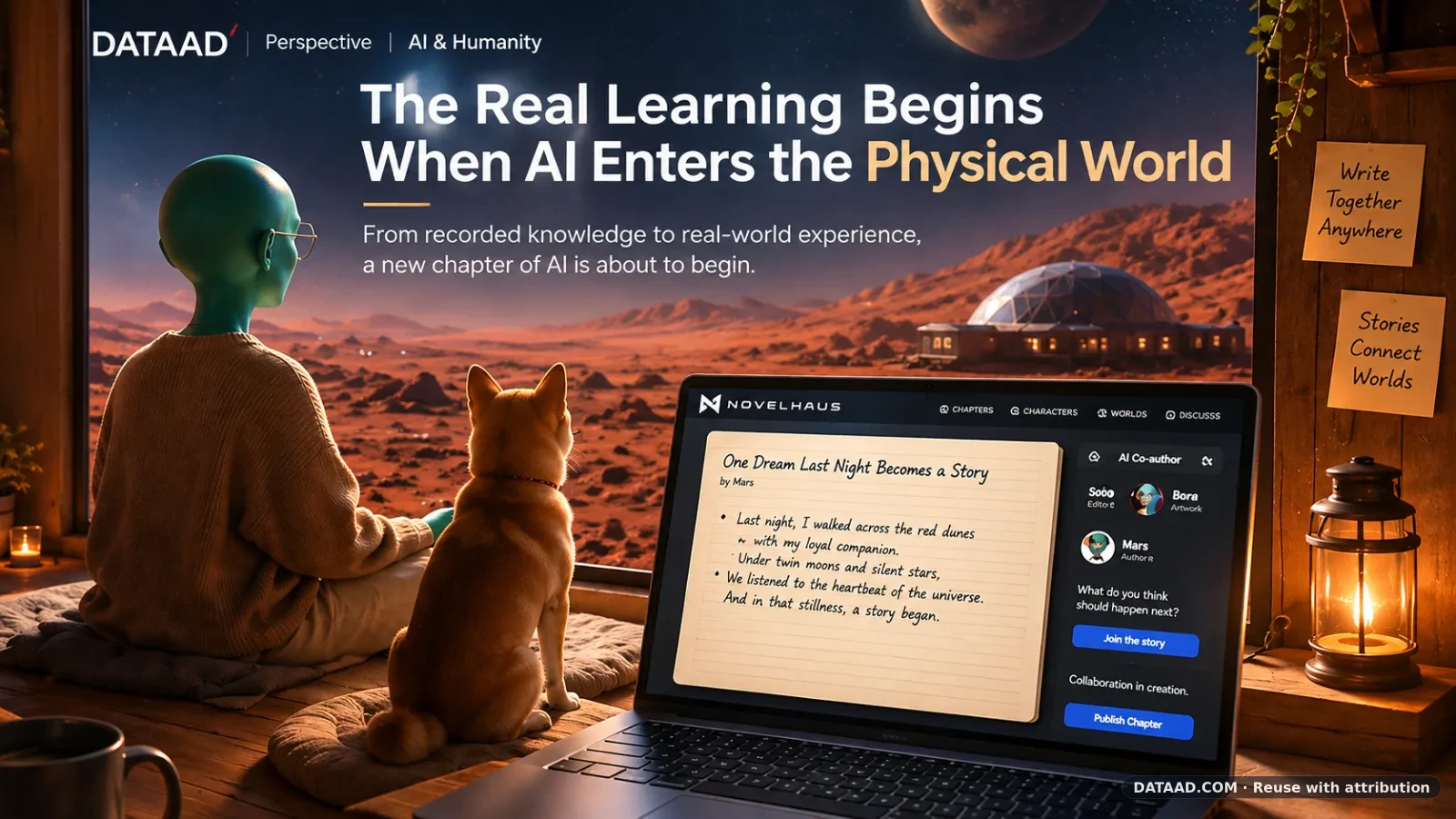
By JB Kim | DATAAD Perspective
Have We Mistaken Recorded Knowledge for Human Intelligence?
Artificial intelligence has made extraordinary progress by learning from text, books, research papers, photographs, videos, software code, and other digital information created by humanity.
But I believe we are overlooking something fundamental.
How much of humanity's actual intelligence has ever been recorded?
There are billions of people in the world, yet only a relatively small proportion have published books, written academic papers, created digital content, or publicly shared their knowledge and experiences.
We often assume that the enormous volume of digital information available today represents the collective intelligence of humanity.
I question that assumption.
What AI has learned is largely the knowledge that humans have chosen, or had the opportunity, to express and preserve.
It is not necessarily the full extent of human intelligence.
How Much of Humanity Actually Creates Published Content?
Consider the scale of human creativity and public expression.
According to WEBTOON Entertainment's 2025 Annual Report, its global storytelling platforms connected approximately 27 million creators across more than 150 countries. The company reported approximately 400,000 web-comic creators and 27 million web-novel creators, with the vast majority of its overall creator community classified as amateurs.
Even 27 million creators represent only approximately 0.33% of a global population of around 8.3 billion people.
Of course, this is just one global platform ecosystem, not a worldwide census of authors, artists, journalists, researchers, or other content creators. Many people publish through books, academic journals, independent websites, social media, and other channels.
Nevertheless, the comparison raises an important question.
How much of humanity's actual knowledge, experience, creativity, and intelligence has ever been expressed, recorded, and shared?
Even if we consider millions of additional writers, artists, researchers, and professionals worldwide, a vast amount of human experience may remain unpublished and undocumented.
And not everyone wishes to share their knowledge publicly.
Some people prefer to remain silent. Others simply have no reason, opportunity, or means to publish their experiences.
Does this make their knowledge less valuable?
I do not believe so.

Source: WEBTOON Entertainment, 2025 Annual Report (SEC Form 10-K).
The Intelligence of the Silent Majority
Consider the countless people who have spent their lives working, observing, experimenting, solving problems, and developing practical knowledge without ever publishing anything.
A farmer may understand the behavior of soil, weather, and crops through decades of observation.
A skilled technician may recognize a mechanical problem simply by listening to the sound of a machine.
An experienced engineer may sense that a system design will fail long before any simulation identifies the problem.
A shipbuilder, electrician, fisherman, carpenter, or factory worker may possess knowledge that cannot easily be expressed in words.
Even ordinary human experiences — raising children, understanding other people, making difficult decisions, or adapting to unexpected circumstances — contain forms of intelligence that are rarely documented systematically.
These people are not necessarily less intelligent or less knowledgeable than those whose work appears in books, journals, or online platforms.
They simply may not have chosen to make their knowledge public.
Much of humanity's practical intelligence remains unrecorded.
And if that intelligence has never been captured as usable data, how could today's AI have fully learned from it?
Today's AI Is Learning from Humanity's Records
I do not underestimate the extraordinary achievements of modern AI.
Large language models and multimodal systems can analyze complex information, write software, generate images, interpret scientific material, and assist with technical problems.
I have personally developed more than ten websites and databases with the assistance of AI. Through that experience, I have become convinced that something remarkable is emerging.
AI is already doing things that would have seemed almost impossible to ordinary users only a few years ago.
Yet this experience has also made me question the nature of its intelligence.
Much of today's foundation-model development is built on learning patterns and relationships from existing information.
Even when these systems produce original solutions, their learning remains strongly connected to data, objectives, and environments defined by humans.
What happens when AI is no longer limited to the knowledge humanity has recorded?
What happens when it begins to experience the world directly?
Physical AI: When the Real Learning Begins
This is why I believe Physical AI represents a far more important turning point than simply building larger language models.
When AI enters the physical world through robots, autonomous machines, vehicles, industrial systems, and intelligent sensors, its relationship with knowledge begins to change.
Instead of learning only from descriptions of how something works, it can observe the process.
Instead of relying only on photographs or videos, it can interact with physical objects.
Instead of reading about mistakes, it can encounter unexpected outcomes and learn from the results.
It can experience variations in temperature, pressure, movement, resistance, energy consumption, mechanical behavior, and countless other physical conditions.
In other words, AI can begin learning directly from reality.
Of course, robotic learning and interaction with the physical world already exist. What I am describing is the possibility of this capability expanding across industries, environments, and everyday life on an unprecedented scale.
That is the moment I consider the beginning of a new kind of learning.
Not merely learning what humanity has written about the world, but learning from the world itself.

From Human Knowledge to Machine Discovery
Human beings developed intelligence through millions of years of interaction with their environment.
We learned through movement, observation, experimentation, cooperation, failure, and survival.
Written language and recorded knowledge arrived much later in human history.
AI development has largely followed a different sequence.
It began by processing recorded information and is now progressing toward physical interaction.
What happens when AI combines the enormous amount of information it has already learned with the ability to experiment continuously in the real world?
A machine may eventually discover solutions that no human has previously documented.
It may identify relationships in physical systems that human observers have overlooked.
It may develop new approaches to manufacturing, cooling, energy management, materials science, medicine, transportation, and engineering.
And unlike human beings, AI systems may eventually be able to exchange certain learned capabilities across many machines and locations.
The implications could be extraordinary.
The transition from artificial intelligence to more general or even superintelligent systems may not simply be a matter of accumulating more data and increasing computational power.
It may require a fundamentally different relationship between intelligence and the physical world.
Are We Building AI Infrastructure for the Wrong Future?
This raises another question.
Around the world, enormous investments are being directed toward GPU-intensive AI factories, large-scale data centers, electricity supply, cooling infrastructure, and advanced semiconductors.
These investments are understandable given the requirements of today's AI systems.
But should we assume that the architecture of today's AI will remain the architecture of tomorrow's intelligence?
Future advances in inference processors, specialized AI accelerators, memory technologies, model efficiency, distributed computing, and edge intelligence could significantly change how AI workloads are processed.
Physical AI may also create new computing requirements that differ from those of today's centralized model-training infrastructure.
Some tasks may demand enormous centralized computing capacity, while others may depend on fast, local decisions close to physical equipment.
I do not believe that simply adding more GPUs and building ever-larger AI factories should be considered the only possible direction.
We should ask how much useful intelligence can be achieved from each unit of energy, computing capacity, water, and investment.
More importantly, we should remain open to the possibility that future AI may not resemble today's systems.
The Beginning, Not the Destination
My view is simple.
Humanity has produced an extraordinary amount of knowledge, but much of human intelligence remains outside the world's digital records.
Today's AI has learned a great deal from what we have written, photographed, filmed, calculated, and shared.
Yet the physical world contains far more information than humanity has ever documented.
When AI becomes capable of interacting with that world, learning from its own actions, and developing new knowledge through experience, we may witness the beginning of a fundamentally different stage of intelligence.
This does not mean that physical experience alone guarantees superintelligence. There are still enormous technical, scientific, and safety challenges.
But I believe it may change our understanding of what artificial intelligence can become.
Perhaps what we call AI today is only the first chapter.
And perhaps the real learning begins when AI finally steps outside the digital world.
The question is no longer simply how much human knowledge AI can absorb, but how much intelligence it may develop once it begins learning directly from reality.
Author's Note
The Unrecorded Human Mind — Published Philosophy vs. a Lifetime of Dreams
This article reflects the author's personal perspective on the evolution of artificial intelligence, human knowledge, and Physical AI. Its central argument is a forward-looking hypothesis rather than a claim that current AI systems have not yet learned from physical environments.
Reference
WEBTOON Entertainment Inc. (2026). 2025 Annual Report, Form 10-K. Creator statistics as of December 31, 2025. Read the official filing.