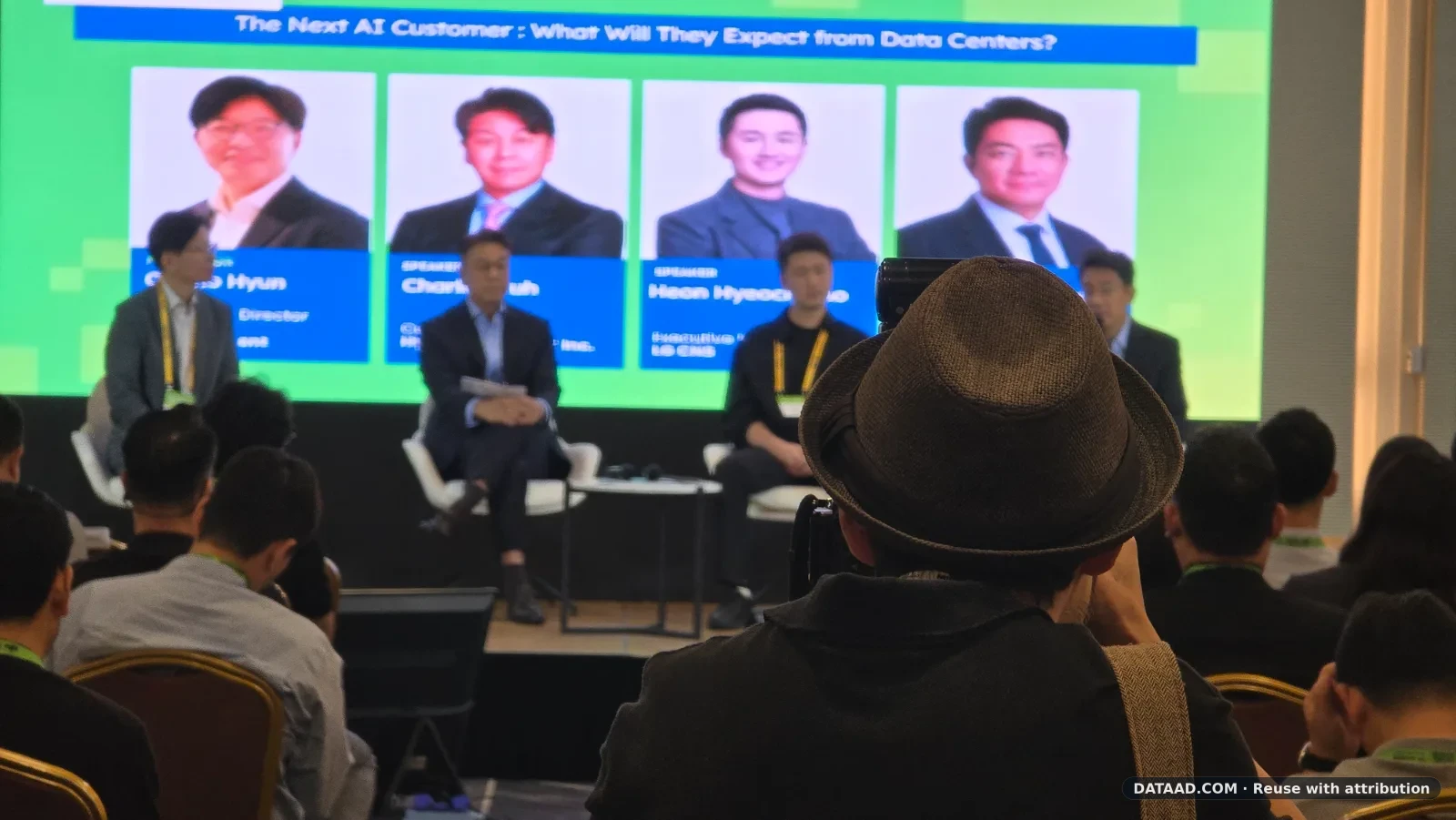
At the Korea Cloud and Datacenter Convention 2026 in Seoul, one of the most interesting observations from today’s panel discussion was that the current AI data center investment cycle may resemble the early Internet infrastructure boom of the 1990s.
The comparison is important.
It does not mean that every AI data center project being announced today will succeed. The Internet itself grew enormously, even though many companies and investments from the dot-com era disappeared.
The more significant similarity is that infrastructure may be expanding before society has fully discovered all of the applications that will eventually use it.
In the 1990s, networks and Internet infrastructure came first. Search engines, e-commerce, social media, streaming, cloud computing and the mobile economy followed later.
AI may now be entering a similar stage.
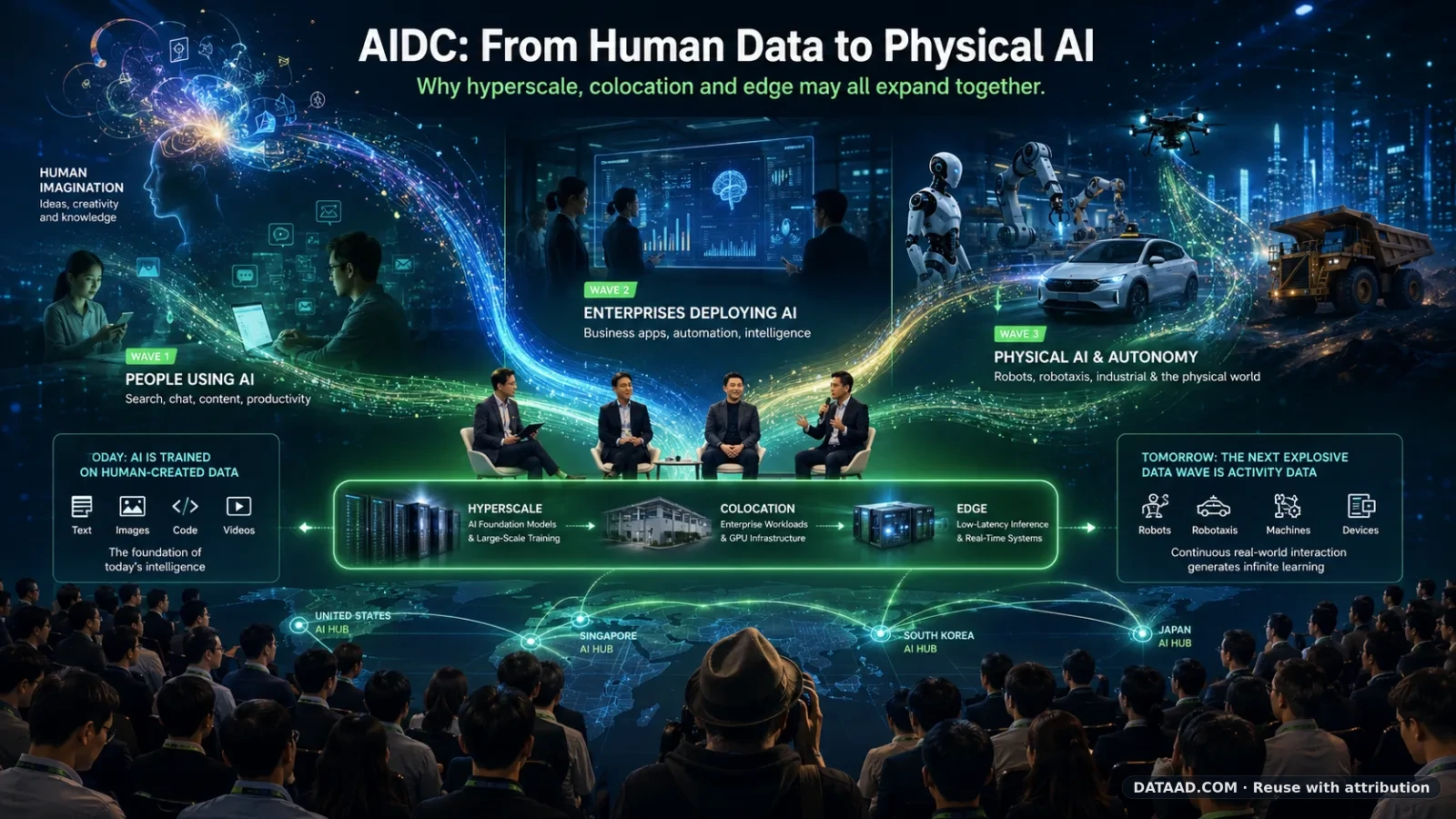
DATAAD sees AI infrastructure demand developing through three major waves:
- Wave 1 — People Using AI
- Wave 2 — Enterprises Operating Through AI
- Wave 3 — Machines Acting Through AI
Wave 1: People Using AI
The first wave is already underway.
Individuals increasingly use generative AI for search, writing, translation, coding, images, video and everyday productivity.
This is the AI market that is most visible today.
Large language models and generative AI have consequently created enormous demand for GPU clusters, high-speed networking, power infrastructure and advanced cooling systems.
This first phase strongly favors hyperscale infrastructure because both foundation-model training and large-scale inference benefit from concentrated computing resources.
But consumer AI may represent only the first layer of demand.
Wave 2: Enterprises Operating Through AI
The second wave begins when AI becomes integrated into the operating systems of companies themselves.
AI will increasingly connect to ERP, procurement, manufacturing, engineering, financial systems, logistics, customer service, quality management and internal corporate knowledge.
The difference could be substantial.
Today, an employee may occasionally ask an AI assistant a question. In the next stage, thousands of AI agents could continuously perform tasks inside a single enterprise.
AI therefore changes from an application into infrastructure.
Some of these workloads will continue to operate inside hyperscale public clouds, but many companies will also require private AI environments, sovereign infrastructure and regional computing because of security, regulation, latency and intellectual-property concerns.
This creates a growing role for colocation data centers and regional GPU infrastructure.
Wave 3: Physical AI
The third wave may be even more transformative.
AI will increasingly leave the screen and interact directly with the physical world.
Physical AI includes humanoid and industrial robots, robotaxis, autonomous vehicles, drones, unmanned construction equipment, mining machines, warehouse automation, ships and intelligent industrial systems.
This stage changes the data-center equation because machines need both centralized intelligence and extremely fast local decision-making.
Large AI factories will remain necessary for training, simulation and model development. However, a robot or autonomous vehicle cannot always wait for a distant hyperscale data center to determine its next action.
Real-time inference must increasingly occur closer to the machine.
This leads toward a distributed infrastructure architecture:
Hyperscale AI Factory → Colocation → Regional Compute → Edge → Machine
Rather than edge replacing hyperscale, both may expand.
Training becomes increasingly centralized, while inference becomes increasingly distributed.
The Next Data Explosion May Come From Machines
There is another reason the third wave could become much larger than expected.
Until now, modern AI has primarily learned from information created by humans.
- Text
- Images
- Video
- Software code
- Books and research
- Websites
- Human conversations and digital behavior
In other words, today’s AI intelligence has largely been built on the accumulated digital history of humanity.
But physical AI introduces a fundamentally different form of information:
Activity Data.
A robot working inside a factory generates information every second. It sees objects, moves, makes decisions, encounters unexpected situations, corrects mistakes and interacts with machines and humans.
A robotaxi continuously generates information about roads, traffic, pedestrians, weather, vehicle behavior and thousands of unpredictable real-world situations.
An autonomous excavator, mining truck or construction machine produces another type of physical-world intelligence involving terrain, loads, equipment condition, energy consumption and operating environments.
The same applies to drones, ships, logistics equipment and intelligent industrial systems.
Unlike much of today’s training data, this information is not static.
It is continuously created by machines interacting with reality.
Millions of autonomous systems could eventually generate enormous volumes of real-world experience every day.
That information could then return to AI infrastructure for analysis, simulation and retraining.
The resulting cycle may look like this:
Machine Activity → Data → AIDC → Model Training → Updated Intelligence → Machine Activity
This feedback loop could become one of the largest future generators of computing demand.
But There May Be Another Data Explosion: Human Imagination
There is another question that receives much less attention.
Where will future human imagination data come from?
Today’s generative AI mainly learns from recorded human output — what humanity has already written, photographed, designed, filmed or programmed.
But human creativity is not limited to the historical record.
People continuously imagine things that do not yet exist:
- New machines
- New buildings
- New materials
- New businesses
- New stories
- New scientific theories
- New engineering structures
- Entirely new ways of organizing society and technology
AI could dramatically increase humanity’s ability to convert those thoughts into structured digital information.
An engineer working with an AI design system may generate hundreds of concepts rather than several. A scientist may explore thousands of potential hypotheses. Architects may simulate entire cities. Industrial engineers may create millions of virtual machine configurations inside digital twins.
Writers, designers and creators may also produce complex worlds, products and concepts at a scale that was previously impossible.
This could produce another category of information that DATAAD calls:
Human Imagination Data.
It is fundamentally different from conventional historical training data.
Historical data tells AI what humanity has already done.
Activity data tells AI what machines are doing now.
Imagination data may tell AI what humans could do next.
The interaction among these three information sources could become one of the most important forces shaping the next AI economy.
Human Knowledge → AI
Machine Activity → AI
Human Imagination → AI
AI can then produce new knowledge, new designs and new machine behavior, generating still more information.
This creates the possibility of a self-reinforcing data and intelligence cycle.
Why Hyperscale, Colocation and Edge May All Expand Together
This framework helps explain why future AIDC development may not become a competition between different types of data centers.
Each architecture performs a different role.
Hyperscale
Hyperscale AI factories are optimized for foundation models, massive training clusters, simulation, centralized data aggregation and large-scale computation.
Colocation
Colocation facilities increasingly support enterprise AI, regional GPU infrastructure, hybrid cloud, sovereign workloads and industry-specific AI platforms.
Edge
Edge computing supports physical AI, industrial systems and applications requiring extremely low latency and real-time decision-making.
The likely architecture therefore becomes:
Hyperscale for intelligence creation.
Colocation for enterprise deployment.
Edge for real-world intelligence.
All three may expand simultaneously.
United States: The AI Factory
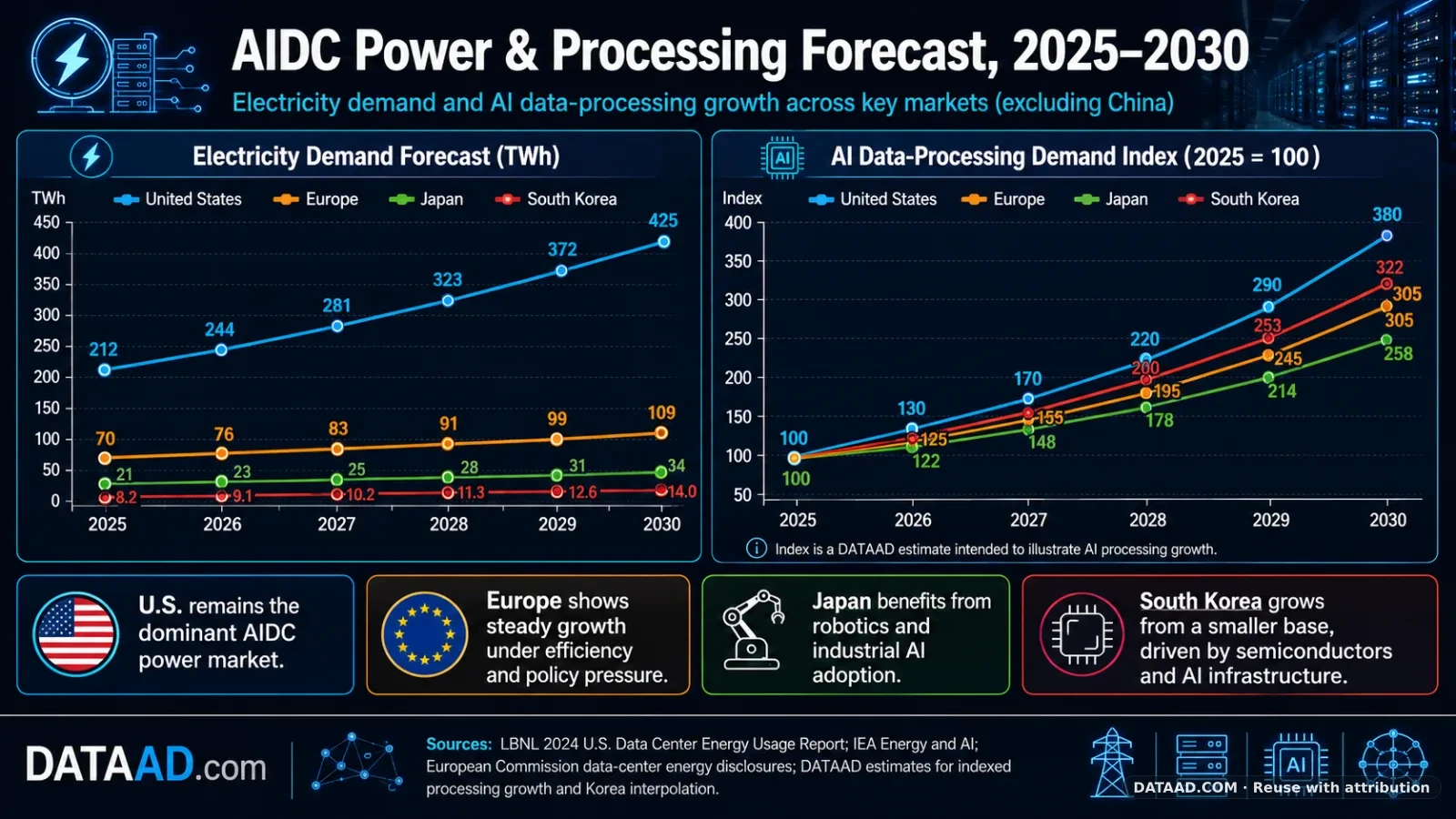
The United States is likely to remain the largest center for frontier AI models and hyperscale AI factories.
Its greatest strength is the concentration of hyperscalers, semiconductor technology, AI model developers, software ecosystems and capital.
However, electricity generation, grid capacity, transmission infrastructure, land and cooling resources are increasingly determining where new AI infrastructure can actually be built.
The U.S. may therefore remain the world’s primary centralized AI training environment while regional and edge infrastructure continues to develop around it.
Singapore: The Regional AI Hub
Singapore follows a different model.
Land and energy limitations make unlimited hyperscale expansion difficult, yet Singapore remains one of Asia’s most important financial, telecommunications, cloud and connectivity hubs.
Its role may increasingly focus on high-value computing, connectivity, regional AI services and premium colocation.
Singapore could function as an important AI coordination and interconnection hub for Southeast Asia while some power-intensive infrastructure expands into surrounding markets.
South Korea: Semiconductors Meet Physical AI
South Korea occupies an unusual position in the global AI infrastructure ecosystem.
The country is already deeply connected to the AI hardware economy through memory semiconductors, advanced manufacturing and electronics.
The next opportunity is to connect those strengths with AI computing, enterprise AI, manufacturing intelligence and robotics.
Korea could eventually create a vertically connected ecosystem:
Semiconductors → AI Data Centers → Enterprise AI → Manufacturing AI → Robotics
For South Korea, physical AI may therefore become especially important because the country already possesses both semiconductor infrastructure and a highly automated industrial base.
Japan: Industrial AI and Robotics
Japan may become one of the most significant physical-AI markets.
The country already possesses deep capabilities in automotive manufacturing, industrial equipment, robotics, precision machinery and factory automation.
As these machines become increasingly intelligent, Japan could generate enormous volumes of industrial activity data.
Its future AIDC demand may therefore become more geographically distributed than traditional cloud infrastructure, with computing positioned closer to factories, robotics clusters and industrial users.
DATAAD View
The current AI data center investment boom should not be evaluated only through today’s chatbot or generative-AI demand.
Consumer AI is the first wave.
Enterprise AI is the second.
Physical AI is the third.
But underneath those three waves is an even larger transition in the nature of data itself.
Until today, AI has primarily consumed accumulated digital information created by humans.
Tomorrow, intelligent machines may continuously produce their own activity data.
At the same time, AI could dramatically amplify humanity’s ability to transform imagination into new digital knowledge.
The future AI ecosystem may therefore be built around three enormous information resources:
Human-created knowledge.
Machine-generated activity.
Human-generated imagination.
If these three streams begin reinforcing one another, the amount of intelligence requiring computation could become far larger than today’s market suggests.
This is why the comparison with the Internet of the 1990s is compelling.
We may currently be looking at AI infrastructure through the applications that already exist, much as people once viewed the Internet primarily through email and simple websites.
The largest applications may still be ahead.
If AI eventually moves from people, to enterprises, to machines — and from historical human data toward continuous physical-world activity and imagination data — the present AIDC investment boom may not represent the peak.
It may represent the beginning.