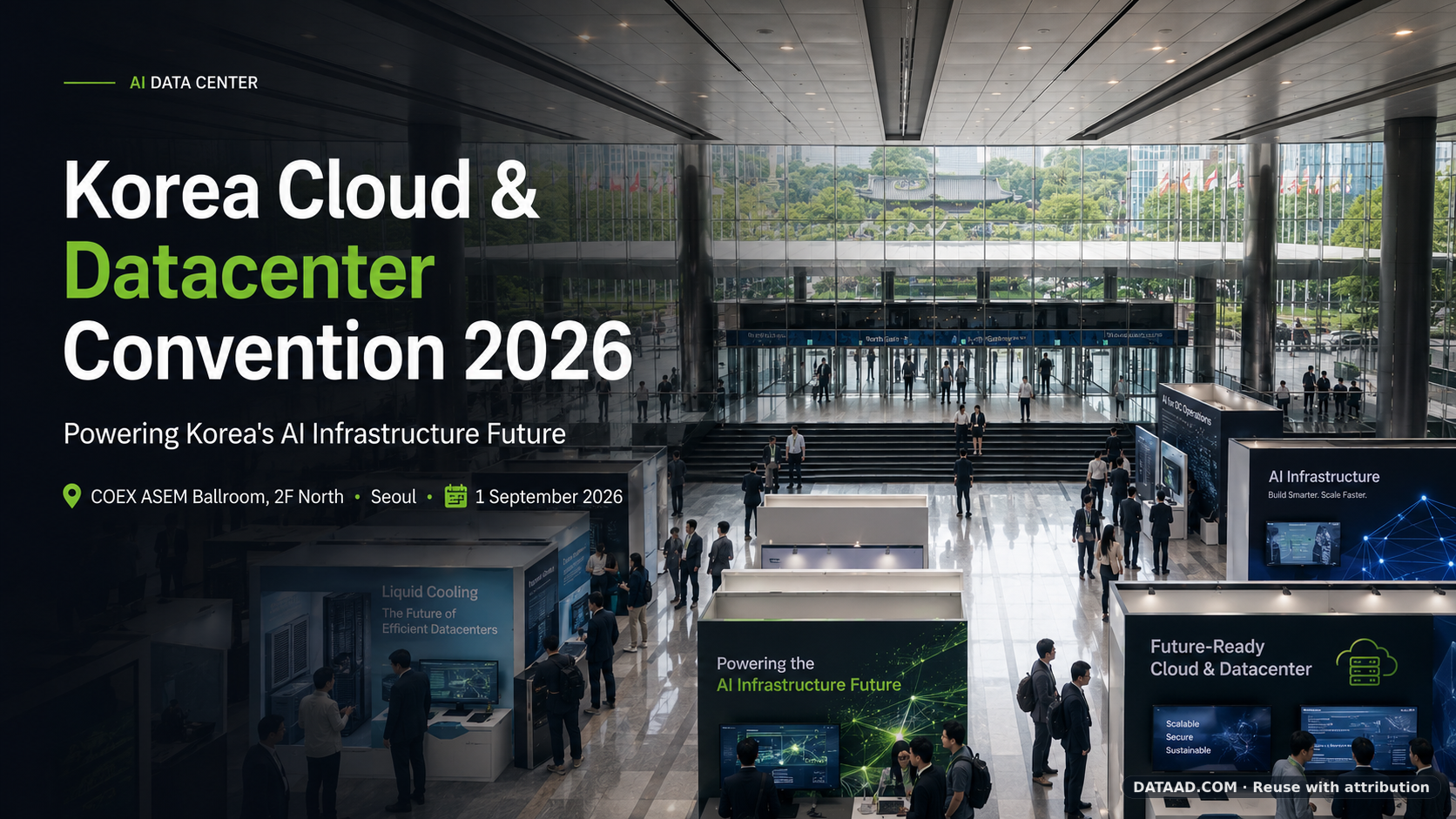
SEOUL — Korea’s AI data-center industry will gather at COEX on September 1 for the Korea Cloud & Datacenter Convention 2026 (KRCDC 2026), as the industry confronts a fundamental shift from conventional cloud infrastructure toward increasingly dense GPU-based AI computing.
The event, held at the COEX ASEM Ballroom, 2F North, will focus on the infrastructure required to support this transition — including electrical power, 100kW+ racks, liquid cooling, data-center operations and the expansion of capacity beyond the Seoul metropolitan area.
As AI models and inference workloads increase computing density, data-center design is increasingly becoming a three-way engineering challenge involving compute density, electrical power and heat removal.
AI Is Changing the Data Center Design Baseline
Traditional enterprise and cloud facilities were largely designed around rack densities that could be handled by conventional air cooling. AI infrastructure is changing that assumption rapidly.
GPU servers concentrate significantly more computing power — and therefore heat — into each rack. As rack density rises toward 100kW and beyond, power distribution, coolant distribution, redundancy, serviceability and facility-level heat rejection must increasingly be designed as one integrated system.
One of the key sessions at KRCDC 2026, “100kW Racks and Beyond,” will examine these issues, including the relative roles of Direct-to-Chip liquid cooling and immersion cooling in future AI facilities.
Liquid Cooling Moves Into Core Infrastructure
Liquid cooling is consequently moving from a specialized technology into a core part of AI data-center architecture.
In Direct Liquid Cooling, heat is removed close to the processor through a cold plate, while coolant is distributed through manifolds, hoses and quick-disconnect interfaces. A CDU — Cooling Distribution Unit — provides the interface between the IT cooling loop and the facility-side cooling infrastructure.
The cooling system therefore extends far beyond the cold plate itself. Engineers must consider the entire fluid path: cold plate → hose → quick disconnect → manifold → CDU → secondary piping → heat exchanger or facility water system.
This is particularly important for existing data centers. Many facilities cannot simply replace all air-cooled infrastructure, making hybrid architectures and retrofit strategies an important part of the transition toward liquid cooling.
Four Cooling Groups for the AI Era
The evolution of AI cooling can broadly be viewed through four technology groups: single-phase DLC, two-phase DLC, single-phase immersion and two-phase immersion cooling. Each addresses heat removal differently and has different implications for server architecture, coolant selection, pumping, maintenance and facility integration.

Four Cooling Groups: DLC Single Phase, DLC Two Phase, Immersion Single Phase and Immersion Two Phase. Image source: IMMERSEKOOL.
1. DLC Single Phase — Direct-to-Chip Liquid Cooling
Single-phase Direct Liquid Cooling (DLC) circulates liquid coolant through cold plates attached directly to CPUs, GPUs and other high-heat components. The coolant stays in liquid form while carrying heat from the server toward the CDU and heat exchanger.
This architecture typically uses cold plates, rack manifolds, hose kits, quick disconnects and an in-rack or in-row CDU. Because the entire server does not need to be submerged, single-phase DLC can also be integrated with remaining air-cooled components, making it particularly attractive for retrofit and transitional AI data centers.
2. DLC Two Phase — Using Phase Change at the Chip
Two-phase DLC goes one step further by allowing the coolant to change phase as it absorbs heat near the processor. Instead of relying only on a temperature increase in the liquid, the system uses the latent heat associated with the liquid-to-vapor transition.
The vapor is subsequently condensed and returned to the cooling loop. This approach is being explored for future extremely high heat-flux processors, but it also places additional requirements on the cold plate, pressure control, sealing, coolant compatibility and system interfaces.
3. Immersion Single Phase — The Server Enters the Coolant
In single-phase immersion cooling, the server or IT hardware itself is submerged in a dielectric cooling fluid. Unlike two-phase immersion, the fluid remains liquid and transfers absorbed heat through circulation to an external heat exchanger.
Removing conventional server fans can reduce airflow requirements and allow more uniform thermal management around densely packed electronic components. The technology is therefore attracting attention for AI, HPC and specialized high-density computing environments.
4. Immersion Two Phase — Evaporation and Condensation
Two-phase immersion cooling also places the IT equipment directly in a dielectric fluid, but the coolant is designed to boil at the operating temperature of the electronics. Heat from the server vaporizes the liquid, and the vapor rises to a condenser where it returns to liquid form.
The architecture can achieve very high heat-transfer capability while reducing the need for conventional server-level airflow. At the same time, coolant properties, vapor containment, condenser design, maintenance procedures and long-term fluid management become important engineering considerations.
Together, these four cooling groups illustrate that there is unlikely to be a single cooling architecture for every AI data center. The appropriate solution will depend on rack power density, chip heat flux, existing building infrastructure, service strategy and total lifecycle economics.
KRCDC 2026 — Key Program Schedule
KRCDC 2026 will cover Korea’s data-center outlook, AI power infrastructure, 100kW+ racks, liquid cooling and the future of high-density AI computing. 주요 프로그램은 다음과 같다.
| Time | Key Session / 주요 세션 |
|---|---|
| 08:00–09:00 | Registration, Networking & Breakfast / 등록 및 네트워킹 |
| 09:10–09:30 |
Korea Data Center Industry Outlook 2026–2030 한국 데이터센터 시장, AI·클라우드·전력 및 지속가능성 전망 |
| 09:30–10:00 |
Beyond Seoul 수도권 전력·부지 제약과 서울 외 데이터센터 시장 |
| 10:00–10:20 |
AI Workload Operational Readiness 고밀도 AI 및 액체냉각 데이터센터의 운영 준비 |
| 10:20–10:35 |
AI Data Center Operations Liquid Cooling, Giga-scale 운영 및 전문인력 과제 |
| 11:15–11:45 |
100kW Racks and Beyond 100kW+ 고밀도 랙, Direct-to-Chip vs Immersion, 전력·배관·기계설비 |
| 11:45–12:05 |
Deploying Liquid Cooling for AI Infrastructure DLC, CDU, Secondary Piping 및 기존 데이터센터 Retrofit |
| 12:05–12:35 |
The Next AI Customer STT GDC, LG CNS, DCI Korea와 함께 보는 새로운 AI 데이터센터 고객 |
| 12:55–14:00 | Lunch Networking / 점심 및 네트워킹 |
| 14:00–14:30 |
Edge Data Center Era AI Inference 확대와 Edge Data Center의 역할 |
| 14:30–14:50 |
Powering AI in Weeks AI 데이터센터 전력 확보, LNG·부유식 발전 및 Behind-the-Meter |
| 14:50–15:20 |
Speed vs Stability AI 데이터센터의 빠른 건설과 장기 안정성의 균형 |
| 15:20–15:50 |
Asia’s AI Infrastructure Future Hyperscaler, Neocloud, GPU/HPC와 아시아 AI 인프라의 미래 |
| 15:50 onward | Sundown Networking Drinks / 마무리 네트워킹 |
Korea Faces a Power Challenge
Cooling is only one part of the AI infrastructure equation. Access to sufficient electrical power is becoming equally critical.
Large AI data centers can require enormous amounts of electricity, while grid connections, substations and suitable development sites often take significantly longer to secure than IT equipment itself.
This makes the geographic expansion of data centers beyond central Seoul and the broader metropolitan region an increasingly important topic. The KRCDC program will examine both the infrastructure opportunities outside Seoul and new approaches to delivering power on schedules compatible with rapidly expanding AI demand.
Speed Versus Stability
The race to secure AI capacity also raises another question: how fast can infrastructure be built without compromising long-term reliability?
AI data-center development is pushing operators toward modular construction, prefabricated infrastructure and increasingly standardized power and cooling blocks. These techniques can shorten deployment schedules, but high-density AI environments also require careful commissioning of electrical, mechanical and liquid systems.
A cooling failure that might once have affected a relatively modest IT load can have much larger consequences when a single rack carries 100kW or more of computing equipment.
The Next AI Customer Is Different
The profile of the data-center customer is changing as well.
Traditional colocation users primarily purchased floor space, electrical capacity and network connectivity. AI customers increasingly require GPU-ready power density, liquid cooling capability, high-speed networking and infrastructure capable of expanding quickly as computing clusters grow.
Hyperscalers, AI cloud providers, sovereign AI projects and enterprise AI deployments are therefore creating a new set of requirements for both operators and their infrastructure suppliers.
DATAAD View
KRCDC 2026 reflects a broader transformation taking place across the data-center industry.
The defining question is no longer simply how large a data center can be built. The more important measure will increasingly be how much computing power can be delivered reliably within a given amount of electrical power, cooling capacity and physical space.
That transition is opening a new infrastructure market around cold plates, CDUs, manifolds, pumps, heat exchangers, hoses, quick disconnects, coolant, secondary piping, power distribution and monitoring systems.
It also means that the boundary between semiconductor technology and facility engineering is becoming less distinct. The thermal characteristics of the GPU increasingly influence rack design, while rack density influences the mechanical and electrical architecture of the entire building.
For Korea — already a major global base for semiconductors, electronics, batteries and advanced manufacturing — the development of AI data centers could therefore create a broader industrial ecosystem connecting chips, servers, cooling, energy and physical infrastructure.
Korea Cloud & Datacenter Convention 2026 will be held on September 1, 2026 at COEX ASEM Ballroom, 2F North, Seoul.