

SEOUL, South Korea — August 21, 2026. The 2026 OCP Korea Tech Day at COEX offered a clear picture of how quickly the AI data center industry is changing.
From servers, power infrastructure and networking to liquid cooling and high-density rack design, the event brought together a broad ecosystem of companies working on the infrastructure required for the next generation of AI computing.
The atmosphere at the Grand Ballroom and ASEM Ballroom also showed something important: AI data centers are no longer a discussion limited to hyperscalers and semiconductor companies. Cooling, power, connectors, hoses, manifolds, cold plates, racks and facility infrastructure are becoming equally important parts of the AI value chain.
AI Is Changing the Physical Data Center
The rapid increase in GPU power density is forcing the industry to rethink traditional data center architecture.
Air cooling alone is becoming increasingly difficult for the highest-density AI systems. As rack power moves higher, Direct-to-Chip liquid cooling, advanced coolant distribution systems and eventually more sophisticated two-phase technologies are moving from specialist technologies toward mainstream infrastructure.
This means that the AI revolution is not only about processors and software. It is also becoming a major mechanical, thermal and energy infrastructure transformation.
Liquid Cooling Becomes a Core Infrastructure Topic
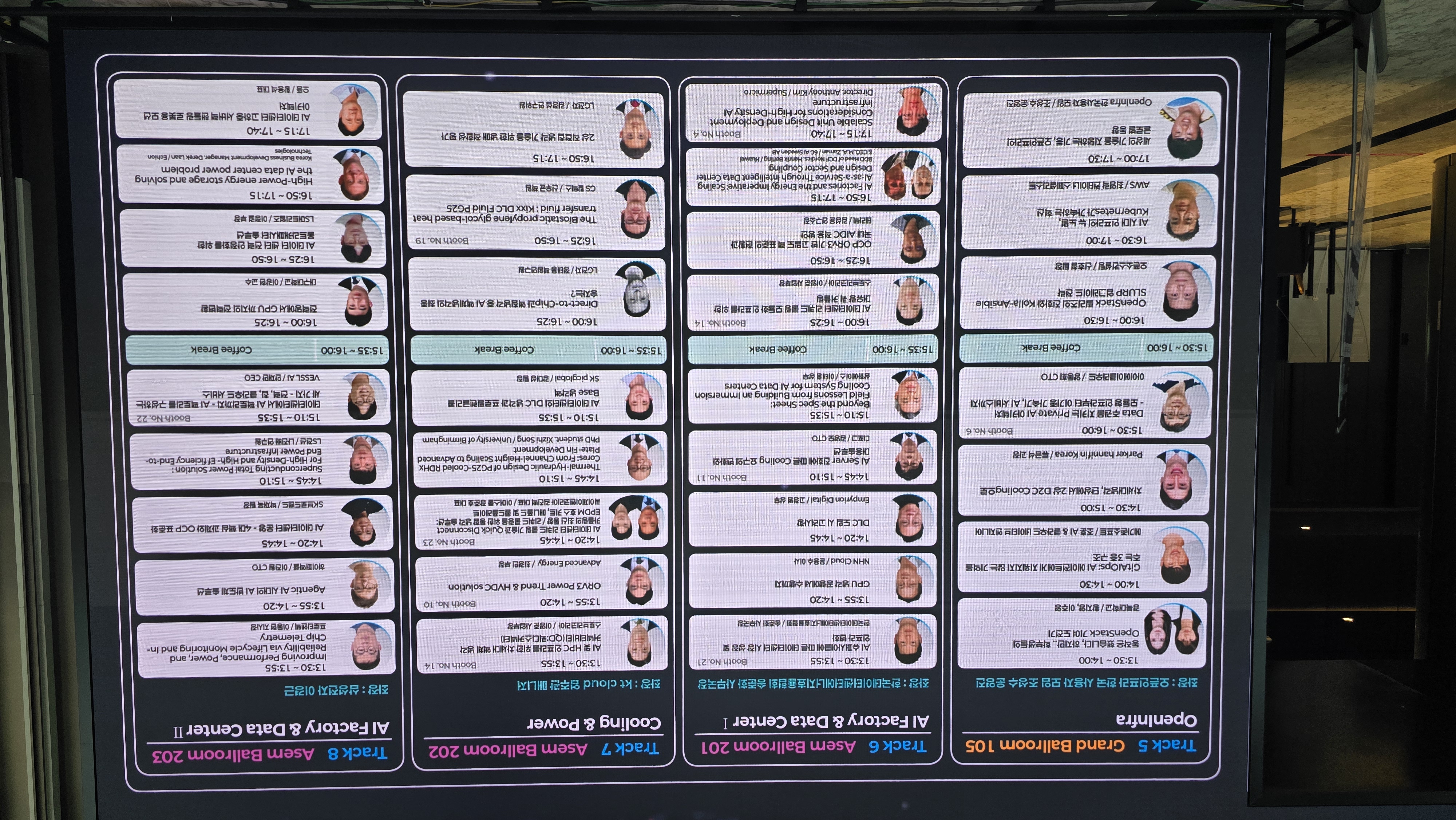
At OCP Korea Tech Day, cooling and power had their own dedicated technical track, reflecting the increasing importance of thermal management in AI infrastructure.
CEJN Korea and ImmerseKool presented technologies related to liquid cooling and the latest trends in Quick Disconnect couplings, together with integrated cooling components such as EPDM hose kits, manifolds and cold plates.
Quick Disconnects may appear to be relatively small components compared with GPUs, servers or CDUs, but they perform a critical role. As liquid cooling systems become larger and more modular, reliable connection and disconnection, low pressure drop, sealing performance, serviceability and compatibility with different coolants become increasingly important.

From Individual Products to an Integrated Cooling Ecosystem
The market is also beginning to move beyond the idea of simply purchasing individual cooling products.
A practical AI data center cooling system requires many components to work together: cold plates, hoses, Quick Disconnects, manifolds, CDU interfaces, rack plumbing and facility-side cooling infrastructure.
The real challenge is therefore system integration.
OCP standards can help create common interfaces and accelerate interoperability between global suppliers. At the same time, regional engineering and manufacturing capabilities will remain important because data center designs, operating conditions, maintenance requirements and supply chains are different in each market.
Korea Needs a Stronger Domestic AI Data Center Supply Chain
One of the most important questions for Korea is how much of this new AI infrastructure can eventually be designed and manufactured domestically.
Today, several critical components in AI liquid cooling are still dominated by a relatively small number of global suppliers. Their technology and experience remain extremely important, and international cooperation will continue to be necessary.
However, Korea also has strong capabilities in precision manufacturing, semiconductors, automotive thermal management, electronics, HVAC, shipbuilding and industrial components.
Connecting these capabilities with Korean data center operators, server manufacturers and major technology companies could create a much stronger domestic AI infrastructure ecosystem.
The goal should not simply be to replace overseas suppliers. It should be to develop Korean technologies that can meet global standards and compete internationally.
Global Standards, Local Engineering
This may become one of the most important opportunities created by OCP.
Open standards allow companies of different sizes to participate in a common infrastructure architecture. A Korean component manufacturer does not necessarily need to build an entire AI data center. It can specialize in a connector, manifold, hose system, cold plate, sensor or cooling module while designing that product to operate within an internationally recognized ecosystem.
For companies such as CEJN Korea and ImmerseKool, the role can therefore extend beyond selling individual products. Working together with Korean manufacturers, engineering companies and large enterprises to build reliable and serviceable AI data center cooling infrastructure could become increasingly important.
Connect, Collaborate, Accelerate
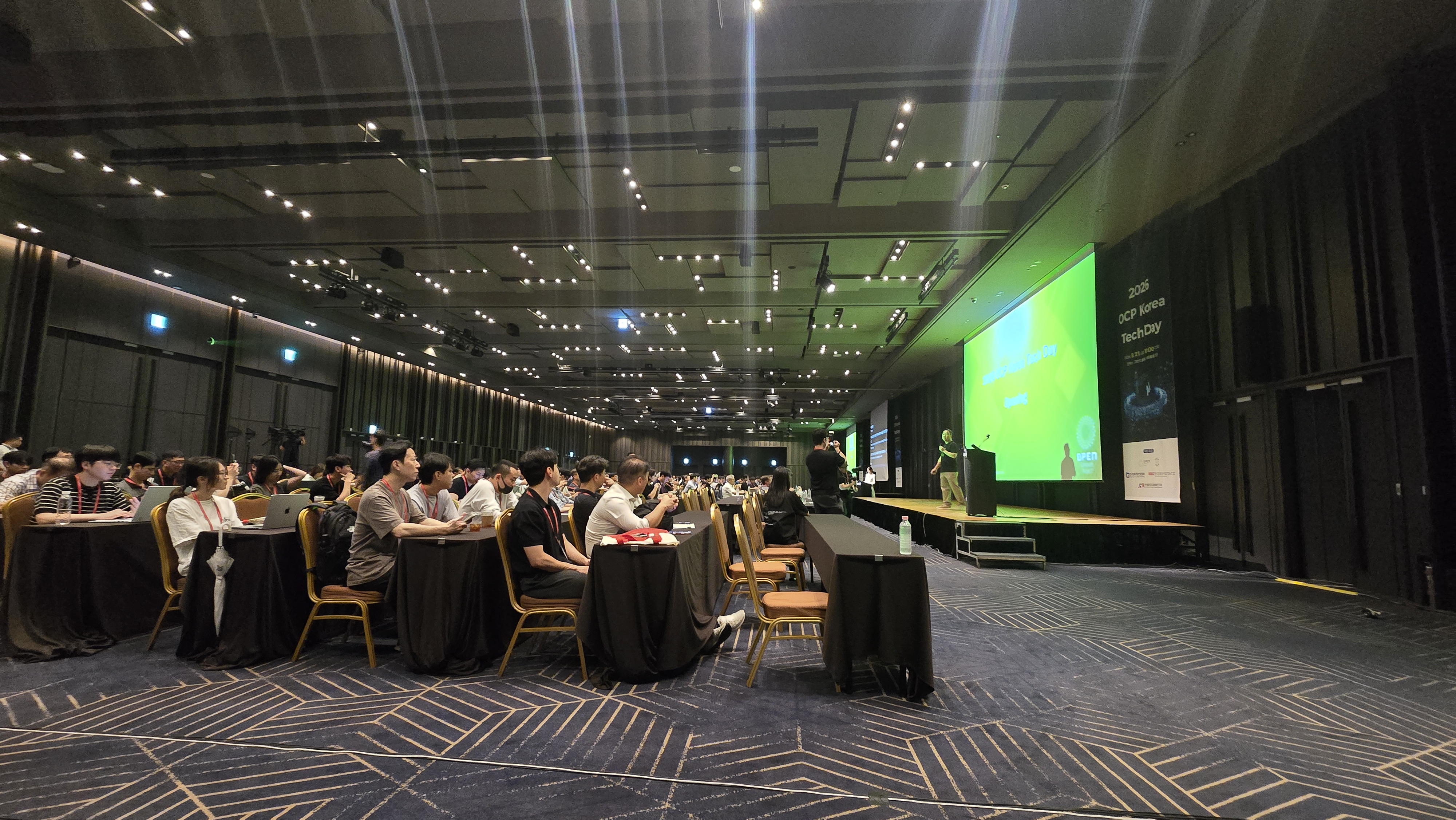
The large banner at the entrance to the 2026 OCP Korea Tech Day carried three words:
Connect. Collaborate. Accelerate.
Those words may also describe the next phase of Korea’s AI data center industry.
AI infrastructure will not be built by one semiconductor company, one server manufacturer or one cooling supplier. It will require collaboration across computing, power, thermal management, mechanical engineering and manufacturing.
Korea already has many of the industrial capabilities required for this transition.
The next step is to connect them.
As AI rack density continues to increase, the companies that understand both global standards and practical local engineering may become some of the most important players in the next generation of data center infrastructure.
DATAAD Market Insight | Seoul, August 2026