
Mitsubishi Electric and Climaveneta Expand Their AI Data Center Cooling Ambitions
South Korea's rapidly expanding artificial intelligence infrastructure market is attracting increasing attention from global cooling technology suppliers.
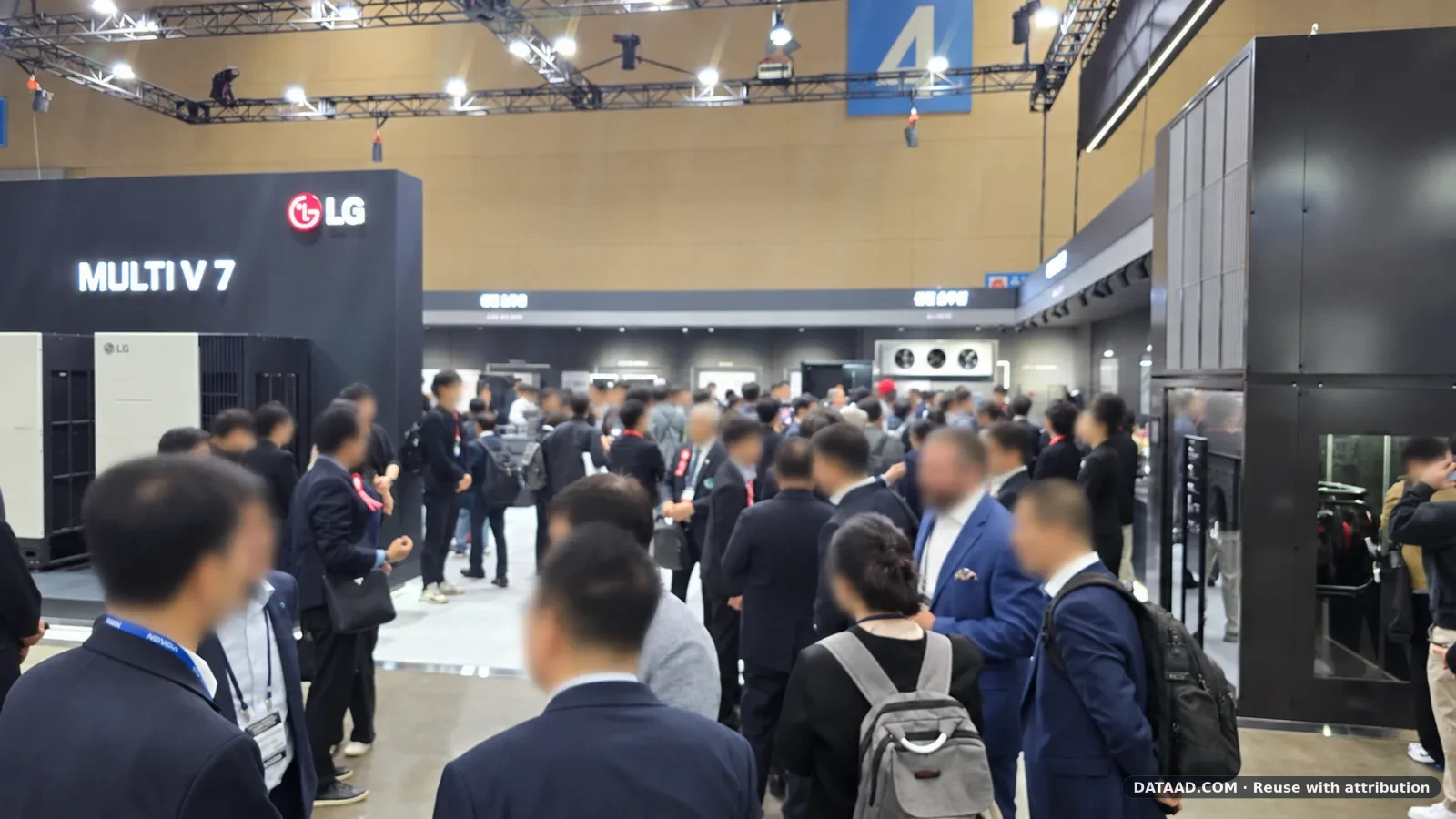
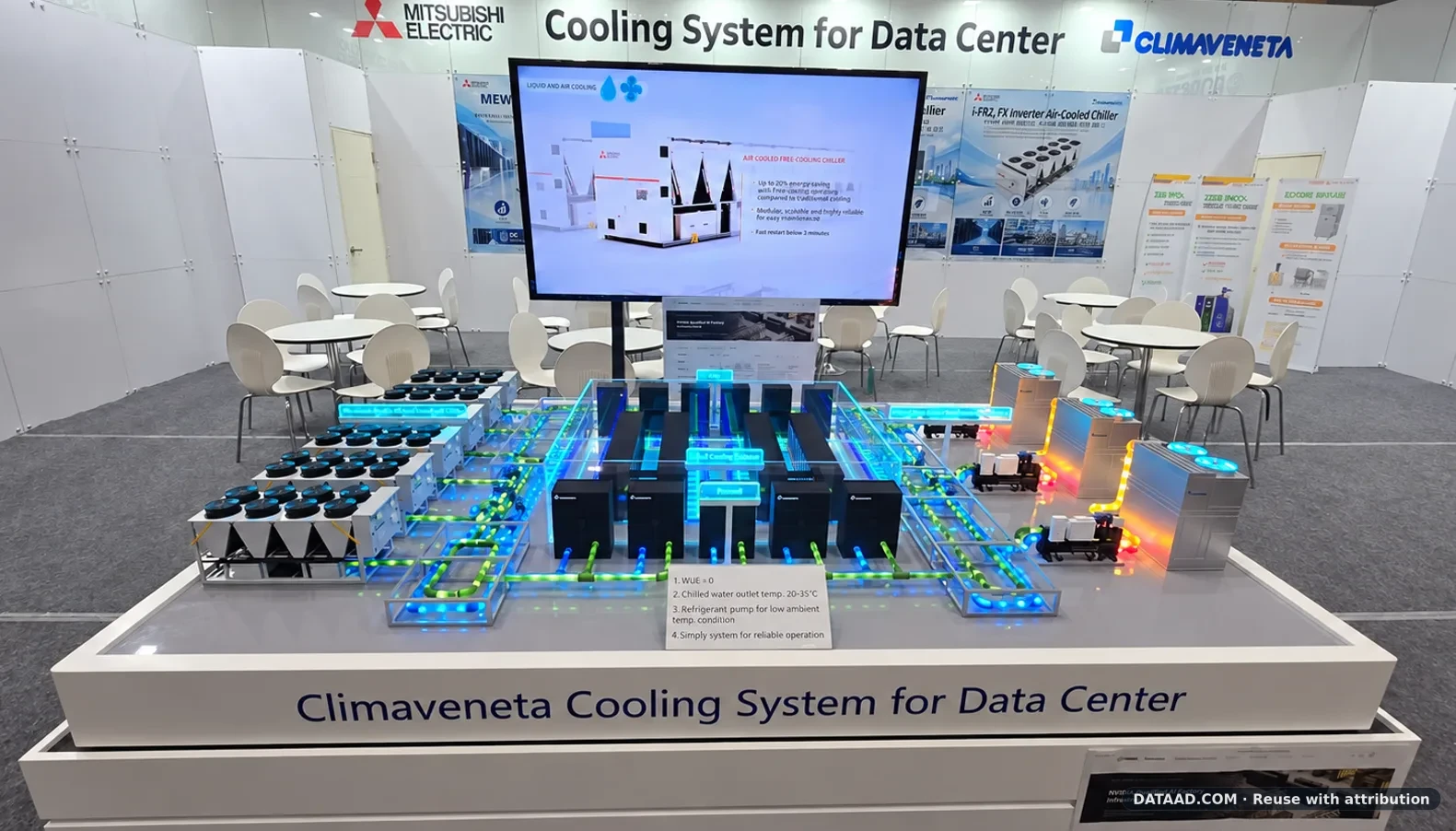
At a recent industry exhibition in Korea, Mitsubishi Electric's Climaveneta brand presented its "Cooling System for Data Center" concept, featuring high-efficiency cooling equipment and an integrated demonstration model of a modern data center cooling architecture.
The exhibition highlighted how traditional heating, ventilation and air conditioning (HVAC) suppliers are repositioning themselves as essential technology providers for the next generation of AI infrastructure.
As GPU-intensive computing increases the power density of servers, cooling is no longer simply a building utility. It is becoming a critical part of data center architecture, influencing energy efficiency, water consumption, operating costs and ultimately the feasibility of deploying high-density AI systems.
Mitsubishi Electric and Climaveneta are positioning their cooling portfolio to address this changing market, while the wider Mitsubishi industrial ecosystem is also advancing next-generation liquid cooling technologies.
From Conventional Chillers to Integrated AI Cooling Systems
Climaveneta is an established European cooling technology brand operating within Mitsubishi Electric Hydronics & IT Cooling Systems, part of the Mitsubishi Electric Group.
The company supplies advanced chillers, air-handling systems and integrated thermal management solutions for commercial, industrial and data center applications.
At the Korean exhibition, the Climaveneta demonstration presented a broader cooling architecture integrating chillers, cooling distribution equipment and server infrastructure.
Such integrated solutions are becoming increasingly important as data centers transition from conventional air-cooled server environments toward hybrid air-and-liquid cooling systems.
Mitsubishi Electric's May 2026 strategic presentation explicitly identified both single-phase and two-phase liquid cooling as part of its future IT cooling portfolio.
The company's stated direction includes integrated data center cooling solutions, advanced energy management, waste heat utilization and technologies targeting high operating efficiency.
This approach places Climaveneta within a larger industrial strategy that extends beyond individual chillers toward comprehensive AI data center thermal infrastructure.
Direct-to-Chip Cooling Becomes Essential for High-Density AI Racks
The transformation of AI infrastructure is changing the thermal requirements of modern data centers.
Conventional air cooling remains suitable for many enterprise and cloud computing environments. However, high-performance AI accelerators generate increasingly concentrated heat loads that are difficult to manage through air cooling alone.
Modern direct-to-chip liquid cooling, also known as direct liquid cooling (DLC) or D2C cooling, transfers heat directly from processors through liquid-cooled cold plates attached to GPUs and CPUs.
In a typical single-phase DLC system, the cooling liquid remains in the liquid state while circulating through the cold plates.
The heated liquid then passes through the rack manifold and coolant distribution unit (CDU), where heat is transferred to the facility cooling infrastructure.
The complete system may include:
- GPU and CPU cold plates
- Server-level liquid cooling connections
- Quick-disconnect couplings and flexible hoses
- Rack cooling manifolds
- Coolant distribution units (CDUs)
- Facility-side heat exchangers and chillers
- Monitoring, leak detection and control systems
Single-phase DLC is already becoming a mainstream cooling architecture for high-density AI computing.
Yet increasing processor power consumption is driving industry interest in technologies capable of absorbing higher localized heat flux while improving overall thermal efficiency.
The Next Frontier: Waterless Two-Phase Direct Liquid Cooling
Two-phase direct-to-chip cooling represents a potentially significant development beyond conventional single-phase systems.
Instead of relying entirely on the temperature rise of a circulating liquid, a two-phase system uses the refrigerant's change of state from liquid to vapor to absorb heat directly at the processor cold plate.
When a suitable working fluid evaporates, it can absorb substantial amounts of thermal energy through latent heat transfer.
The vapor is subsequently condensed back into liquid and recirculated within a closed cooling loop.
This process can provide high localized heat-transfer performance and may reduce the coolant flow required for a given thermal load.
Single-Phase vs. Two-Phase DLC
| Category | Single-Phase DLC | Two-Phase DLC |
|---|---|---|
| Working Fluid | Water-based coolant or other suitable liquid | Engineered phase-change refrigerant |
| Heat Transfer | Sensible heat | Latent heat through evaporation |
| Fluid Behavior | Remains liquid | Liquid-to-vapor phase change |
| Technology Maturity | Commercially deployed | Developing and early commercial adoption |
| Main Challenges | Flow, pressure drop and heat flux | Refrigerant management, pressure, materials and reliability |
| Water at Cold Plate | Common in water-based designs | Not required in waterless refrigerant designs |
One important distinction is that waterless direct-to-chip cooling does not necessarily mean an entirely waterless data center.
Even a closed-loop two-phase system may use water-based facility cooling or evaporative heat rejection elsewhere in the infrastructure.
The actual reduction in water consumption depends on the complete cooling system, including the condenser, cooling plant, climate and heat rejection technology.
Nevertheless, two-phase cooling could help operators develop high-density systems with lower server-side water exposure, improved heat transfer and potentially reduced overall cooling energy consumption.
Mitsubishi Heavy Industries Is Also Developing Two-Phase Cooling Technology
Within Japan's broader industrial technology landscape, Mitsubishi Heavy Industries (MHI) has separately developed a two-phase direct-to-chip cooling solution for data center applications.
This technology should be distinguished from Mitsubishi Electric's Climaveneta business because the two companies operate independently.
MHI describes a closed-loop, waterless cold-plate system that uses refrigerant evaporation to remove heat from high-performance processors.
According to its published technical information, the system has been developed for high-density server applications, including processors with thermal loads of 1,500 W and above.
The disclosed architecture demonstrates how two-phase cooling technologies are evolving from laboratory concepts toward practical deployment in high-density data center environments.
For the Korean AIDC market, this technology illustrates the potential direction of future cooling systems, although it should not be interpreted as confirmation that Climaveneta is already supplying MHI's two-phase equipment.
LG Electronics Accelerates Its Chip-to-Chiller Strategy
South Korean companies are also expanding their presence in the advanced data center cooling market.
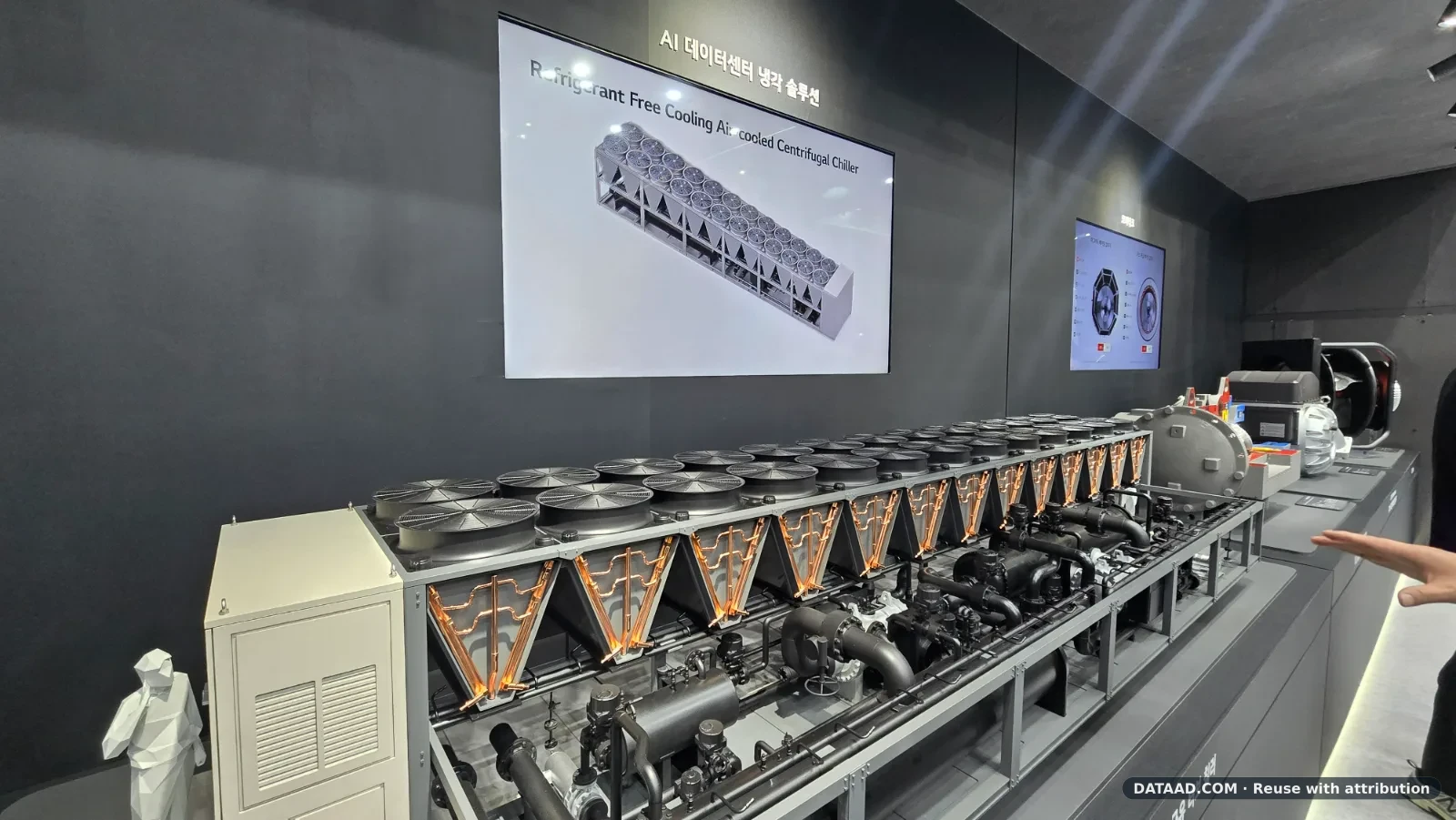
LG Electronics has established a broad portfolio combining chillers, coolant distribution units, direct-to-chip cooling and integrated thermal management systems.
In July 2026, LG announced that its 600 kW CDU had received NVIDIA quality certification.
The company subsequently announced approval of its 2.6 MW CDU under NVIDIA's DSX-ready specifications in September 2026.
LG is also expanding chiller production capacity and pursuing a broader "Chip-to-Chiller" approach, integrating cooling equipment across the server and facility infrastructure.
Beyond conventional liquid cooling, LG is working with external partners on immersion cooling technologies and standard system designs.
These initiatives position LG as a significant Korean competitor in the rapidly expanding AI thermal management market.
Two-phase direct-to-chip technology represents another potential stage of industry development, although commercial schedules for specific LG two-phase products have not been publicly established in the sources reviewed for this article.
Samsung Expands Its AI Data Center Cooling Capabilities
Samsung Electronics is similarly strengthening its presence in the global HVAC and data center cooling industry.
The company's acquisition of FlaktGroup has expanded its capabilities in large-scale HVAC systems, ventilation and precision cooling infrastructure.
In August 2026, Samsung announced an investment of approximately KRW 240 billion to establish a FlaktGroup HVAC production line in Gwangju, South Korea.
The facility is scheduled to begin operations in 2028 and will manufacture advanced HVAC products, including cooling solutions for AI data centers.
Samsung's industrial capabilities could provide a foundation for increasingly integrated AI infrastructure solutions as rack power density continues to increase.
However, its announced HVAC expansion should be distinguished from a confirmed commercial launch of two-phase direct-to-chip cooling products.
Further development and partnerships may be required as the market advances toward higher-density liquid cooling architectures.
Shinsung E&G Targets Modular and High-Density Cooling

Shinsung E&G is another Korean company positioning itself for the next stage of AI data center infrastructure.
Drawing on its experience in semiconductor cleanroom engineering, environmental control and industrial air-handling technologies, Shinsung has developed an integrated modular data center platform known as AIO, or All In One.
The platform integrates server infrastructure and cooling equipment into a compact modular architecture.
According to the company's 2026 disclosures, AIO can support hybrid cooling configurations incorporating in-row cooling and direct liquid cooling.
The company has described configurations supporting up to 140 kW per rack, depending on system requirements.
Such designs are particularly relevant for data centers where physical space, floor loading, ceiling height and mechanical infrastructure constrain expansion.
Rear-door heat exchangers and integrated liquid cooling systems may provide additional options for upgrading existing facilities without extensive structural changes.
Industry discussions also point to interest in two-phase cooling development, with approximately 2029 emerging as a possible target within the longer-term development roadmap.
However, this timing should be treated as an industry-level indication rather than a formally confirmed commercial launch schedule.
2028–2030: A Potential Transition Period for Two-Phase DLC
The Korean AI infrastructure industry is entering a period of rapid technological change.
From 2026 through 2028, single-phase direct liquid cooling is expected to remain the principal commercially established solution for high-density AI racks.
Meanwhile, two-phase direct-to-chip systems are attracting attention as GPU power requirements and localized heat flux increase.
The period from late 2028 to 2030 could become an important window for broader pilot deployments, qualification programs and initial commercial services in Korea.
Such a transition will depend on several critical factors:
- Reliable refrigerant supply and long-term fluid compatibility
- Cold-plate heat-transfer performance and manufacturability
- Low-leakage quick-disconnect couplings and piping systems
- Condenser, pump and pressure-control architecture
- GPU and server manufacturer qualification
- Maintenance procedures and system serviceability
- Environmental performance, including refrigerant leakage and life-cycle impact
- Total cost of ownership and operational energy efficiency
These requirements demonstrate why two-phase DLC should be considered an integrated system-level technology rather than simply a new type of cold plate.
Water Conservation Becomes a Strategic Requirement
For AI data center operators, electricity consumption is only one part of the environmental challenge.
Cooling water availability, local infrastructure limitations and community concerns over water consumption are becoming increasingly relevant to data center development.
Two-phase cooling can potentially reduce or eliminate water circulation at the processor cold plate by using dielectric phase-change refrigerants.
However, the overall water savings depend heavily on the facility-side design.
Air-cooled chillers, dry coolers, free-cooling systems and other heat-rejection technologies may allow data centers to reduce water withdrawals and evaporation, although they can involve additional electricity consumption under certain ambient conditions.
Consequently, the next generation of AI data center cooling will need to optimize both power usage effectiveness (PUE) and water usage effectiveness (WUE).
The most successful designs may combine efficient chip-level thermal management with cooling infrastructure tailored to local environmental and operating conditions.
DATAAD VIEW | The Competition Is Shifting from Chillers to Complete Thermal Infrastructure
The emergence of Mitsubishi Electric's Climaveneta in Korea's AI data center market reflects a wider transformation taking place across the cooling industry.
Traditional HVAC suppliers are moving toward integrated cooling infrastructure, while specialist liquid cooling companies are advancing into server-level thermal management.
LG Electronics is developing its chip-to-chiller portfolio, Samsung is expanding its industrial HVAC platform, and Shinsung E&G is pursuing modular, high-density cooling architecture.
At the same time, two-phase DLC developers are exploring new ways to remove heat directly from increasingly powerful processors.
These developments suggest that future competition will not be determined by cooling capacity alone.
It will depend on how efficiently cooling technology can integrate cold plates, refrigerants, couplings, manifolds, CDUs, chillers, controls and facility infrastructure into a reliable operational system.
The emerging question is no longer simply how to cool an AI server, but how to design an AI data center that uses less electricity and less water while supporting far greater computing density.
For Mitsubishi Electric, LG, Samsung, Shinsung E&G and other technology suppliers, the period leading to 2030 could determine their positions in this expanding industry.
Single-phase liquid cooling is establishing the commercial foundation today. Two-phase direct liquid cooling may define an important part of the industry's next phase.
References & Further Reading
- Mitsubishi Electric Hydronics & IT Cooling Systems — Climaveneta
- Mitsubishi Electric — 2026 IT Cooling Business Strategy
- Mitsubishi Electric — Data Centre Cooling Solutions
- Mitsubishi Heavy Industries — Two-Phase Direct-to-Chip Cooling
- LG Electronics — AI Data Center Cooling Expansion
- Samsung Electronics — HVAC Manufacturing Expansion, 2026
- Shinsung E&G — AIO Modular Data Center Cooling Platform
Editorial note: This independent DATAAD industry analysis combines publicly disclosed company strategies, exhibition observations and forward-looking industry assessments. Commercial adoption timelines for specific two-phase cooling products remain subject to technical qualification and market development. Mitsubishi Electric and Mitsubishi Heavy Industries are separate companies.