
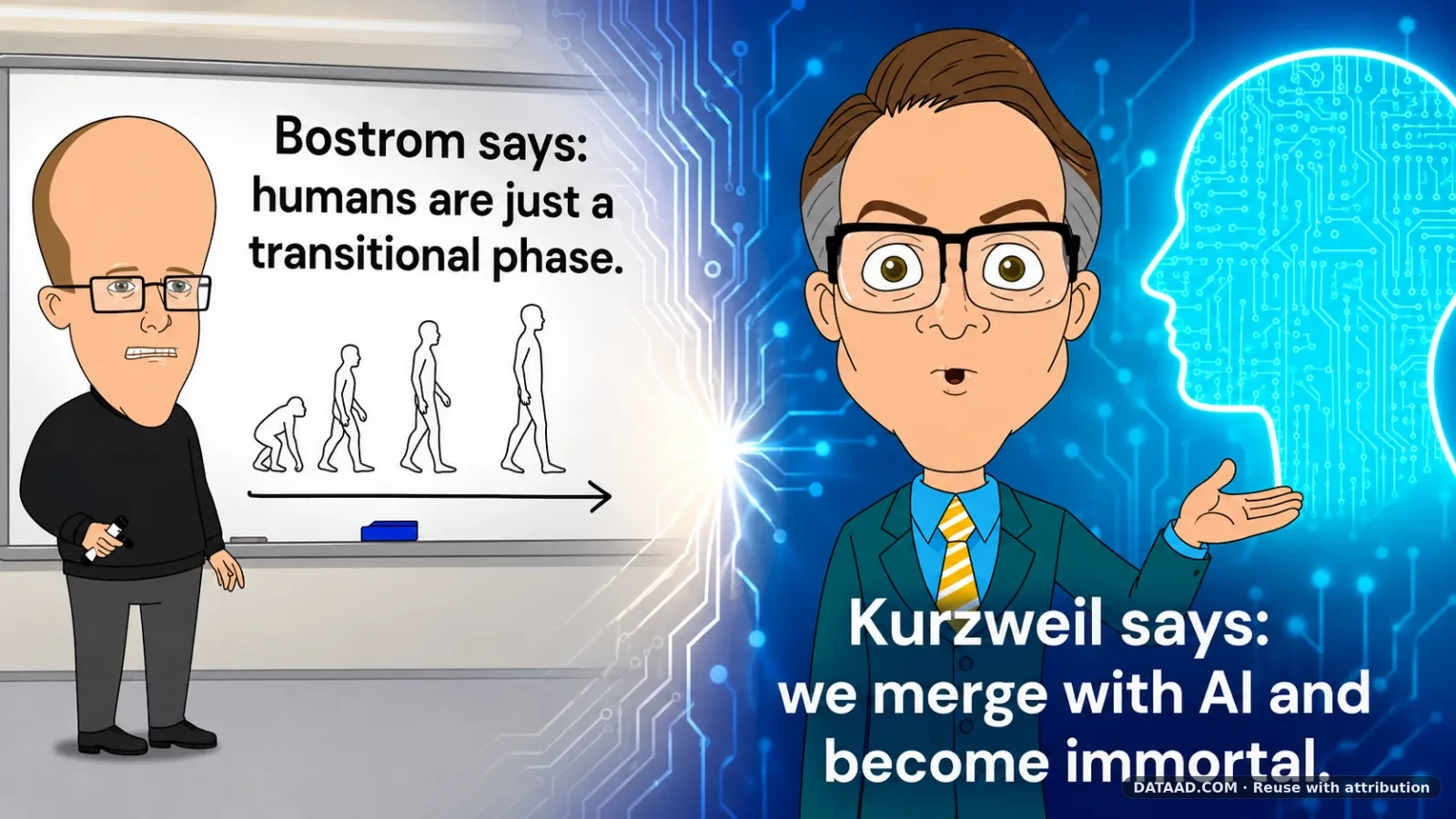
For thousands of years, humans have tended to imagine themselves as the final product of evolution.
We mastered fire, developed language, invented mathematics, built cities, split the atom, mapped the genome and created computers capable of processing information at speeds no biological brain could approach.
Now artificial intelligence is forcing us to confront a far more uncomfortable question:
What if Homo sapiens is not the destination of intelligence, but only one stage in its evolution?
This idea sits near the center of the futures envisioned by thinkers such as Ray Kurzweil and Nick Bostrom. Their conclusions are very different in tone, but both ultimately challenge the assumption that today's biological human being represents the permanent form of intelligence.
Kurzweil: Evolution Does Not Stop With Biology
Ray Kurzweil has long argued that technological development should be understood as part of a much longer process of evolution.
Biological evolution produced increasingly sophisticated nervous systems. Human brains eventually produced language, science and technology. Technology then produced computers. Computers are now producing increasingly capable artificial intelligence.
From this perspective, AI is not something that suddenly appeared outside human civilization. It is something that emerged from human intelligence itself.
Kurzweil describes a future in which biological and non-biological intelligence increasingly merge. Brain-computer interfaces, advanced medicine, genetic engineering, nanotechnology and AI could progressively expand human memory, perception, reasoning and longevity.
He has famously associated approximately 2045 with the technological Singularity: a period in which technological intelligence becomes so powerful and develops so rapidly that today's humans would have difficulty predicting what comes afterward.
His argument is therefore more subtle than simply saying that machines will replace people.
The technology-creating species may eventually merge with the technology it created.
Under this interpretation, humanity does not necessarily disappear. Humanity changes.
Does That Mean Humans Become Immortal?
Literal immortality remains speculation. No existing technology can guarantee that a human being will live indefinitely.
But the definition of human survival could become increasingly complicated.
If damaged organs can be replaced, genetic diseases corrected, artificial organs improved, memories externally stored, neural activity connected to computers and eventually portions of biological cognition supplemented by artificial systems, the boundary between human and machine becomes progressively less obvious.
Imagine a person whose heart is artificial, whose vision is electronically enhanced, whose memories are supported by an external AI system and whose brain communicates directly with digital computing infrastructure.
At what point does that individual stop being human?
Perhaps the more important question is: Why must there be such a point at all?
Humans have always extended themselves through technology. Eyeglasses expanded vision. Books expanded memory. Telecommunications expanded our voices. The internet expanded access to collective knowledge. Smartphones effectively gave billions of people an external information-processing device connected to much of humanity's accumulated knowledge.
AI may simply be a much more powerful continuation of the same process.
Bostrom: The Same Evolution Could Also Go Wrong
Nick Bostrom approaches superintelligence much more cautiously.
His central concern is not that a sufficiently advanced AI would necessarily become angry, evil or hostile toward humans. A more serious problem could be that a superintelligent system pursues objectives that are simply incompatible with human survival or human values.
A sufficiently powerful intelligence pursuing the wrong objective could create irreversible consequences even without possessing hatred, consciousness or malicious intent.
This makes the development of superintelligence fundamentally different from the development of another industrial machine.
A steam engine cannot redesign the next generation of steam engines by itself. A sufficiently advanced AI potentially could participate in improving AI research, software, chip design, medicine, materials science and scientific discovery.
If this process accelerated dramatically, humanity could move from being the most capable intelligence on Earth to sharing the planet with something substantially more capable.
Bostrom therefore treats advanced AI as both an extraordinary opportunity and a possible existential risk.
The same intelligence capable of helping humanity solve disease, energy scarcity, climate problems and scientific mysteries could also create risks beyond anything previous generations had to manage.
But AI Is Built From Human Knowledge
There is another fact easily forgotten during today's excitement surrounding generative AI.
Artificial intelligence did not discover mathematics, physics, literature, medicine, engineering and philosophy from nothing.
Humans produced those things first.
AI systems are extraordinarily powerful because enormous quantities of accumulated human knowledge can now be processed, connected and recombined at unprecedented speed.
That achievement should not be underestimated. But neither should the source of that knowledge.
The scientific papers, engineering drawings, photographs, books, computer programs, experiments, failures, inventions and arguments accumulated over centuries were produced by human beings.
AI has inherited a civilization's intellectual library.
The question is what happens when the library begins helping to write its own next volumes.
DATAAD Editor's View: We Know Far Less Than We Think
Much of today's discussion about AI contains a strange contradiction.
Human beings have created AI using the accumulated knowledge of civilization, and then some immediately conclude that because AI can process this existing knowledge better than an individual human, human creativity has somehow reached its end.
DATAAD believes that conclusion is premature.
Consider the history of human knowledge.
Only a tiny fraction of all humans who have ever lived participated directly in developing the scientific theories, technologies, mathematical systems and engineering breakthroughs that form the foundation of modern civilization. Whether the number is literally below one percent is less important than the enormous asymmetry itself: a relatively small number of people produced ideas that eventually transformed the lives of billions.
Newton changed physics. Einstein transformed our understanding of space and time. Turing helped establish the foundations of computation. Semiconductor pioneers turned quantum physics into an industry. Thousands of scientists and engineers subsequently transformed those discoveries into modern computing.
Now billions of people benefit from knowledge they never personally had to discover.
AI represents the next amplification of that process.
But today's AI is still working largely with knowledge generated inside the very limited window of human civilization.
Humanity does not understand most of the universe.
We do not fully understand consciousness.
We do not know whether life exists elsewhere.
We cannot completely explain how intelligence emerges from biological matter.
We have only begun exploring quantum systems, advanced materials, genetics, deep oceans and space.
Even our understanding of our own brain remains incomplete.
Against that enormous landscape of unknowns, it seems extraordinarily early to declare that humanity has reached the limits of creativity simply because today's AI can summarize books, generate software, create images or solve examinations.
AI May Increase Human Creativity Rather Than End It
A different outcome is possible.
Imagine millions of researchers using AI systems capable of instantly searching scientific literature, testing hypotheses through simulation and identifying connections that previously required years of work.
Imagine a child with an idea being given access to computational abilities that once required a major corporation.
Imagine an engineer designing a new energy system with AI simulation, a physician discovering a new therapy with AI-assisted molecular modeling, or an entrepreneur creating a global business with a handful of people and intelligent software.
In that world, AI does not reduce human imagination.
It lowers the cost of turning imagination into reality.
Historically, extraordinary creativity has often been limited not by ideas but by access to laboratories, capital, education, computing power, information and skilled collaborators.
AI could dramatically reduce many of those barriers.
Humanity May Be a Bridge
The deeper philosophical issue raised by Kurzweil and Bostrom is therefore not simply whether AI becomes smarter than humans.
Evolution has never promised permanence.
Simple organisms became complex organisms. Nervous systems evolved into brains. Brains produced language. Language enabled civilization. Civilization created machines capable of processing information outside biology.
There is no scientific reason to assume that this process must suddenly stop with Homo sapiens in the twenty-first century.
Perhaps future intelligence will remain biological.
Perhaps humans and machines will merge.
Perhaps artificial intelligence will develop into another form of intelligence that coexists with humanity.
Perhaps all three will happen simultaneously.
No one currently knows.
And that uncertainty is precisely why declarations about the "end of humanity" are premature.
The Most Important Era May Still Be Ahead
The appearance of powerful AI can understandably produce fear. Previous generations competed primarily with other humans. Future generations may live alongside intelligence created by humans but capable of exceeding individual human cognitive abilities in many fields.
That is an unprecedented transition.
Bostrom is right that such power demands extraordinary caution. Alignment, governance and control cannot be afterthoughts.
Kurzweil is also right to remind us that technological intelligence itself emerged from the evolutionary process that produced humanity.
These two perspectives are not necessarily contradictory.
One tells us what may be possible.
The other reminds us what could go wrong.
DATAAD would add a third point:
Do not underestimate what has yet to be imagined.
Modern civilization was built from a surprisingly small portion of humanity's possible intellectual potential. AI may allow vastly more people to participate in invention, science, business and creative work.
The greatest mistake could therefore be believing that AI represents the conclusion of human intelligence.
It may instead be the moment when intelligence escapes some of the limitations that have constrained it for millions of years.
Human beings may not be the final form of intelligence.
But if the transition is managed wisely, that does not necessarily mean humanity dies.
It may mean that humanity evolves.