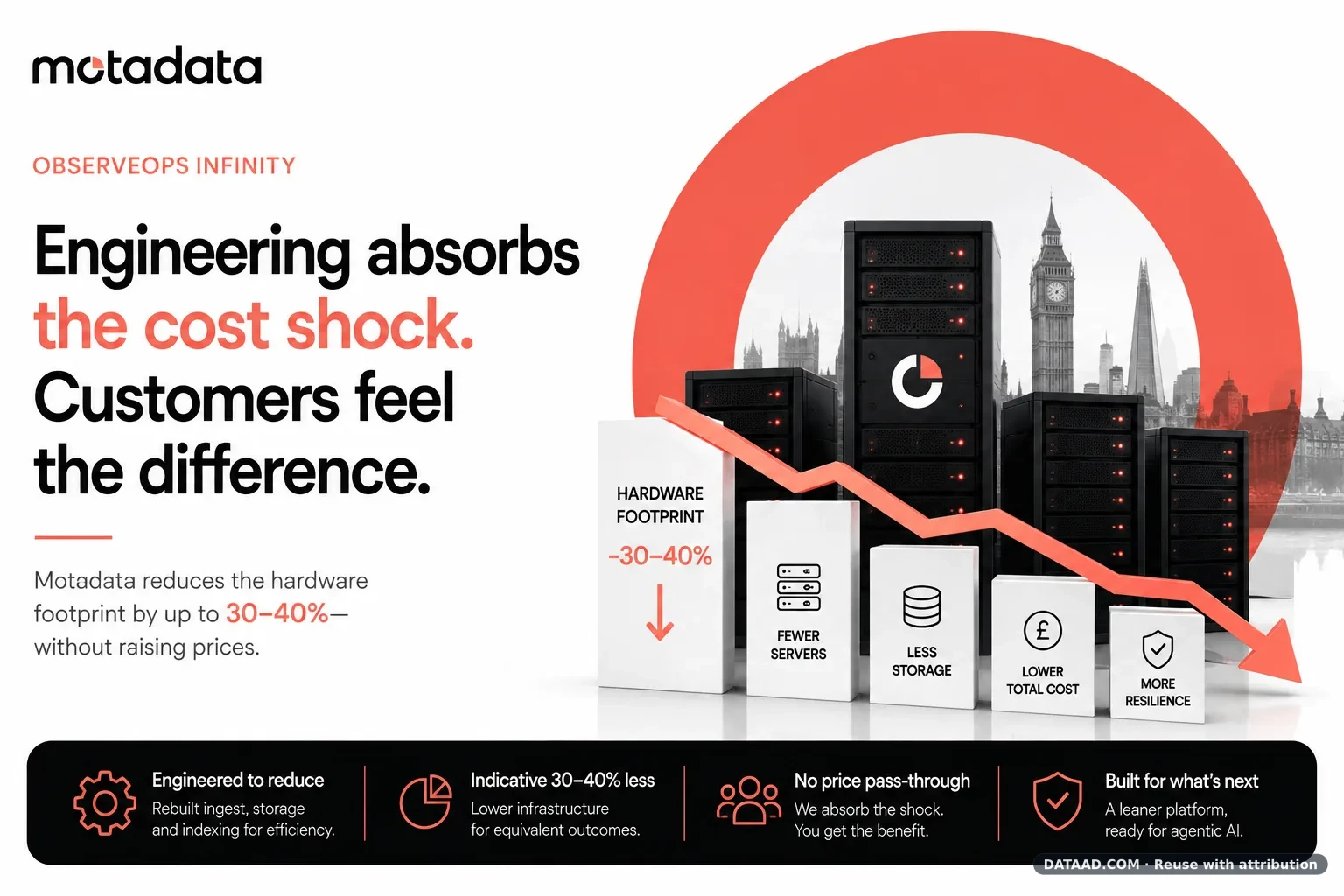
When an input cost rises across an entire industry, the ordinary commercial response is to pass it on. Server, memory and storage prices have climbed sharply worldwide, and enterprise software vendors whose products consume large quantities of all three have often responded by passing those costs through.
Motadata says it has taken a different route with ObserveOps Infinity, the observability platform release the company made generally available in August 2026. Rather than raising prices to cover a rising infrastructure requirement, the company says it set out to reduce the requirement itself.
The Cost That Sits Outside the Software Line
Observability platforms occupy an unusual position on a corporate balance sheet. They are compute-heavy when telemetry arrives and storage-heavy once that telemetry is retained. As a result, a substantial part of their total cost may never appear on the software invoice itself.
Instead, those costs appear in servers, storage, hypervisor licenses, power consumption and rack space.
Motadata says its engineering team treated the infrastructure footprint itself as a design constraint for ObserveOps Infinity. According to the company, the team reworked ingest paths, storage layout, rollup strategy, index structures and collector efficiency.
The company reports an indicative reduction of approximately 30–40% in the hardware required for an equivalent deployment, while maintaining the same device counts, retention requirements and query behavior.
Motadata also emphasizes that this range is workload-dependent. Actual reductions can vary according to device mix, retention policy, polling interval, optional modules and network topology. Each deployment is therefore sized separately against the company's official configuration matrix.
For an enterprise customer, the claimed benefit is straightforward: fewer infrastructure nodes for the same monitored environment, less storage for the same retention period, and potentially lower costs for power, rack space and associated infrastructure.
A secondary consequence may be greater flexibility in implementing high availability and disaster recovery, since resilience no longer necessarily requires duplicating an already large infrastructure footprint.
Deciding What to Keep Before Paying to Keep It
Much of the claimed reduction comes from changing where decisions about telemetry are made.
ObserveOps Infinity introduces an observability pipeline positioned between telemetry sources and the systems where data is ultimately stored.
According to Motadata, the pipeline can structure logs, events, traps, flows and metrics into queryable fields as they arrive. It can also filter, reduce, redact and mask data while that data is still in motion.
The platform can attach ownership, site and service context before an event is stored, allowing an alert to arrive with additional operational context already attached.
Retention can also be treated as a policy decision, with data separated among full-fidelity, aggregated and dropped tiers. The company says the pipeline is designed to absorb telemetry surges rather than discard data during periods of unusually high load.
The commercial logic is simple: data that is never stored requires no storage capacity.
Motadata says this observability pipeline is included in the base platform rather than being sold as a separately metered capability.
Four Products Become One
The release also changes the company's product structure.
Motadata previously offered its observability platform in four different editions, with different feature combinations and upgrade paths.
With ObserveOps Infinity, those editions have been withdrawn and replaced with a single platform edition containing the core capabilities from the beginning.
The primary licensing basis is now the number of devices a customer monitors. Optional modules can then be added for functions including:
- Flow monitoring
- Log monitoring
- Network configuration management
- Application performance monitoring
- Real user monitoring
Licensing for log and flow monitoring has also moved from a per-gigabyte-per-day approach toward a per-source model.
Under this model, customers are billed according to how many sources or devices they monitor rather than how much data those systems happen to generate.
This can make IT budgets more predictable in environments where telemetry volume changes substantially over time.
Motadata says existing customers using the previous four editions are not required to migrate and that their existing contracts will continue under their agreed terms.
A Deliberately Modest Claim About AI
ObserveOps Infinity is also being positioned as groundwork for greater automation and autonomous operations.
Here, however, Motadata has taken a comparatively cautious position.
The company argues that many AI capabilities in observability have historically been built on data layers that are not sufficiently structured or governed for dependable production use.
Its current release therefore focuses on the underlying data foundation: structured and enriched telemetry, governed retention and masking, correlation, anomaly detection, and automation that can include an approval step before actions are executed.
The autonomous layer above that foundation has not yet been released, and Motadata has not announced a specific release date or product name for it.
The company's stated commitment is that future autonomous capabilities will arrive on the same platform and licensing framework rather than requiring customers to migrate to another product.
Why Infrastructure Efficiency Matters
The broader significance of the release extends beyond one observability platform.
As enterprise infrastructure becomes more data-intensive, software efficiency increasingly affects physical infrastructure requirements as well. Monitoring systems themselves consume compute, memory, storage, network capacity and power.
Reducing the amount of infrastructure required to monitor an environment can therefore influence both IT cost and operating complexity.
The question for customers will ultimately be how closely the claimed savings translate into their own environments. Device mix, retention requirements, telemetry volume and optional modules can all materially affect the final result.
ObserveOps Infinity has been generally available since August 2026.