

NVIDIA's Vera Rubin generation is pushing AI infrastructure beyond the conventional idea of a GPU server. Supermicro's NVIDIA Vera Rubin NVL72 brings 72 NVIDIA Rubin GPUs and 36 NVIDIA Vera CPUs into a single 48U rack, combining compute, high-speed networking, power and direct liquid cooling as one rack-scale AI system.
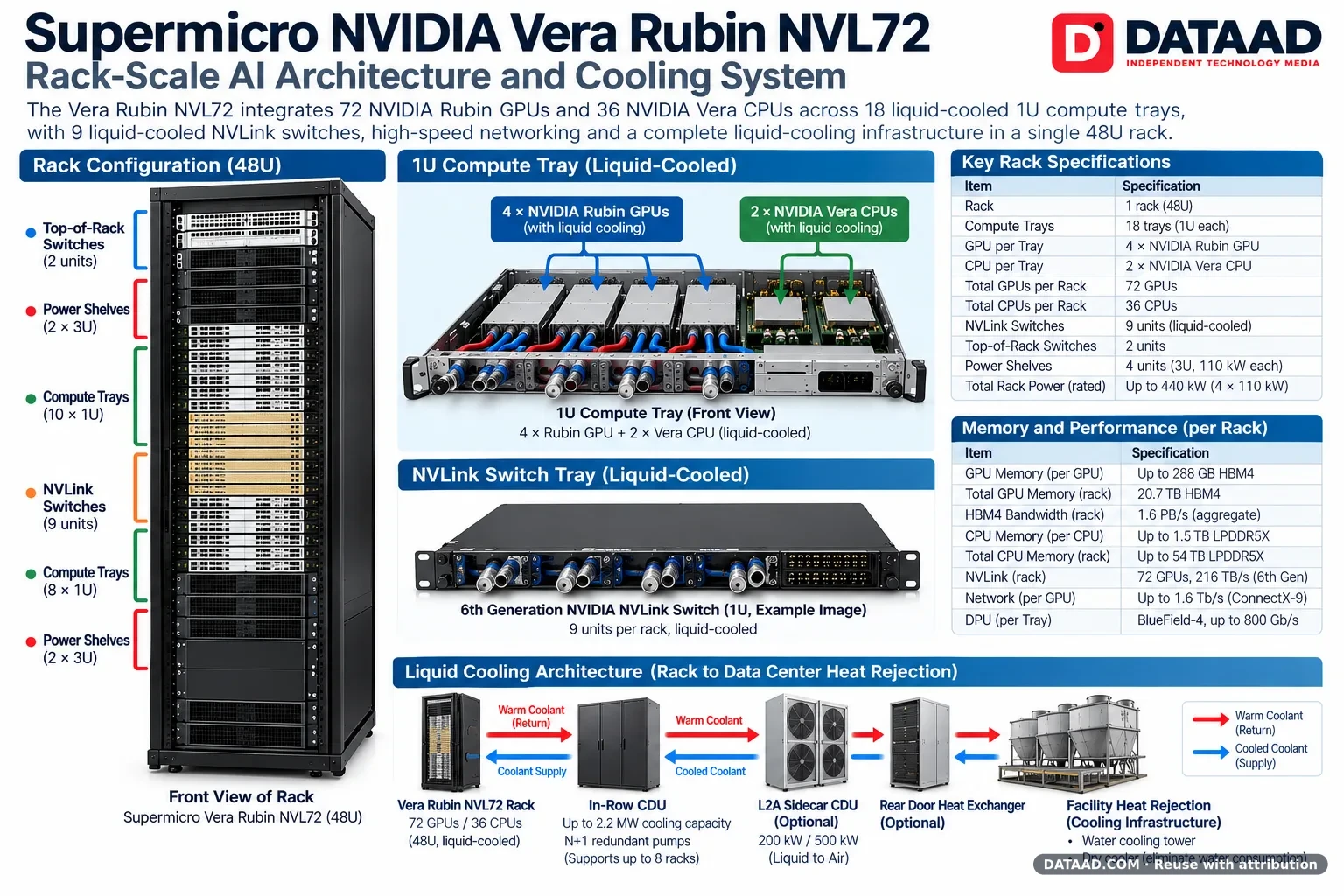
The architecture is built around 18 liquid-cooled 1U compute trays. Each compute tray contains four NVIDIA Rubin GPUs and two NVIDIA Vera CPUs. Across the rack, those 18 trays provide 72 GPUs and 36 CPUs, interconnected through nine sixth-generation NVIDIA NVLink switch trays.
| Rack Component | Vera Rubin NVL72 Configuration |
|---|---|
| Rack | 1 × 48U rack |
| Compute Trays | 18 × 1U liquid-cooled compute trays |
| GPU per Tray | 4 × NVIDIA Rubin GPUs |
| CPU per Tray | 2 × NVIDIA Vera CPUs |
| Total GPUs per Rack | 72 NVIDIA Rubin GPUs |
| Total CPUs per Rack | 36 NVIDIA Vera CPUs |
| NVLink Switches | 9 × liquid-cooled 6th-generation NVLink switch trays |
| GPU Memory | Up to 288GB HBM4 per GPU / 20.7TB per rack |
| CPU Memory | Up to 1.5TB LPDDR5X per CPU / 54TB per rack |
| Power Shelves | 4 × 3U, 110kW each |
Inside One Vera Rubin NVL72 Rack
The internal rack arrangement illustrates how much infrastructure is now required around the GPUs themselves.
The rack includes two top-of-rack switches, four 3U power shelves, 18 compute trays and nine NVLink switch trays. The compute section is divided into two groups: ten compute trays in the upper section and eight additional compute trays below the NVLink switching section.
Each compute tray contains four Rubin GPUs and two Vera CPUs. Multiplying that configuration across 18 trays results in the complete rack configuration of 72 GPUs and 36 CPUs.
This is particularly important from a thermal-engineering perspective. Liquid cooling is no longer limited to the GPU cold plate. The compute trays and the high-bandwidth NVLink switching infrastructure both become part of the rack-level thermal system.
Liquid Cooling Moves Beyond the GPU
Supermicro's DLC-2 Direct Liquid Cooling architecture extends from direct-to-chip cold plates and distribution manifolds through coolant distribution units and facility-side cooling infrastructure.
For Vera Rubin NVL72, the cooling challenge is particularly significant because the liquid-cooling system must support not only 18 high-density compute trays, but also the liquid-cooled NVLink switching layer.
As rack density increases, coolant distribution, pressure drop, flow balancing, connection reliability and serviceability become increasingly important parts of the overall system design.
Supermicro's broader DLC-2 architecture integrates cold plates, CDUs, distribution manifolds, rear-door heat exchangers, cooling towers and Supermicro SMC PG25-A coolant.
From the Chip to the Data Center
The thermal architecture can be viewed as a continuous path from silicon to the data center's final heat-rejection system:
This means that cooling performance is determined by much more than the efficiency of an individual cold plate. Hose diameter, quick disconnects, manifold design, coolant flow, pressure drop, pump capacity and facility-water conditions all become part of the same thermal system.
CDU Becomes a Critical Part of Rack-Scale AI
At the rack and facility level, Supermicro provides several cooling options. Its In-Row CDU platform reaches up to 2.2MW of cooling capacity and incorporates redundant pumping for high-availability operation.
For facilities without a dedicated facility-water loop, Supermicro also provides 200kW and 500kW liquid-to-air Sidecar CDU configurations. The 200kW configuration is intended for one rack, while the 500kW configuration can support two racks.
Rear-door heat exchangers provide another option for removing heat close to the rack, while facility-level heat can ultimately be rejected through cooling towers or dry-cooling infrastructure.
| Cooling Layer | Published Configuration |
|---|---|
| Compute Cooling | 18 liquid-cooled compute trays per rack |
| NVLink Cooling | 9 liquid-cooled NVLink switch trays |
| In-Row CDU | Up to 2.2MW cooling capacity |
| Pump Redundancy | Redundant pump architecture |
| L2A Sidecar CDU | 200kW / 500kW |
| Rear Door Heat Exchanger | Optional |
| Facility Heat Rejection | Cooling tower / dry cooler options |
What the Published Specification Does Not Tell Us
The published architecture provides a useful picture of the overall thermal system, but several important rack-level hydraulic specifications are not disclosed.
| Cooling Parameter | Published Status |
|---|---|
| Rack Manifold Design | Not specified |
| Quick Disconnect Manufacturer | Not specified |
| QD Size | Not specified |
| OCP UQD Compatibility | Not specified |
| Blind-Mate Connection | Not specified |
| Hose Size | Not specified |
| Flow Rate | Not specified |
| Operating Pressure | Not specified |
| Pressure Drop | Not specified |
| Supply / Return Temperature | Not specified |
These missing parameters will become increasingly important as rack density rises. The performance of the cooling system depends not only on the cold plate, but on the complete hydraulic path — including QD bore size, hose diameter, manifold geometry, coolant velocity, pressure loss and flow distribution across multiple parallel branches.
From One Rack to a 1,152-GPU Building Block
Supermicro's Data Center Building Block Solutions (DCBBS) scale the same infrastructure concept beyond an individual NVL72 rack. A scalable unit contains 16 Vera Rubin NVL72 compute racks.
With 72 Rubin GPUs in each rack, 16 compute racks provide 1,152 NVIDIA Rubin GPUs. The scalable unit also includes dedicated networking, high-performance storage and context-memory storage racks.
| DCBBS Element | Published Configuration |
|---|---|
| Power Envelope | 5MW to 1GW |
| Scalable Unit | 1,152 NVIDIA Rubin GPUs |
| Compute Racks | 16 racks |
| GPU Memory | 331TB HBM4 |
| Networking Racks | 6 racks — 4 compute + 2 converged |
| High-Performance Storage | 4 racks |
| Context Memory Storage | 2 racks |
The DCBBS model therefore moves beyond deploying individual GPU racks. Supermicro combines compute, storage, networking, power distribution, advanced liquid cooling and site infrastructure into repeatable deployment blocks.
The blueprint can then be configured around an available power envelope, from approximately 5MW to 1GW.
Cooling Becomes Infrastructure
At multi-rack scale, the thermal architecture becomes significantly more complex. Supermicro's published DCBBS configuration includes cooling towers, multiple In-Row CDUs, vertically mounted distribution manifolds and hundreds of direct-to-chip copper cold plates.
One published configuration includes 16 vertically mounted distribution manifolds and 576 direct-to-chip copper cold plates, illustrating the scale of the liquid distribution network required when rack-level cooling is expanded into an AI-factory building block.
This is an important transition for the liquid-cooling industry. The engineering challenge is moving from cooling an individual GPU toward controlling a complete thermal network containing many parallel coolant paths.
At this scale, the cold plate, QD, hose, manifold, CDU and facility loop can no longer be optimized independently. They become components of the same hydraulic and thermal system.
Power, Networking and Cooling Must Be Designed Together
The same integration is visible on the electrical side. Each Vera Rubin NVL72 rack contains four 110kW power shelves. At the DCBBS level, Supermicro extends the electrical architecture from medium-voltage transformers through low-voltage distribution, rack-level power systems and battery backup.
Networking follows the same approach. The scalable unit supports NVIDIA Spectrum-X Ethernet or NVIDIA Quantum-X800 InfiniBand, with compute-fabric networking reaching up to 1.6Tb/s per GPU.
The result is an infrastructure architecture in which compute density can no longer be considered separately from power delivery, network bandwidth and heat removal. Increasing one immediately changes the requirements placed on the others.
Vera Rubin shows that the basic unit of AI infrastructure is changing. The discussion is no longer simply about how many GPUs can fit into a server. One 48U rack now combines 72 GPUs, 36 CPUs, nine liquid-cooled NVLink switches, high-capacity power distribution and a complex liquid-cooling network.
At this density, compute, memory, networking, power and thermal management increasingly have to be engineered as one system. The competitive boundary is therefore expanding from the semiconductor itself to the physical infrastructure required to keep that silicon operating reliably.
From GPU Server to AI Factory
Supermicro says its DCBBS Blueprints for NVIDIA Vera Rubin NVL72 and NVIDIA HGX Rubin NVL8 are available for customer engagements, with deployments scheduled for the second half of 2026.
The larger message is not simply that the next generation of GPUs will be faster. The physical infrastructure surrounding those GPUs is becoming an increasingly important part of AI system performance.
The progression can now be seen clearly:
The AI infrastructure race is therefore moving beyond the GPU itself toward the engineering of the complete system — from silicon and HBM to networking, power, liquid cooling, rack distribution and ultimately the data center.
Editorial note: This article was independently prepared by DATAAD based on Supermicro's publicly released technical information. Supermicro granted DATAAD permission to use the Vera Rubin NVL72 press image.