

Giga Computing, a GIGABYTE subsidiary, is extending its role from server maker to AI infrastructure partner. On September 22, 2026, it announced GAIFA (GIGABYTE AI Factory Accelerator), its first proprietary AI computing center, in New Taipei City, Taiwan. The facility is designed to let customers test rack-scale AI systems, including power and liquid cooling, before deploying them at scale.
One GB300 NVL72 Rack
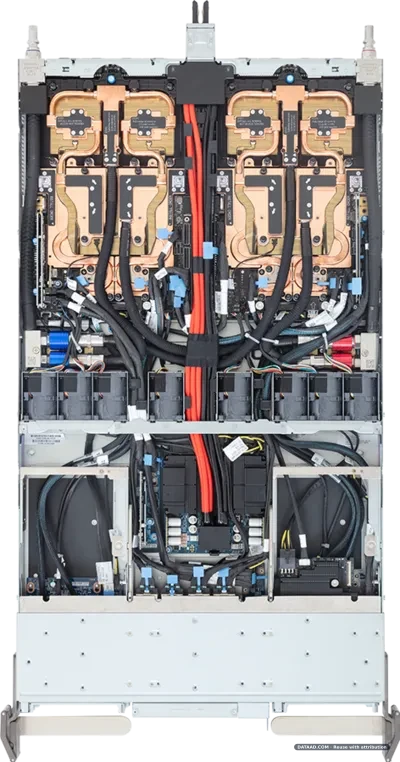
The centerpiece of GAIFA is Giga Computing's GIGAPOD GB300 NVL72 rack-scale solution, which combines 72 NVIDIA Blackwell Ultra GPUs and 36 NVIDIA Grace CPUs in one liquid-cooled rack.
| Rack Component | GIGAPOD GB300 NVL72 Configuration |
|---|---|
| Dimensions | 1,068 x 600 x 2,299 mm (L x W x H) |
| Compute Trays | 18 × GIGABYTE XN15-CB0-L01 (1U liquid-cooled) |
| GPU / CPU per Tray | 4 × Blackwell Ultra GPUs / 2 × Grace CPUs |
| Total per Rack | 72 GPUs / 36 CPUs |
| NVLink Switch Trays | 9 × NVIDIA NVLink switches |
| GPU Memory | 279GB HBM3E per GPU / 20TB per rack |
| CPU Memory | 480GB LPDDR5X per CPU / 17TB per rack |
| Networking per Tray | 4 × 800Gb/s OSFP (ConnectX-8 SuperNIC), 1 × BlueField-3 DPU |
| Power Shelves | 6 × 1U, 33kW each; 54V DC, 1,400A bus bar |
| CDU | Compatible with in-row or in-rack CDU |
Each compute tray has two Superchip cold-plate loops. The published tray specification also lists eight 40mm fans, so airflow remains part of the tray design alongside the liquid loops. Facility water must meet the ASHRAE water-quality guidelines cited by Giga Computing.
From a Rack to a GIGAPOD
GIGAPOD scales this rack into pod-scale infrastructure. In the GB300 NVL72 configuration, one scalable unit combines 16 compute racks and 8 management racks.
| GIGAPOD GB300 NVL72 (PAC2) | Published Configuration |
|---|---|
| Racks per Scalable Unit | 16 compute + 8 management |
| GPUs / CPUs | 1,152 Blackwell Ultra GPUs / 576 Grace CPUs |
| GPU Memory | 320TB HBM3E |
| CPU Memory | 272TB LPDDR5X |
| Rack Power | Up to 140kW per rack |
| Cooling | Direct liquid cooling; in-row or in-rack CDU |
| Rack Height | 48U |
Giga Computing adds an integrated G-REX kit for cluster-level power and cooling management. It uses an N120-LS0 management node and supports Modbus, Redfish and REST APIs to connect with CDUs and rear-door heat exchangers. The optional GIGABYTE POD Manager (GPM) software handles cluster monitoring and orchestration.
GAIFA: Testing the Whole System
GAIFA starts with six racks for compute, storage and networking and a planned first-phase power capacity of 700kW. Additional capacity will be added in later phases. Giga Computing says the facility validates compute, power and thermal management as one integrated system.
| GAIFA Compute Rack | Platform |
|---|---|
| 2 racks | NVIDIA GB300 NVL72 |
| 1 rack | G4L4-SD3-LAX7 DLC servers with NVIDIA HGX B300 |
| Additional | XL44-SX2-AAS1 with NVIDIA RTX PRO 6000 GPUs; liquid-cooled B683-Z80-LAS1 with AMD EPYC CPUs |

GAIFA builds on Giga Computing's Proof of Concept service. Customers can validate compute performance, rack power density, liquid-cooling thermal performance (cooling capacity, flow rate and thermal load), network performance, system compatibility, rack deployment and L12 cluster-level validation. The company says the goal is to reduce engineering risk and shorten the path from proof of concept to production.
What the Published Specification Does Not Tell Us
Giga Computing has published the rack, pod and test-facility configurations, but several cooling and power details remain undisclosed. It has said detailed GAIFA specifications will follow once the facility is complete.
| Parameter | Published Status |
|---|---|
| CDU Capacity and Model | Not specified |
| Quick Disconnect Type / Size | Not specified |
| Rack Manifold Design | Not specified |
| Flow Rate / Pressure Drop | Not specified |
| Supply / Return Temperature | Not specified |
| GAIFA Heat Rejection Method | Not specified |
| Liquid-Captured Heat Share | Not specified |
A simple calculation shows why these numbers matter. Two GB300 NVL72 racks at Giga's published maximum of 140kW each would draw up to 280kW, or 40% of the 700kW first-phase envelope, before the HGX B300 rack, other platforms, storage and networking are counted. This is arithmetic on published maximums, not a measured load. The published thermal figures will show how much headroom GAIFA really has.
The Next Step: Vera Rubin
Giga Computing's pod-scale lineup already lists NVIDIA Vera Rubin NVL72 (PAC3 series) at 240kW per rack, with 8 compute and 12 management racks per scalable unit and 3RU, 110kW power shelves. That is roughly 1.7 times the 140kW of the GB300 generation. A test facility built at 700kW will be judged by how it prepares customers for that jump in rack density.
DATAAD VIEW
GAIFA reflects a shift in how server makers compete. Selling a rack is no longer enough when power delivery, liquid cooling and networking must all work together on day one. By building its own facility and opening it to customer testing, Giga Computing is turning validation into part of the product.
The value of that approach will depend on transparency. Customers evaluating a proving ground will want measured data on power, flow, temperature and heat rejection, not just the list of racks inside.
Chip → Compute Tray → Rack → GIGAPOD → GAIFA Validation → AI Factory
Related coverage: Supermicro Unveils 5MW-to-1GW DCBBS Blueprint for NVIDIA Vera Rubin NVL72 AI Factories
Editorial note: This article was independently prepared by DATAAD based on Giga Computing's publicly released technical information. Giga Computing permitted DATAAD to use its official product images and the GIGABYTE logo. Images courtesy of Giga Computing / GIGABYTE.